

close
Choose Your Site
Global
Social Media


Views: 0 Author: Site Editor Publish Time: 2026-06-05 Origin: Site


Rigging failures and premature equipment wear rarely stem from sudden operational errors. Instead, they often trace back to a severe mismatch between sling construction and the active lifting environment. Selecting the right round sling requires looking far beyond the basic Working Load Limit (WLL). You must critically evaluate internal yarn alignment, outer jacket weave, and the underlying material composition. If you ignore these structural details, you risk load drops and severe site safety violations.
This guide breaks down exactly how the structural engineering of a round sling impacts load distribution, environmental resilience, and overall rigging safety. It provides a clear, actionable framework. Procurement professionals and operational teams can use this baseline to properly evaluate their lifting gear before executing the next major lift.
A round sling’s performance is heavily divided into two components: the internal multi-strand core (which dictates load capacity and stretch) and the outer jacket (which dictates abrasion resistance and lifespan).
Upgrading from standard polyester to high-performance HMPE (High-Modulus Polyethylene) reduces stretch by 75% and significantly lowers equipment weight, making it highly effective for low-headroom and heavy-lift applications.
Manufacturing quality markers—such as length tolerance precision and splicing methods—are critical evaluation dimensions for multi-part lifts where uneven weight distribution can lead to catastrophic failure.
Regulatory compliance (OSHA / EN-1492-2) is baked into the construction via standardized color-coding and mandatory tagging, forming the baseline for risk mitigation and daily inspections.
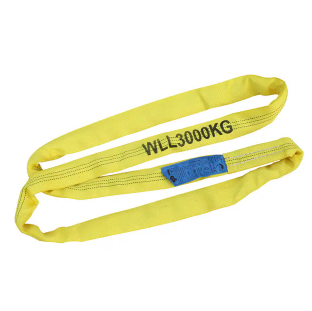
Endless loops of synthetic yarn form the functional core of the lifting device. Manufacturers typically use polyester or high-modulus polyethylene (HMPE) to spin these yarns. The total number of yarn wraps directly correlates to the designated WLL. Proper alignment and precise tensioning of these core yarns during manufacturing remain critical. They ensure the load distributes evenly across all internal strands during a lift.
Poorly constructed cores inevitably create internal stress concentrations. These weak points lead directly to premature fiber fatigue. When a few strands bear too much tension, they snap early. This internal failure forces the remaining strands to absorb catastrophic excess weight.
The outer jacket shields the delicate core yarns from the harsh outside world. Weave density plays a massive role in equipment longevity. A tight-weave cover provides superior abrasion resistance against rough surfaces. Conversely, a looser weave offers greater ergonomic flexibility. This flexibility proves essential for wrapping around complex rigging angles.
Premium options heavily utilize a double-walled construction. This double-layer jacket provides a reliable fail-safe mechanism. It actively fights against aggressive UV degradation and unexpected physical punctures. The design keeps the inner load-bearing core completely isolated from external hazards.
You must actively assess your specific application needs before procurement. Determine whether the daily operation requires maximum abrasion resistance. If so, you should heavily favor double-walled, tight-weave jackets. Alternatively, you might need maximum flexibility. Delicate, highly contoured loads demand softer, more pliable jacket weaves.
Best Practice: Always match the jacket weave to the load surface texture.
Common Mistake: Using loose-weave jackets on raw steel edges without secondary wear pads.
Standard polyester remains the dominant material across general rigging applications. These models offer a highly cost-effective solution for everyday lifts. They provide an excellent strength-to-weight ratio. They also naturally resist environmental moisture and standard UV exposure.
However, you must consider the inherent stretch factor. Polyester exhibits slight elongation under heavy load. A standard round sling typically stretches a few feet per 100 feet under maximum WLL. This elasticity can help absorb sudden shock loads safely. Yet, this same stretch becomes highly problematic in tightly constrained spaces.
High-Modulus Polyethylene (HMPE) represents a massive leap in lifting technology. An HMPE sling weighs approximately one-seventh of an equivalent-capacity wire rope. Crews can easily carry these high-capacity slings over their shoulders. This directly reduces operator fatigue and workplace injuries.
The stretch factor differences are equally staggering. HMPE features exceptionally low elongation under load. It offers up to 75% less stretch than standard polyester materials. This minimal elongation makes HMPE the optimal choice for low-headroom lifts. You gain exact control over load placement without worrying about unpredictable bounce.
You should specify standard polyester for general rigging tasks. It serves budget-conscious operations perfectly for standard warehouse lifts. You must escalate to HMPE for ultra-heavy lifting requirements. We strongly recommend HMPE for capacities exceeding 350,000 lbs. It also excels in restricted-space operations requiring rapid, ergonomic rigging.
Feature | Standard Polyester | High-Performance HMPE |
|---|---|---|
Weight | Lightweight and easy to handle. | Ultra-light (1/7th the weight of wire rope). |
Elongation (Stretch) | Moderate (absorbs shock well). | Extremely low (75% less than polyester). |
Best Application | General daily rigging, outdoors. | Heavy lifts, low-headroom spaces. |
Heat Resistance | Max operating limit 194°F (90°C). | Highly sensitive to friction heat. |
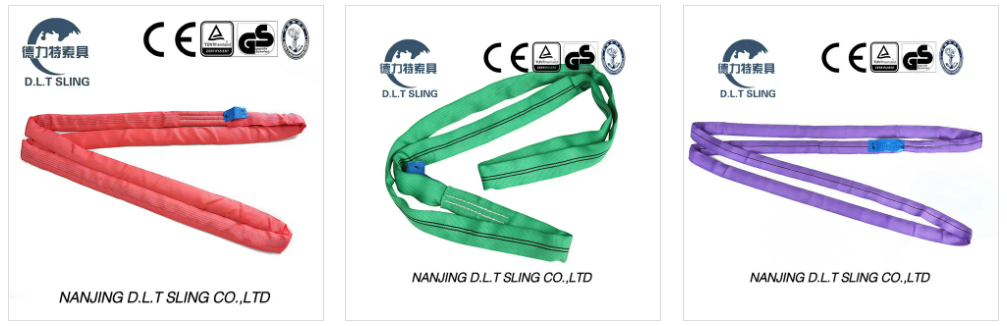
The structural integrity of the outer cover splice dictates load transfer smoothness. Splicing methods vary significantly across different manufacturers. Experienced riggers often evaluate hand-splicing higher than automated machine stitching. Hand-splicing creates seamless, weak-point-free connections. These smooth connections actively resist catching on rough load surfaces.
Length tolerance poses a massive risk during multi-part lifts. Imagine using three or four slings simultaneously to lift a generator. High length tolerances inevitably lead to severe load imbalances. The shortest round sling takes on a disproportionate amount of weight. It can easily snap, dropping the entire load.
Rigging engineers must aggressively verify manufacturing standards. You must ensure the manufacturer enforces strict length tolerances. Synchronized load-bearing depends entirely on exact length matching across all supporting legs.
Verify the exact length tolerance standard published by the manufacturer.
Request matched sets if ordering multiple units for a specific multi-part lift.
Measure all legs visually before executing a critical four-point basket hitch.
The continuous loop construction provides a massive operational advantage. It allows riggers to manually rotate the contact points before each use. This simple rotation totally prevents fixed wear-and-tear spots from forming. You can double or even triple the asset's lifespan compared to fixed-eye slings.
The soft, pliable nature of these synthetic tools allows for immense versatility. Crews can quickly adapt their rigging methods to match the load geometry. This operational flexibility saves valuable time on the job site.
Vertical Hitches: This straightforward configuration relies purely on the straight-line tensile strength of the internal core. It supports the load directly underneath the crane hook.
Basket Hitches: The flexible construction allows the material to cradle the load effectively. This method effectively doubles the WLL. It provides superior stability for loose or exceptionally long materials.
Choker Hitches: The pliable synthetic nature allows the material to bite down securely. It tightens heavily on cylindrical loads to prevent dangerous slipping during transit.
You cannot blindly trust the baseline WLL in every configuration. Choker hitches fundamentally alter the tension dynamics inside the synthetic core. According to strict OSHA guidelines, angles matter significantly.
If a choker hitch angle drops below 120 degrees, capacity drops. You must significantly derate the rated capacity of the equipment. Buyers and engineers must ensure their daily load calculations account for these specific operational realities. Overlooking hitch derating leads directly to catastrophic equipment failure.
Rigging often involves moving highly valuable, delicate materials. The soft synthetic construction prevents surface damage completely. It safely handles highly machined metal parts and fresh automotive paint. It also protects delicate architectural loads like polished stone.
This non-marring characteristic eliminates severe secondary damage. You avoid the expensive load repair processes heavily associated with rough chains or stiff wire rope. Your products arrive at their destination looking exactly as they did before the lift.
Synthetic materials possess strict thermal boundaries. Standard polyester slings generally have a strict maximum operating limit of 194°F (90°C). You cannot ignore this hard boundary. Prolonged exposure to temperatures above 140°F (60°C) slowly degrades the breaking strength of the core fibers.
HMPE fibers present a different set of thermal challenges. They are incredibly sensitive to friction-induced heat. Rapid sliding against a load generates intense heat instantly. HMPE also melts quickly upon contact with welding splatter. You must deeply assess the thermal environment of your facility before finalizing any material specs.
Synthetic materials naturally resist organic rot and aggressive mildew. They also handle exposure to common industrial chemicals perfectly. Standard machine grease and lubricating oil will not compromise core strength.
However, specific acids or harsh alkalis completely destroy synthetic fibers. Polyester reacts poorly to strong alkalis. Nylon melts in the presence of strong acids. If your environment involves chemical baths, you require targeted material formulations.
Daily visual inspections form the backbone of a safe rigging program. European standards (EN-1492-2) utilize strict color-coding rules. Purple always equals one ton. Green always equals two tons. This visual compliance allows rapid, accurate confirmation of capacity. It prevents massive overloading errors directly on the shop floor.
You must memorize the strict rejection criteria. A round sling must be immediately removed from service if compromised. If the outer cover is cut enough to expose the inner core yarns, destroy the equipment. Furthermore, if the OSHA-mandated identification tags are missing or totally illegible, the equipment is dead. You cannot use undocumented lifting gear under any circumstances.
The performance of your lifting gear is never an accident. It operates as a direct result of meticulous internal construction. Precision tensioning of the core yarns provides the brute strength. The specialized protective weave of the outer jacket determines the lifespan. Furthermore, the selected material heavily dictates the environmental limitations.
To maintain peak safety, we recommend three immediate next steps:
Audit your current rigging inventory immediately for worn jackets, exposed cores, or illegible capacity tags.
Request detailed material spec sheets from manufacturers when procuring new assets.
Ensure your new purchases explicitly state length tolerances, weave specifications, and confirmed OSHA or EN compliance.
A: Even minor discrepancies in sling lengths during a multi-point lift create severe danger. The shorter sling will bear a heavily disproportionate amount of the total load weight. This unequal stress risks catastrophic fiber failure. Precise manufacturing ensures even weight distribution across all lifting legs.
A: No. If the outer cover is punctured, torn, or melted to the point where inner core yarns become visible, you must act immediately. Industry safety standards require you to destroy the sling and remove it from service. Temporary repairs are strictly prohibited under all circumstances.
A: HMPE (High-Modulus Polyethylene) offers a massive reduction in total equipment weight. It also provides up to 75% less stretch than standard polyester alternatives. This specific material is highly ideal for exceptionally heavy lifts and constrained environments requiring limited overhead clearance.
A: Yes. Despite their overall durability, the synthetic construction remains highly susceptible to cutting. Pulling them across sharp edges or tight corners under heavy tension easily slices the fibers. You must use dedicated wear pads or protective sleeves to maintain safety and prolong equipment life.


