

close
Choose Your Site
Global
Social Media


Views: 0 Author: Site Editor Publish Time: 2026-06-04 Origin: Site


Measuring heavy lifting equipment demands absolute precision. Accurate measurement is never just a basic operational task. Instead, it serves as a critical compliance and safety requirement for heavy lifting operations. Replacing or ordering a new synthetic round sling requires exact specifications every single time. Guessing the difference between circumference and effective length leads directly to imbalanced loads. These easily avoidable errors trigger rejected safety audits and expensive operational downtime.
Before we begin, we must clarify our exact focus. This guide strictly addresses industrial polyester lifting slings. We will not discuss patio furniture replacement slings or light-duty recreational straps. You are about to learn the precise industry standards required to safely specify, measure, and order heavy industrial lifting gear. We will cover correct measurement techniques, critical safety standards, and practical procurement checklists.
Industrial round slings are measured by Effective Working Length (EWL) (bearing point to bearing point), not the total circumference.
Accurate measurement requires the "flat surface technique" to eliminate twists and tension variables.
Determining the correct replacement requires cross-referencing length with the required Working Load Limit (WLL) and industry-standard color codes.
If a sling's identification tag is missing or illegible during measurement, OSHA standards dictate immediate removal from service—do not attempt to re-certify it based on size alone.
Incorrect specifications in B2B procurement create dangerous cascading failures. Procurement teams often order the wrong size based on poor field measurements. Rigging crews then attempt to use this mismatched equipment. This forces dangerous adaptations on the job site. You must understand the specific risks associated with poor measurement protocols.
Even a minor length discrepancy drastically shifts your center of gravity. This imbalance poses a severe physical risk. It threatens an immediate load drop during hoisting operations. Uneven legs create localized stress points across the rigging hardware. These stress points easily exceed the intended design capacity. The equipment will eventually snap under this unnatural tension. You must maintain perfect symmetry during multipoint lifts.
Improperly sized lifting equipment invites massive legal and financial risks. OSHA inspectors routinely examine rigging setups during facility audits. They actively penalize undocumented or modified configurations. You cannot legally use improperly measured gear. Fines compound quickly when auditors discover these safety protocol breaches. A single mismatched strap can halt an entire construction site. You lose money every minute your site remains closed.
Expedited shipping destroys procurement budgets rapidly. You face massive hidden costs when returning incorrectly measured slings. Project delays compound these direct financial hits. You pay idle crews while waiting for the correct replacement gear. Accurate initial measurements eliminate this costly procurement waste completely. You secure the right equipment on the first purchase order.
You must follow strict physical protocols to ensure an accurate measurement. Skipping steps leads directly to procurement errors. Your team should memorize this exact sequence.
You must clear a clean, flat surface first. The floor or a large industrial workbench works best. Lay the equipment out completely. Tension or twists will severely distort your measurement. Dirt and debris can also alter the way the material lays. You must smooth out all wrinkles. Ensure the core fibers rest completely flat inside the outer jacket.
The industry standard for procurement is Effective Working Length (EWL). You must understand this concept clearly before touching a tape measure.
Effective Working Length (EWL): This is the distance from one load-bearing end to the other. You measure it when the gear lays perfectly flat. Think of it as the reach of the equipment.
Circumference: This is the EWL multiplied by two. It represents the total continuous loop of material.
You should never blindly order a "6-foot sling". Always specify if you mean EWL or circumference. This simple clarification prevents disastrous procurement mistakes. Suppliers will always default to EWL unless instructed otherwise.
Follow these specific physical steps to measure accurately:
Flatten the material completely against your clean surface.
Ensure the seams lay perfectly straight along the edges.
Align a certified industrial measuring tape alongside the material.
Measure from the extreme inside apex of one loop.
Pull the tape tightly to the inside apex of the opposite loop.
Record this specific "bearing point to bearing point" distance as your EWL.
Used synthetic polyester materials elongate under heavy loads. You will notice minor elongation over time. Treat your old measurements as approximate baselines. Do not expect an old round sling to match a brand-new one perfectly. You must account for this stretch when submitting new orders. Always reference the original specification charts when replacing heavily used gear.
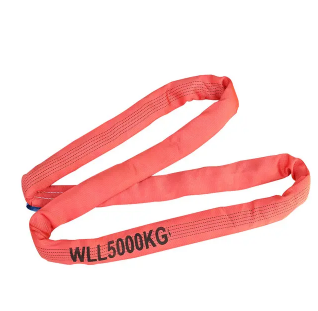
Procurement teams need a structured evaluation framework. You cannot base purchasing decisions on length alone. Use this actionable checklist to guarantee safe, compliant ordering.
Cross-reference your required lift capacity. Check the WLL tag carefully. You cannot separate length from capacity. A perfectly measured strap fails if it cannot hold the target weight. Calculate the maximum dynamic load you expect to lift. Always order equipment rated slightly above your maximum required capacity. This provides a crucial safety margin.
The industry uses a universal color-coding system. This system identifies the vertical load capacity visually. You must ensure your visual confirmation aligns with your requested specifications. Use the chart below to match colors to their proper tonnage.
Jacket Color | Vertical WLL Capacity | Typical Industrial Application |
|---|---|---|
Purple | 1 Ton (2,000 lbs) | Light manufacturing, machine shop components |
Green | 2 Ton (4,000 lbs) | Standard automotive engines, small pipes |
Yellow | 3 Ton (6,000 lbs) | Heavy equipment parts, medium steel beams |
Gray | 4 Ton (8,000 lbs) | Construction materials, concrete blocks |
Red | 5 Ton (10,000 lbs) | Structural steel supports, large generators |
Brown | 6 Ton (12,000 lbs) | Massive industrial machinery, bridge components |
Calculate your necessary length based on the specific application. The effective length changes based on your intended rigging configuration. You must plan for these geometric changes.
Vertical Hitch: This configuration uses the standard EWL directly.
Choker Hitch: This setup reduces the effective length slightly. It also reduces the overall lifting capacity.
Basket Hitch: This doubles the lifting capacity. However, it requires significantly more length. You must account for the wrap around the load. You also need enough distance to reach back to the crane hook safely.
Check your specific lifting environment. Does your application require standard polyester? High heat environments destroy basic polyester fibers rapidly. UV exposure degrades synthetic materials during outdoor construction projects. Chemical degradation ruins standard materials in weeks. You might need specialized synthetic materials instead. Evaluate your surroundings before finalizing the order. Ask your supplier about Aramid or high-performance polyethylene options for extreme environments.
Safety regulators demand strict adherence to maintenance protocols. You must understand the legal frameworks governing lifting operations. Proper measurement includes rigorous safety audits.
OSHA 1910.184 states this rule unequivocally. If the tag is missing, you must act immediately. If the WLL or length tag is unreadable, measurement becomes irrelevant. You must destroy the equipment. You must replace it completely. You cannot safely guess the capacity of an untagged strap based on its color or length. The tag serves as the sole legal identifier for safe usage.
Use your measurement process as a secondary safety audit. Instruct your operators to inspect the fabric closely. Check the entire outer jacket for snags or tears. Look closely for acid burns, weld spatter, or melting. Inspect carefully for exposed core yarns. Any core exposure means instant failure. You must retire the equipment immediately upon discovering exposed core threads.
New replacement orders require strict documentation. They must come with proper manufacturer certifications. Clear tagging ensures ongoing OSHA compliance. You need this paper trail for safety audits. It proves your commitment to heavy lifting safety standards. Demand digital proof-testing certificates from your vendor. Keep these records readily accessible for future facility inspections.
Vendor selection represents a core procurement objective. You cannot buy heavy lifting gear from unverified sources. You must evaluate potential suppliers on strict technical merits.
You must evaluate your vendor carefully. Look for strict adherence to ASME B30.9 standards. Quality suppliers possess robust in-house testing capabilities. They must test their products thoroughly before shipping. Proof-testing certificates guarantee operational reliability. Ask potential vendors to explain their quality assurance protocols. Reject any supplier unwilling to share testing data.
Assess their overall manufacturing flexibility. Can the supplier manufacture exact custom lengths? Do not force your operations to adapt to restrictive off-the-shelf sizes. Compromising on length ruins complex lift plans. A highly capable vendor scales production to your exact specifications. They should deliver precise custom measurements without massive delays.
You need more than just a basic manufacturer. You need comprehensive rigging engineering support. A strong supplier verifies complex lift plans. They help you calculate basket hitch adjustments before you make a purchase. They prevent costly procurement mistakes early in the planning phase. Prioritize vendors offering direct access to certified rigging engineers.
Proper measurement dictates the safety of your entire lifting operation. Understanding Effective Working Length (EWL) is absolutely non-negotiable. You must specify the correct Working Load Limit (WLL) every single time. Accurate measurements prevent load drops, compliance fines, and costly delays. Do not leave your next major lift to chance. Check your tags, measure on a flat surface, and verify your hitch requirements. Contact our rigging engineering team today for a dedicated safety consultation. You can fill out our custom quote request form to get started. Download our comprehensive product specification and sizing chart to ensure your next order is perfectly accurate.
A: The length, or Effective Working Length (EWL), measures the distance from one bearing point to the other when laid perfectly flat. The total circumference is the entire continuous loop of material. The circumference equals exactly twice the EWL. Always specify EWL when ordering to ensure proper fit and prevent dangerous load imbalances.
A: Yes, synthetic polyester materials exhibit minor elongation under heavy, repeated use. At their fully rated capacity, they can stretch up to three percent. You must account for this standard elongation when measuring old equipment. Always use the original manufacturer specifications as your baseline for exact replacement orders.
A: No, you cannot. The industry standard color-coding system only dictates the Working Load Limit (WLL). For example, a yellow jacket always denotes a three-ton vertical capacity. It does not indicate the length whatsoever. You must measure the Effective Working Length separately regardless of the jacket color.
A: A basket hitch requires you to account for the load's specific geometry. You must calculate the distance from the crane hook, around the entire bottom of the load, and back up to the hook. This total required distance dictates the circumference. You halve this circumference to determine your required EWL.


