

close
Choose Your Site
Global
Social Media


Views: 0 Author: Site Editor Publish Time: 2025-12-08 Origin: Site


When it comes to industrial lifting operations, selecting the right lifting sling is crucial for both safety and efficiency. Whether you're moving machinery, heavy-duty equipment, or materials on construction sites, understanding the different types of slings and their applications can prevent accidents, reduce downtime, and improve overall productivity. This article will guide you through the key factors to consider when choosing the right industrial lifting sling for your specific needs, ensuring you make the best decision for your lifting tasks.
Before you start looking at different types of slings, it's essential to first assess your lifting requirements. This involves evaluating the weight, size, and shape of the load you're handling, as well as understanding how the load will be lifted.
The weight and size of the load are the first and most important factors to consider when selecting a lifting sling. The sling must be rated to handle the weight of the load you intend to lift. Overloading a sling can cause it to fail, leading to damage to equipment, products, or even injury. Make sure that the Working Load Limit (WLL) of the sling exceeds the weight of the load.
The shape of the load plays a significant role in determining the type of sling you need. A load with an irregular shape or uneven weight distribution may require special lifting equipment like slings with specific hitch types to ensure balance. Additionally, the center of gravity of the load must be considered to determine the optimal lifting technique.
The way the load will be lifted (vertical, choker, or basket hitch) affects the sling type you choose. Different hitch configurations are suited to different lifting operations. A vertical lift, for instance, requires a different type of sling than a basket or choker lift. Make sure you match the sling configuration to the lifting task at hand.
There are various types of slings available in the market, each designed for specific applications. Understanding the differences between them can help you choose the best one for your needs.
Chain slings are known for their durability and strength. They are ideal for lifting heavy loads and are resistant to heat and abrasion. However, they are rigid and can damage delicate loads.
Wire rope slings are highly versatile and are often used for lifting large, heavy loads. They are strong and can be used in harsh environments, but they are not as flexible as webbing slings and may not be suitable for lifting fragile loads.
Polyester webbing slings are lighter, flexible, and less damaging to sensitive loads. These slings are ideal for lifting items such as machinery, equipment, and construction materials. They have lower elongation and are safer in terms of shock loading compared to other slings. Industrial webbing slings are widely regarded as the best choice for many medium-weight lifting applications due to their durability, flexibility, and ease of use.
Polyester webbing slings are less likely to stretch under load, ensuring that the load remains stable during lifting. They are also more affordable and easy to handle compared to chain or wire rope slings, making them a popular choice for many industrial lifting operations.
When it comes to lifting applications that require flexibility, ease of use, and minimal impact on the load, polyester webbing slings stand out. At D.L.T Sling, we manufacture high-quality industrial lifting slings, including eye-eye webbing slings, which offer a number of advantages:
One of the primary advantages of polyester webbing slings is their low elongation under load. Unlike chain or wire rope slings, which can stretch, polyester webbing slings maintain their shape and prevent the load from moving erratically. This characteristic helps reduce the risk of shock loading and ensures a smooth, controlled lift.
Polyester webbing slings are available in multiple layers, such as simplex, duplex, triplex, and quadraplex designs. These variations allow for different lifting capacities, depending on the load's weight and the sling's configuration. The multi-layer design also adds versatility, allowing the sling to be used for a range of lifting tasks, from light to heavy-duty applications.
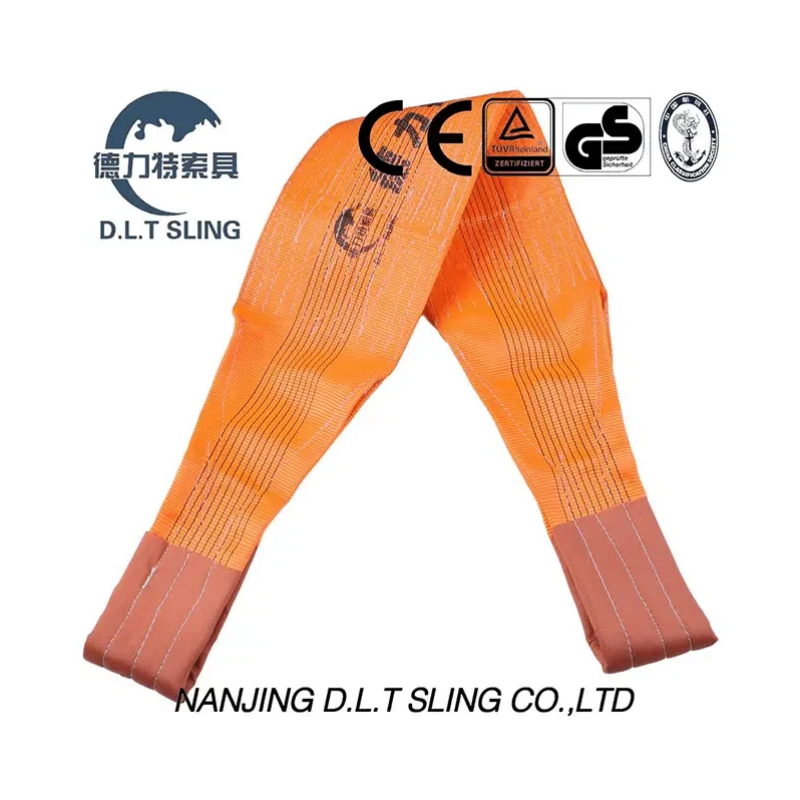
Our eye-eye webbing slings are equipped with reinforced eye loops, which provide greater durability and ensure secure attachment points. The loops can be made flat, twisted, or reversed, allowing the sling to be used in various lifting configurations. This versatility makes polyester webbing slings an excellent choice for numerous industrial lifting applications.
Polyester webbing slings can be used in vertical, choker, and basket lifting configurations. This flexibility ensures that the sling can be adapted to different types of lifting tasks, such as lifting machinery, equipment, or construction materials. No matter the lifting configuration, polyester webbing slings provide a reliable and efficient solution.
While polyester webbing slings are ideal for many lifting applications, it's important to consider the environment in which the sling will be used. Certain environmental factors can affect the performance and lifespan of the sling.
Extreme temperatures can weaken the material of a sling, especially if it is exposed to heat or freezing conditions for prolonged periods. Additionally, chemicals, acids, and alkalis can degrade polyester slings. It's important to choose a sling that is designed to withstand the specific environmental conditions of your lifting tasks. If you're working with sharp edges or abrasive surfaces, make sure to protect the sling with edge guards or padding.
While polyester webbing slings are excellent for many applications, they do have limitations. They are not as resistant to high temperatures or sharp edges as chain or wire rope slings. Therefore, it's important to use the right sling for the job and ensure that the sling is properly protected in harsh environments.
Before purchasing or using any sling, it's essential to verify that it meets the required safety standards and is rated for the load you'll be lifting.
Each sling should have a label or tag indicating its SWL (Safe Working Load), manufacturer, batch number, layer count, and eye type. This information is critical for ensuring the sling is suitable for the intended application.
The Rated Capacity (also known as the Working Load Limit, WLL) of the sling must match or exceed the actual load being lifted. Using a sling with insufficient capacity can lead to dangerous failures, causing accidents or damage.
For slings with multiple layers, such as duplex, triplex, or quadraplex webbing slings, it's important to understand how the load capacity increases with each additional layer. Make sure you know the rated capacity for each layer configuration and select the appropriate sling based on the load's weight and the required lifting capacity.
Different lifting applications require different types of slings. Here are some practical recommendations to help you choose the right sling for common industrial lifting tasks:
For lifting machinery, equipment, or materials that fall within a light to medium weight range, polyester webbing slings are the ideal choice. Their flexibility, ease of use, and load-carrying capacity make them suitable for a wide variety of tasks.
In more demanding environments, such as heavy-duty machinery lifting or high-temperature applications, chain slings or wire rope slings may be more suitable. These slings are designed to withstand higher loads and more extreme conditions.
For applications involving regular lifting of materials or goods in indoor environments, where sharp edges are not a concern, webbing slings offer a cost-effective and reliable solution. Their versatility and ease of handling make them ideal for a wide range of tasks.
Choosing the right industrial lifting sling is essential for ensuring the safety and efficiency of your lifting operations. Factors like load weight, shape, and environment all play a crucial role in determining the best sling for the job. Polyester webbing slings, especially eye-eye webbing slings, are an excellent choice for many industrial lifting applications due to their flexibility, low elongation, and versatility in different lifting configurations.
At D.L.T Sling, we offer high-quality lifting slings designed to meet the specific needs of various industries. Our polyester webbing slings are perfect for light to heavy-duty lifting tasks, providing safety and durability in even the most demanding environments. For more information on our products or to discuss your specific lifting needs, feel free to contact us today.
Q1: What is the difference between a webbing sling and a wire rope sling?
A webbing sling is lighter and more flexible than a wire rope sling, making it ideal for lifting sensitive loads without causing damage. Wire rope slings are stronger and more durable, suitable for heavy-duty applications.
Q2: How do I choose the right lifting sling for my equipment?
You should consider the weight, shape, and material of the load, as well as the lifting configuration. Polyester webbing slings are a great choice for medium-weight loads, while chain slings are better for heavy-duty tasks.
Q3: Can I use polyester webbing slings for all lifting applications?
Polyester webbing slings are suitable for many lifting applications, but they may not be appropriate for high-temperature environments or where sharp edges are present. Make sure to select the correct sling based on the environment and load type.
Q4: How often should lifting slings be inspected?
Lifting slings should be inspected daily before use, and periodically checked for wear and tear. Any damaged sling should be removed from service immediately to ensure safety.


