

close
Choose Your Site
Global
Social Media

Views: 0 Author: Site Editor Publish Time: 2026-07-01 Origin: Site


Miscalculating a sling's load limits does not just risk equipment damage. It creates catastrophic safety liabilities and triggers severe OSHA compliance failures. A snapped sling can halt operations, destroy valuable cargo, and endanger lives on your job site. For procurement managers and safety engineers, evaluating load capacity goes far beyond simply reading a manufacturer's label. It requires a deep understanding of rigging geometry. You must calculate dynamic safety factors and account for environmental degradation. Heat, chemicals, and sharp edges all silently reduce material strength over time.
This guide breaks down the essential technical evaluation criteria you need. We will show you exactly how to spec and source the correct lifting slings for high-stakes operational environments. You will learn how hitches change capacity limits, why color codes matter, and how material selection dictates safety. By the end, you will know how to match sling architecture to your precise operational load profile safely and effectively.
Procurement teams often confuse minimum breaking strength (MBS) with safe operational limits. This error leads to dangerous undersizing in the field. When an operator assumes a sling can lift its absolute breaking limit daily, they introduce massive failure risks. You must distinctively separate what a sling can hold before snapping from what it can lift safely during normal operations.
Working Load Limit (WLL) is the maximum authorized mass a webbing sling is designed to raise, lower, or suspend. Manufacturers determine this number under standard environmental and geometric conditions. It serves as your absolute operational ceiling. Never exceed the WLL during a standard lift.
Manufacturers build a buffer into every certified sling. We call this the Safety Factor (SF) ratio. In the United States, general lifting applications require a 5:1 safety factor. This means a sling rated for 1 ton of WLL physically breaks at 5 tons of static force. Certain international standards or specialized lifting environments demand an even stricter 7:1 ratio.
Trust and Transparency Note: The safety factor exists exclusively to absorb unexpected shock loads, minor friction wear, and slight weight shifts. It is never meant to justify lifting a load heavier than the stated WLL. If a lift requires 4 tons, you must use a sling rated for 4 tons, regardless of its breaking strength buffer.
Riggers rely on visual indicators for speed, but safety engineers require verifiable proof. The industry balances fast visual identification against legal verification through a standardized tagging system.
International standards assign specific colors to specific load capacities. This system helps riggers quickly grab the right equipment from the storage locker. Below is a standard color-code mapping matrix used for synthetic slings.
| Sling Color | Standard Working Load Limit (WLL) |
|---|---|
| Violet | 1 Ton |
| Green | 2 Tons |
| Yellow | 3 Tons |
| Grey | 4 Tons |
| Red | 5 Tons |
| Brown | 6 Tons |
For example, a brown jacket immediately indicates a 6 ton webbing sling. However, dirt, oil, and prolonged UV exposure often fade these colors. A violet sling covered in industrial grease might look black. A red sling left in the sun might fade to a pale pink. Therefore, color alone is never a sufficient safety check.
Visual identification becomes unsafe without legal verification. Under strict OSHA and ASME compliance standards, the manufacturer's identification tag serves as the ultimate authority. The tag must clearly display the manufacturer's name, material type, and the rated capacities for various hitches.
This introduces a critical implementation risk. A missing or illegible manufacturer tag mandates immediate removal from service. It does not matter if the sling is brand new or physically flawless. If the inspector cannot read the tag, the sling is legally unusable. You must cut it up and discard it to prevent accidental use.
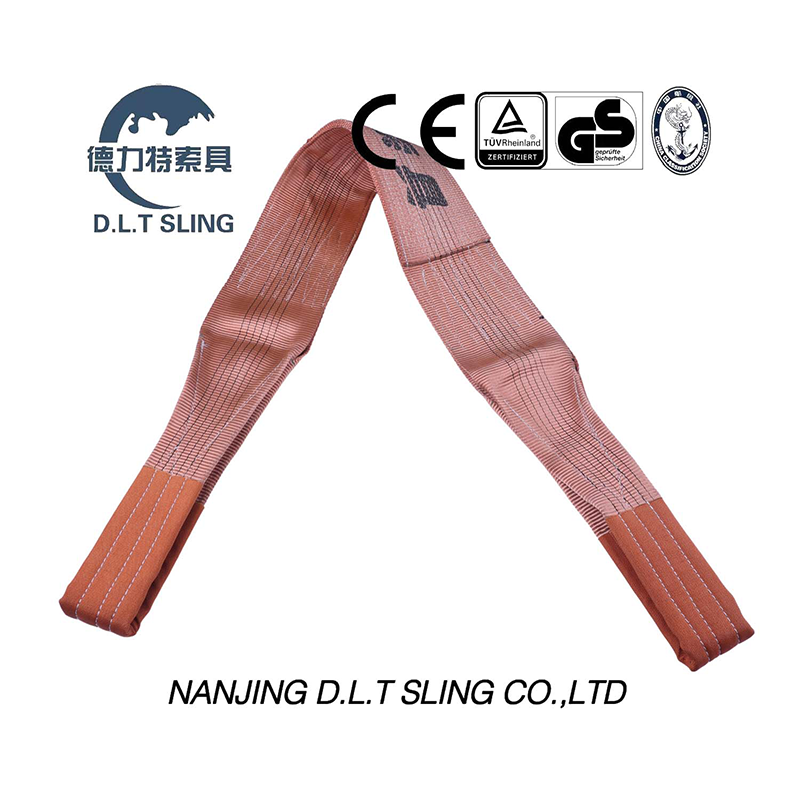
The rated capacity printed on the tag comes with a major caveat. It only applies to a perfectly straight vertical hitch. Real-world lifting rarely happens in a straight line. Buyers must account for capacity derating based on field applications and rigging geometry.
The way you attach the sling to the load drastically alters its lifting capacity. We use hitch multipliers to calculate the actual safe working load.
The basket hitch multiplier drops rapidly as the sling angle decreases. Tension increases exponentially as the horizontal angle between the sling and the load gets shallower.
If you lift a load with a sling at a 30-degree horizontal angle, the stress on each leg doubles compared to a 90-degree angle. Operators who fail to calculate angle tension often overload slings, even when lifting a mass well below the total rated WLL. Always consult a rigging angle chart before performing complex lifts.
Solving complex lifting challenges means matching the sling architecture to the operational load profile. The right choice maximizes operational lifespan and provides better ROI over time.
Eye-and-eye slings feature a flat body with sewn loops at both ends. They are the most common solution for straightforward vertical and choker hitches. Operators find them easy to slide under loads and secure to crane hooks.
However, eye-and-eye slings suffer from concentrated wear. The crane hook and the load always bear down on the exact same points—the inside of the eyes and the center of the body. Over repeated uses, these specific friction points degrade much faster than the rest of the material.
An endless flat lifting webbing sling offers a robust alternative. It forms one continuous, sewn loop without distinct ends. This architecture provides a massive mechanical advantage.
The continuous loop design allows riggers to rotate the bearing point with every single use. You never subject the same section of fabric to hook friction twice in a row. This drastically extends the operational life of the equipment. Endless slings are ideal for heavy, abrasive loads. They also excel when choking a load requires maximum surface-area contact, as they lack the bulky sewn eyes that can disrupt a tight grip.
Selecting the right lifting equipment demands a structured decision framework. Use this practical checklist for procurement and safety teams when shortlisting suppliers.
Procuring the right lifting equipment represents a delicate balance. You must accurately calculate dynamic loads, thoroughly understand material limitations, and enforce strict regulatory compliance. Neglecting any of these areas transforms a simple lift into a severe safety hazard.
To secure your operations immediately, implement the following action steps:
A: Yes, a true basket hitch can increase capacity up to 200% of the standard Working Load Limit. However, this full capacity only applies if the sling legs sit at a perfect 90-degree angle to the load. As the horizontal sling angle decreases, tension increases rapidly. You must calculate derating factors for any angle under 90 degrees to avoid accidental overloading.
A: You must remove it from service immediately. OSHA and ASME regulations dictate strict removal criteria for lifting equipment. No tag means no lift. Without a legible tag detailing the manufacturer, material, and rated capacities, operators cannot legally verify safe limits. The sling must be destroyed to prevent accidental usage.
A: Capacity is identical if both slings are rated for the same Working Load Limit. However, polyester generally offers better load control because it stretches only about 3% under tension. Nylon stretches up to 10%, which provides better shock absorption but can cause issues in tight headroom environments. Choose based on chemical resistance and stretch tolerance.
A: Operators must conduct a visual pre-use inspection before every single shift. They should look for cuts, chemical burns, UV degradation, and missing tags. Additionally, OSHA requires a thorough, documented periodic inspection by a qualified professional at least once every 12 months, or more frequently in severe operating conditions.

