

close
Choose Your Site
Global
Social Media

Views: 0 Author: Site Editor Publish Time: 2026-06-29 Origin: Site


Selecting industrial lifting equipment constitutes a critical risk-management decision. It is never just a routine procurement task. Incorrect sling selection frequently leads to severe safety hazards, stringent compliance failures, and unexpected operational downtime. You must treat this gear as a vital safety asset. We utilize the endless webbing sling specifically for its exceptional versatility in challenging environments. Its continuous loop design allows you to rotate hook and load contact points continuously. Furthermore, the flat bearing surface distributes tension evenly across delicate or highly polished payloads.
To prevent catastrophic drops, you need an evidence-based framework to evaluate, specify, and source the right equipment. This comprehensive guide provides exactly that. We will explore structural material choices, regional compliance standards, and mandatory inspection protocols. You will learn how to match lifting specifications perfectly to your most complex load handling requirements.
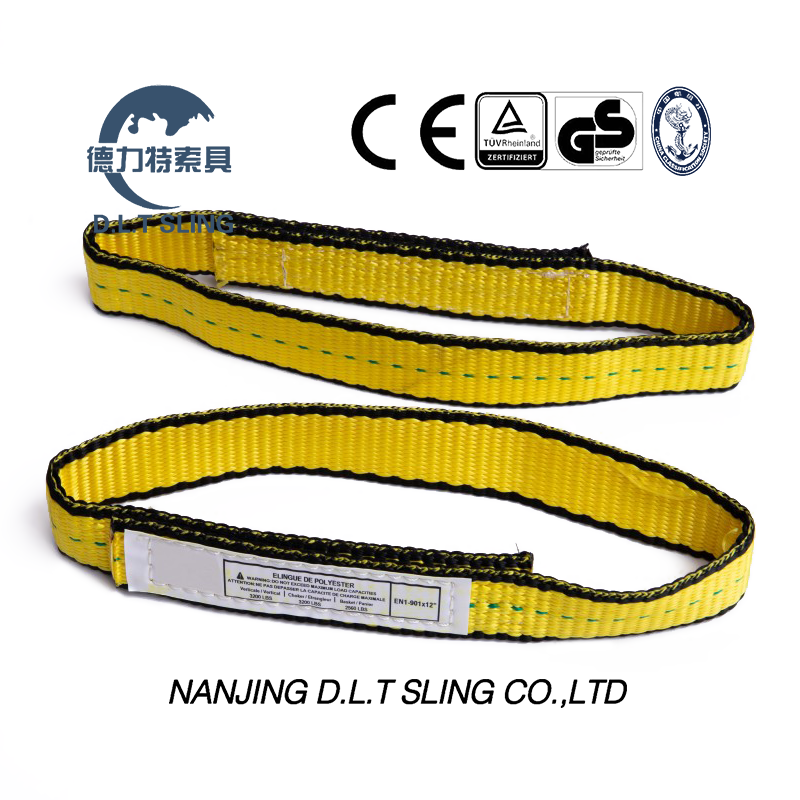
Riggers must understand structural differences between synthetic slings before rigging a load. We define a Webbing Sling in the endless configuration as a flat woven continuous loop. Manufacturers sew the ends of high-tenacity industrial webbing together to form an unbroken circle. Conversely, a round sling consists of a continuous yarn core wrapped inside a protective tubular jacket.
You should choose flat endless webbing for applications requiring a wider load-bearing footprint. The flat surface grips smooth, slippery, or fragile loads securely. It distributes the crushing force over a larger area. This protects delicate cargo like finished steel panels, wooden crates, or specialized machinery parts from compression damage.
However, you must acknowledge scenarios where alternative gear excels. You should choose round slings for highly abrasive environments. The independent outer jacket protects the internal load-bearing core threads from friction. Round slings also dominate ultra-heavy lifts because manufacturers can pack enormous volumes of core yarn into the jacket. They easily scale to massive tonnage capacities.
Riggers face different inspection realities based on these designs. Webbing allows direct visual inspection of the actual load-bearing fibers. You can see cuts and abrasions immediately. Round slings conceal their core. You must rely on the integrity of the outer jacket to infer internal safety.
| Evaluation Criteria | Flat Endless Webbing Slings | Tubular Round Slings |
|---|---|---|
| Load Footprint | Wide and flat; minimizes compression damage. | Tubular; can bunch up under heavy loads. |
| Inspection Reality | Load-bearing fibers are fully visible. | Load-bearing core remains hidden inside the jacket. |
| Abrasive Resistance | Vulnerable to edge cuts without extra sleeves. | Outer jacket absorbs friction before the core takes damage. |
| Flexibility | Stiffens slightly under extreme tension. | Highly flexible; conforms easily to irregular shapes. |
The industry uses standardized color codes to indicate synthetic sling capacity quickly. For instance, violet denotes a 1-ton limit. Green signifies a 2-ton limit. Yellow indicates 3 tons. You can identify standard tonnage from a distance using this visual system.
We caution you against relying solely on color. Sun exposure causes severe fading over time. Dirt and grease obscure the original dye. Furthermore, non-compliant manufacturers sometimes use incorrect colors. You must read the manufacturer's identification tag for absolute WLL verification. The printed tag remains the only legal and operational source of truth.
Material selection dictates operational survival. You cannot treat all synthetic fibers identically.
You must respect strict temperature limits. Standard synthetic slings operate safely between -40°C and 100°C (-40°F to 212°F). We strictly warn against using them outside these bounds. Extreme heat melts the fibers instantly, while extreme cold makes certain synthetics dangerously brittle.
Sharp edges represent the primary cause of synthetic sling failure. A sharp steel edge can slice a sling entirely in under a second under tension. You must mitigate this risk proactively.
We mandate the use of anti-abrasion sleeves. You can slide polyurethane pads or reinforced Kevlar sleeves directly over the webbing. These protectors sit between the sharp edge and the sling body. They absorb the cutting force, leaving the structural webbing intact. Investing in quality edge protection prevents catastrophic drops and extends equipment life.
You must understand the explicit difference between a Design Factor and a Working Load Limit. The WLL represents the maximum legal weight you can lift. The Safety Factor (SF) represents the mathematical breaking strength ratio built into the product during manufacturing.
Regional compliance bodies demand different margins of error. The American standard, ASME B30.9, requires a 5:1 minimum safety factor. If the WLL is 1 ton, the sling breaks at 5 tons. European standard EN 1492-1 demands a stricter 7:1 safety factor. Never use the safety factor to justify overloading a sling. It exists solely to absorb unpredictable dynamic forces like sudden wind gusts or mechanical jerks.
Rigging geometry completely alters sling capacity. OSHA and ASME principles dictate strict operational facts regarding hitches. Your baseline capacity assumes a perfectly straight, vertical lift.
Safety policies fail without rigorous field execution. You must implement strict daily inspection routines to protect your personnel and assets.
Visual inspection is mandatory before every single shift. Supervisors must enforce pre-use checks rigorously. Riggers must run their bare hands along the entire length of the continuous loop. They must feel for hidden cuts, stiff spots, or localized thinning. You cannot skip this step, regardless of how new the equipment appears.
You must apply non-negotiable rejection criteria to remove damaged gear from service. Remove any sling exhibiting these defects instantly:
You should actively leverage the rotation advantage. Unlike eye-to-eye models, the continuous loop lacks fixed wear points. We advise operators to rotate the loop slightly before every lift. This operational best practice distributes friction and crane hook pressure evenly across the entire circumference. This simple habit maximizes durability and ensures consistent structural integrity over time.
Sourcing lifting gear demands rigorous supplier scrutiny. You cannot afford to purchase non-compliant equipment from unverified sources.
Require absolute traceability from your suppliers. Every single sling must feature an individual serial number. The manufacturer must supply a corresponding physical test certificate. If a vendor cannot produce independent batch testing documents, you must disqualify them immediately.
Evaluate tagging quality carefully. The identification tag serves as the operational passport for your lifting gear. Ensure manufacturers use highly durable materials like heavy PVC or thick leather. They must sew the tag securely into the main body webbing. Remember this strict industry rule: a missing tag equals a dead sling. If the tag tears off, you must destroy and discard the equipment.
Assess supplier expertise before signing contracts. True rigging partners offer profound application support. They provide detailed load charts. They supply comprehensive derating factor tables for complex angles. They help you specify the exact chemical resistance needed for your facility. You should avoid vendors who treat this critical safety equipment as a cheap, interchangeable commodity.
Choosing the correct equipment requires balancing specific load geometry, environmental chemistry, and strict adherence to defined WLL parameters. You must respect the structural limits of synthetic fibers. You must enforce rigorous inspection protocols to prevent tragic accidents.
We urge safety managers and procurement teams to take immediate action. First, audit your current lifting setups to identify degraded or untagged equipment. Second, map out your heaviest and sharpest loads to ensure you have adequate edge protection. Finally, consult directly with certified rigging engineers to match your purchasing specifications strictly with your daily operational realities.
A: Absolutely not. Knotting significantly derates the sling's capacity. Knots typically reduce lifting strength by 50% or more. This practice strictly violates ASME and OSHA safety standards. You must always use proper rigging hardware or select a shorter sling instead.
A: There is no strict chronological expiration date. Lifespan is dictated entirely by usage frequency, environmental exposure, and physical wear. Ultraviolet light degrades synthetic fibers over time. Regular, documented visual inspections solely dictate when you must retire the equipment.
A: "Type 5" is simply the technical designation used in EN and ASME standard classifications for an endless synthetic web sling. They refer to the exact same product. The continuous loop design defines this specific category.

