

close
Choose Your Site
Global
Social Media

Views: 0 Author: Site Editor Publish Time: 2026-07-02 Origin: Site


In high-volume manufacturing and logistics, lifting operations require a precise balance. You must manage raw load capacity alongside worker safety continually. Protecting fragile or finished goods remains equally critical during transit. Traditional heavy-duty equipment like steel chains and wire ropes present distinct disadvantages. They often damage sensitive payloads during routine rigging processes. Their sheer weight also slows down rigging times considerably. Synthetic materials have naturally become the standard alternative in modern facilities. However, evaluating the right polymer and configuration is absolutely critical. Proper selection ensures strict compliance and drives daily operational efficiency. This guide breaks down the commercial and operational advantages of the webbing sling in detail. We explore essential evaluation criteria and specific material limitations comprehensively. You will also learn vital procurement shortlisting logic for safety-critical environments.
Logistics hubs and manufacturing plants often lose significant revenue to rigging inefficiencies. Two primary issues plague daily heavy-lifting operations. First, abrasive lifting gear causes severe product surface damage. Scratched paint and dented enclosures require expensive, time-consuming rework. Second, maneuvering excessively heavy steel rigging wastes valuable staging time. Crews struggle to position cumbersome chains around oversized payloads efficiently. These operational bottlenecks directly impact your daily bottom line.
Heavy wire ropes and chains increase rigger fatigue rapidly during long shifts. Rigger exhaustion naturally slows down the entire staging process. A physically exhausted crew simply operates less efficiently overall. They also become much more prone to costly safety errors. Lighter alternatives resolve these ergonomic bottlenecks immediately. Workers can easily carry synthetic lifting gear across large warehouse floors. This mobility reduces physical strain and accelerates the overall workflow safely.
Hoisting equipment must meet strict regional safety standards globally. Regulations like ASME B30.9 or EN 1492-1 govern these operations strictly. You cannot sacrifice safety for the sake of speed. Fast-paced warehousing demands high agility from every equipment piece. Operators need tools offering rapid deployment alongside unwavering regulatory compliance. The right synthetic gear bridges this critical operational gap perfectly. Facilities can maintain rigorous safety profiles while optimizing their daily output metrics.
Choosing between synthetic polymers determines your lifting success entirely. Let us closely compare polyester and nylon characteristics. Elongation profiles differ vastly between these two common materials. Polyester stretches approximately 3% at its maximum rated capacity. Nylon stretches up to 10% under similar heavy loads. When a crane lifts a heavy load abruptly, nylon absorbs the shock well. However, this elasticity causes a dangerous bouncing effect. Riggers struggle to position bouncing loads safely into tight machinery bays. Polyester becomes strictly mandatory where load bounce poses a risk. It also excels when vertical overhead clearance remains incredibly tight. Precision manufacturing requires this low-stretch stability for accurate part placement.
Chemical resistance profiles also dictate your material selection process. Polyester strongly resists bleaching agents and common industrial acids. However, highly concentrated alkalis degrade polyester quickly. Nylon exhibits the exact reverse chemical behavior in industrial settings. You must evaluate your specific chemical environment before purchasing gear. A simple chemical spill can compromise material integrity instantly. Proper chemical evaluation prevents catastrophic mid-air failures.
Moisture absorption matters heavily in outdoor logistics applications. Polyester absorbs almost zero water during heavy rain or snow. This characteristic prevents dangerous freeze-lock in cold outdoor logistics yards. It also maintains a consistent gross weight in wet environments. Your rigging crew avoids handling unexpectedly heavy, waterlogged straps. Dry equipment resists harboring dangerous mold or corrosive mildew over time.
We must also contrast synthetics against traditional wire or chain. A high-quality webbing sling provides an exceptional strength-to-weight ratio. Chains routinely cause a destructive crush factor on fragile loads. You can easily protect steel pipes, composite materials, or painted machinery using synthetics. The soft fabric conforms safely around the payload without gouging the finish.
| Lifting Medium | Stretch / Elongation | Chemical Vulnerability | Ideal Application Scenario |
|---|---|---|---|
| Polyester | Low (~3% at capacity) | Vulnerable to strong alkalis/ethers | Precision lifting, fragile surfaces, low headroom |
| Nylon | High (~10% at capacity) | Vulnerable to bleaches and acids | Towing, dynamic loading, high energy absorption |
| Wire Rope / Chain | Near Zero | Resists most chemicals; rust risk | Foundries, extreme heat, highly abrasive loads |
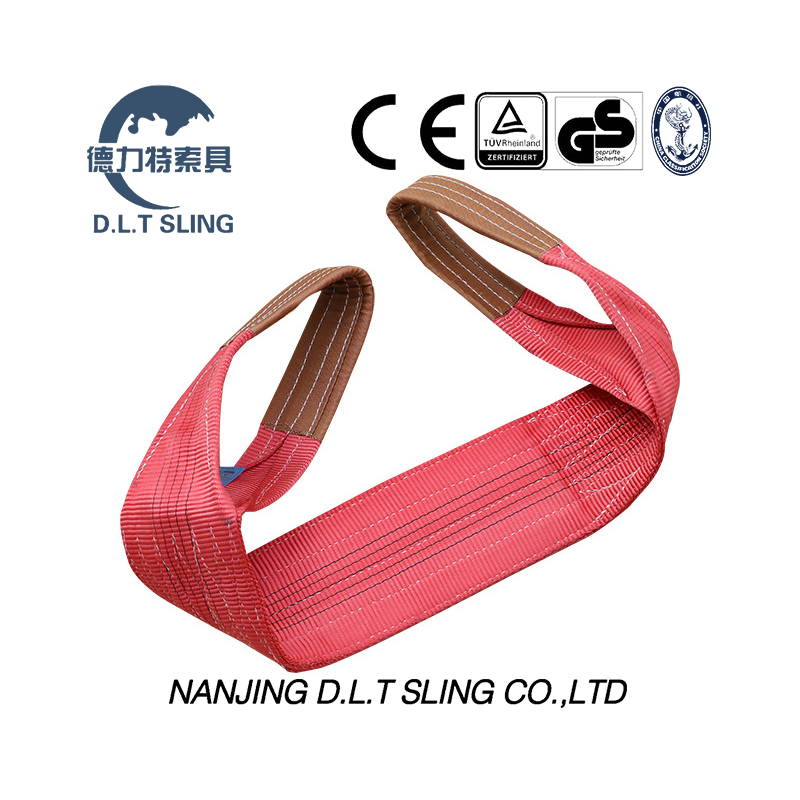
Visual safety checks rely heavily on a universal color-coding system. This global standardization prevents catastrophic overloading errors on the floor. Riggers can identify load capacities instantly from a distance. For example, violet indicates a standard 1-ton capacity. Green represents 2 tons. Yellow signifies 3 tons. You will identify red for 5 ton lifting straps easily across the warehouse. Brown typically denotes 6 tons, while blue covers 8 tons.
Hitch types dynamically alter the effective Working Load Limit (WLL). A straight vertical pull delivers the base rated capacity exactly. A basket hitch effectively doubles this safe working capacity safely. Both eyes attach directly to the main crane hook. Conversely, a choker hitch reduces the total capacity by 20%. Riggers must calculate these dynamic geometric shifts before executing every single lift.
Safety Factor (SF) standards define the ultimate breaking strength metric. These metrics provide a critical buffer against unexpected dynamic loads. European standard EN 1492-1 mandates a strict 7:1 safety ratio. General US standards typically require a standard 5:1 ratio. A 5-ton rated strap featuring a 7:1 SF breaks only at 35 tons during destructive testing. This massive margin saves lives during sudden crane jerks or unexpected load shifts.
Ply and width variations dictate how equipment distributes physical pressure. Simplex models feature a single-ply construction for lighter, everyday tasks. Duplex models utilize double-ply webbing for robust, heavy-duty applications. Wider profiles distribute pressure broadly across the entire load surface. This wide footprint effectively prevents localized load deformation on soft materials. You protect valuable inventory by selecting the appropriately wide configuration for your loads.
Even the strongest synthetic fibers possess specific operational vulnerabilities. You must mitigate these risks actively to ensure workplace safety. Understanding these limits prevents catastrophic accidents during routine operations.
Cutting remains the absolute leading cause of synthetic gear failure globally. The sharp edge vulnerability demands strict operational safety protocols. Operators must use dedicated corner protectors during high-risk lifts constantly. Polyurethane wear sleeves or heavy-duty edge guards remain absolutely mandatory. You need them when lifting sheet metal or abrasive cast iron. A single micro-cut can unravel the entire load-bearing structure instantly.
Temperature restrictions dictate clear operational boundaries for synthetic materials. Safe operational thresholds generally range between -40°C and 100°C (-40°F to 212°F). High-heat manufacturing environments exceed these thermal limits quite easily. Fibers will melt rapidly if exposed to extreme ambient heat. Foundries and steel mills must default to traditional wire or chain to maintain safe operations.
Prolonged outdoor exposure weakens polyester fibers significantly over time. UV degradation attacks the polymer molecular structure relentlessly. This invisible damage compromises the lifting integrity without obvious visual cues. Warehouse managers often overlook this silent degradation process entirely. They occasionally leave gear sitting in open flatbed trucks for days. Proper indoor storage away from direct sunlight is absolutely necessary. You must train personnel to return all equipment to designated lockers immediately.
Criteria for immediate removal from service require rigid adherence. Follow this numbered inspection protocol before beginning every shift:
Sourcing reliable equipment requires a methodical, rigorous evaluation process. Always verify supplier certifications before placing any bulk commercial orders. Require vendors to provide comprehensive batch test certificates proactively. They must offer concrete proof of ongoing regulatory compliance. Look for strict ASME, OSHA, or CE standard adherence in their documentation. Genuine manufacturers happily supply these testing reports upon request.
Tag integrity represents a massive legal compliance factor internally. Ensure the gear features highly durable, fully legible traceability tags. These specialized labels must detail WLL, material type, SF, and the manufacturer name. Slings missing tags are legally unusable in any industrial setting. Illegible tags carry the exact same severe legal penalty. Many premium manufacturers now use reinforced leather or thick vinyl tags to survive harsh conditions.
Procurement teams must also factor in necessary hardware accessories initially. Evaluate the need for specialized wear sleeves and heavy-duty shackles thoroughly. Shackles and hoist rings must match the sling capacity perfectly. Using undersized hardware creates a dangerous weak link in the system. Purchasing these protective accessories alongside the base equipment extends operational lifespan. This strategic bundling prevents premature replacement cycles in harsh environments. Proper sleeves protect your main investment from catastrophic edge damage.
You must conduct a thorough operational load audit next. Evaluate your current standard payloads carefully on the floor. Document payload weights, awkward shapes, and center of gravity data. Assess the surrounding chemical and thermal environment meticulously. This comprehensive audit specifies the exact ply, length, and WLL required. Complete this vital step fully before initiating any official RFQ process.
Polyester synthetic gear offers an unmatched combination of industrial benefits. It delivers exceptional load protection alongside pinpoint precision handling. The operational efficiency suits the vast majority of modern logistics workflows perfectly. You will achieve maximum performance provided you respect strict environmental limitations constantly. Proper education regarding chemical and thermal boundaries ensures long-term safety.
Transitioning to high-quality, standardized synthetic rigging transforms your daily operation. It directly reduces payload surface damage rates significantly across the board. Lighter equipment also accelerates overall operational throughput safely and ergonomically. Begin this transition by auditing your heaviest, most fragile loads today. Determine exact specifications to optimize your modern lifting strategy immediately.
A: Lifespan is dictated by usage frequency, environmental exposure, and abrasion, not strict chronological time. Daily visual inspections are required by law. Replacement is mandated upon specific wear criteria, such as broken stitches, chemical burns, or missing tags. Always prioritize physical condition over purchase age.
A: Yes, but the Working Load Limit (WLL) is typically derated by 20%. This geometric reduction lowers the safe operating capacity to 4 tons. Always consult the manufacturer’s load chart printed directly on the tag before executing a choker configuration.
A: Flat slings are woven flat to distribute weight widely across surfaces. They remain ideal for protecting delicate payload finishes. Round slings contain continuous loops of polyester yarn inside a protective tubular jacket. They offer higher flexibility and often higher load capacities for bulky, irregular load shapes.

