

close
Choose Your Site
Global
Social Media

Views: 0 Author: Site Editor Publish Time: 2026-07-29 Origin: Site


Rigging and rescue operations demand absolute precision. Equipment failure is not an option when secure load stabilization or victim extraction determines the success of the mission. Choosing the wrong material, structural configuration, or load rating introduces severe risks. These errors routinely lead to catastrophic load drops, victim slippage during emergency extraction, and serious compliance violations. Establishing a rigorous evaluation framework for procuring a webbing sling is mandatory for operational safety. This guide breaks down exactly how these tools function under extreme stress. You will learn the mechanical principles of load distribution, the distinct advantages of specific synthetic materials, and the structural configurations required for different operational environments. We cover application-specific requirements ranging from heavy industrial lifting to critical Search and Rescue maneuvers, providing actionable data for field deployment.
Application Specificity: In Search and Rescue (SAR) scenarios, a webbing sling provides a secure grip around a victim’s upper body for safe extraction, whereas industrial applications rely on them for load distribution without surface damage.
Material Selection: A Polyester Webbing Sling is the industry standard for minimizing elongation and resisting UV/acid degradation, making it ideal for precision lifting.
Configuration Impact: The Eye-Eye Webbing Sling configuration offers versatile hitching options (choker, vertical, basket) critical for adapting to varying load shapes and center-of-gravity challenges.
Compliance & Risk: Procurement must align with ASME B30.9, OSHA, or NFPA standards, requiring strict adherence to Working Load Limits (WLL) and mandatory inspection protocols.
Understanding the physics of load distribution is the first step in safe rigging. A synthetic sling utilizes a wide, flat surface area to distribute weight evenly across the contact zone. This design prevents the localized pressure points and dangerous slippage commonly associated with bare wire rope or steel chain. The friction generated by this broad contact patch ensures the load remains stable during complex maneuvers. When you wrap a flat synthetic strap around a cylindrical pipe, the material conforms to the radius. This maximizes surface contact and drastically increases the friction coefficient compared to a rigid chain link.
In Search and Rescue operations, structural stability dictates survival. A synthetic strap provides a secure grip around the victim's upper body, specifically routed under the armpits and across the chest. This exact placement captures the body's center of gravity. Securing a victim around the waist, arms, or legs creates a high risk of the person slipping out of the loop during a drag. The upper body grip ensures the airway remains relatively clear while the rescuer maintains mechanical advantage. Field tests show that dragging a 200-pound victim by the wrists can dislocate joints, whereas a chest harness distributes the pulling force across the ribcage and spine.
Fast strapping techniques rely heavily on these tools. Rescuers use pre-tied loops for rapid victim packaging in low-visibility or toxic environments. The rescuer quickly passes the loop under the downed victim's arms, creating an immediate harness. This method drastically reduces time spent in the hazard zone compared to tying complex knots on the fly. Here is the standard sequence for a rapid webbing drag:
Approach the victim from the head and assess the airway.
Slide the pre-tied continuous loop under the victim's armpits.
Cross the loop over the chest to create a secure X-pattern.
Pull the remaining slack behind the victim's head to support the neck.
Stand up using leg muscles and drag the victim backward out of the hazard zone.
For single-rescuer drags, the physical efficiency of a synthetic loop far exceeds relying on a rescuer's bare hands, forearms, or improvised blanket rolls. The loop extends the rescuer's reach, allowing them to stand in a more ergonomic, upright position. This leverages the rescuer's leg muscles rather than straining the lower back, increasing the speed and distance of the drag. Extracting unresponsive victims requires specialized maneuvers. Rescuers frequently use these slings to drag unconscious individuals along the floor beneath the thermal layer of a fire. During ladder-assisted removals, the sling secures the victim to the rescuer or the ladder rungs, preventing catastrophic falls if the victim shifts weight unexpectedly.
Operational logistics dictate how these tools are carried. Many firefighters keep pre-tied loops stuffed in their turnout gear pockets for immediate deployment. While dedicated full-body rescue harnesses offer superior stabilization, they take significantly longer to apply. In time-critical extractions, the pocket loop provides the best balance of speed and security.
Industrial environments present entirely different challenges. Machined parts, cylindrical pipes, and fiberglass boat hulls require careful handling to prevent surface damage. The flat profile of the synthetic material conforms perfectly to irregular shapes. It spreads the compressive forces over a wider area, protecting fragile finishes from crushing or scratching. When lifting a freshly painted steel beam, a wire rope will bite into the coating and expose the bare metal to rust. A synthetic strap glides over the surface, maintaining the integrity of the protective layer.
When configured in a choker hitch, the material's inherent friction coefficients allow it to grip smooth surfaces securely. As tension increases on the crane hook, the choke point tightens. The synthetic fibers bite into the load surface just enough to prevent lateral shifting without gouging the material. Riggers must ensure the choke angle is correct to maximize this gripping force. A choke angle less than 120 degrees significantly reduces the capacity of the setup.
Load Material | Surface Vulnerability | Grip Mechanism | Recommended Sling Type |
|---|---|---|---|
Machined Steel | High (Scratches/Gouges) | High friction, wide surface area | Wide single-ply synthetic |
Fiberglass Hulls | High (Cracking/Crushing) | Broad load distribution | Multi-ply wide synthetic |
Concrete Pipes | Medium (Chipping) | Conformity to radius | Heavy-duty synthetic with wear pads |
Rough Cast Iron | Low (Abrasion to sling) | Tight choke, high tension | Synthetic with heavy edge protection |
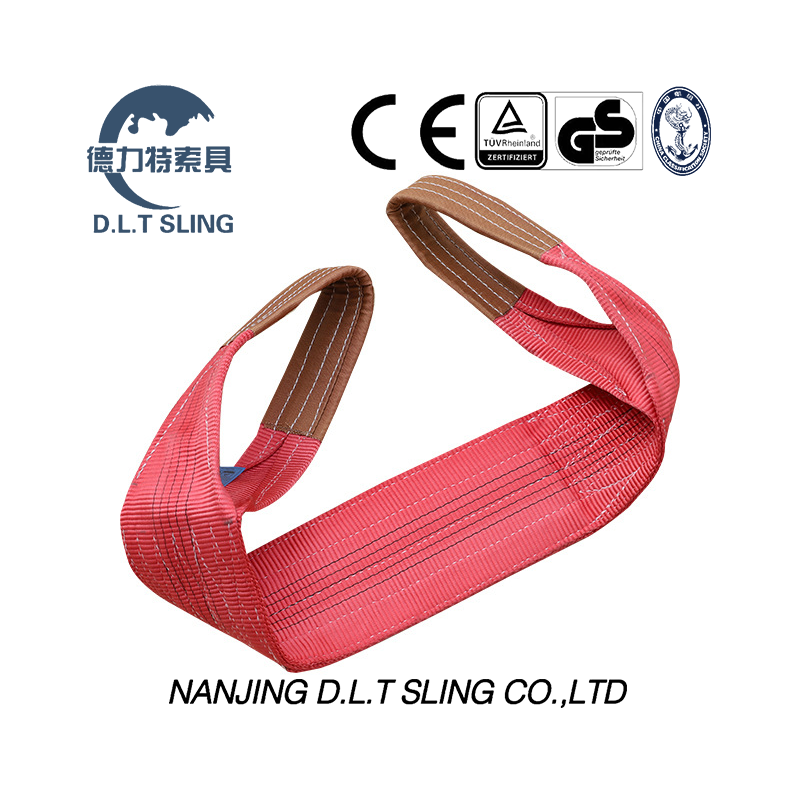
Modern sling manufacturing relies primarily on synthetic fibers, but not all synthetics perform equally under load. Selecting the correct material requires analyzing the specific environmental hazards and mechanical demands of the lift. Using the wrong fiber in a chemically active environment will cause the load-bearing strands to dissolve silently.
A Polyester Webbing Sling is engineered for dimensional stability. It features exceptionally low stretch properties, typically elongating only 3% at its rated capacity. This low stretch is essential for load control and precision placement. When a crane operator needs to set a heavy generator onto tight mounting bolts, they cannot afford the load bouncing or settling unpredictably. If you use a high-stretch material for a precision lift, the load will drop several inches after the crane stops moving as the fibers relax.
Environmental resistance is another major factor. Polyester demonstrates superior resistance to ultraviolet (UV) rays and acidic environments compared to nylon. Prolonged exposure to sunlight degrades synthetic fibers, but polyester maintains its structural integrity significantly longer in outdoor construction settings. It also withstands exposure to common industrial acids, preventing rapid chemical degradation. If your rigging yard is exposed to direct sunlight 365 days a year, polyester will outlast nylon by a wide margin.
Nylon offers higher elasticity, stretching up to 10% under full load. This stretch acts as a shock absorber. If a load is subject to sudden jerks or dynamic loading, nylon can absorb the kinetic energy without snapping. However, this same elasticity makes nylon unsuitable for precision lifts where clearance is tight. If you are lifting a load off a flatbed truck and the load snags, a nylon strap will stretch like a rubber band before violently snapping the load free.
Procurement decisions must follow a strict matrix based on environmental exposure. If the lifting operation occurs in a chemical plant with acid exposure, polyester is mandatory. If the operation involves alkaline environments or requires shock absorption, nylon is the better choice. Always consult the manufacturer's chemical compatibility charts before deploying synthetic lifting gear in hazardous environments.
Environmental Factor | Polyester Performance | Nylon Performance |
|---|---|---|
Acid Exposure | Excellent Resistance | Severe Degradation |
Alkaline Exposure | Severe Degradation | Excellent Resistance |
UV/Sunlight | High Resistance | Moderate Degradation |
Stretch at Capacity | ~3% (Low Stretch) | ~10% (High Stretch) |
Water Absorption | Low (Retains strength) | High (Loses some strength when wet) |
The physical construction of the sling dictates its functional application. Understanding the structural differences between configurations ensures the rigger selects the right tool for the specific center-of-gravity challenge. You cannot force a square peg into a round hole when rigging heavy machinery.
An Eye-Eye Webbing Sling features reinforced loops at both ends. These eyes can be manufactured flat or twisted. Twisted eyes allow the sling to sit more naturally in a crane hook or shackle when rigged in a choker hitch, reducing stress on the fibers. Flat eyes are generally easier to extract from beneath a load once it is set in place. If you are rigging a tight choke on a steel pipe, a twisted eye prevents the material from bunching up and tearing at the seams.
This configuration performs exceptionally well across the three primary hitches: vertical, choker, and basket. The eyes provide distinct attachment points, making it easy for riggers to thread the sling through itself for a choke or attach both ends to a hook for a basket hitch. However, the bearing points inside the eyes are subject to intense friction. Wear pads are absolutely necessary in these bearing points to prevent the crane hook or shackle pin from cutting through the fibers. A bare eye rubbing against a rough cast-iron crane hook will fail rapidly under heavy use.
Endless slings form a continuous loop of material. Unlike the eye-eye configuration, they do not have fixed attachment points. This design offers a massive advantage in longevity. Riggers can rotate the endless loop before each lift, constantly shifting the wear points. This prevents the crane hook or the load edges from abrading the exact same section of fibers repeatedly. If you are lifting rough concrete blocks all day, an endless loop will survive much longer because you distribute the abrasion across the entire length of the material.
When assessing the cost-to-lifespan ratio, endless configurations often provide superior value in high-frequency lifting operations. If the load involves heavy abrasion, the ability to rotate the wear points extends the product lifecycle significantly. Eye-eye configurations are typically preferred when riggers need fast, intuitive choker hitches without managing a doubled-over continuous loop. Endless loops can be cumbersome to thread through tight lifting lugs because you are dealing with two parallel layers of thick material.
Standardizing procurement across a facility requires a clear understanding of capacity ratings and structural geometry. Riggers must calculate the exact forces applied to the equipment based on the hitch type and load angle. Guessing the weight or the angle tension will eventually result in dropped loads.
Synthetic web slings used for industrial rigging are manufactured with a standard 5:1 design factor. This means the breaking strength of the material is five times higher than the stated Working Load Limit (WLL). In contrast, life-safety and rescue applications often require a 10:1 or higher safety margin to account for dynamic shock loading if a victim falls. You must never use industrial rigging equipment for human suspension unless specifically engineered and approved for that purpose. The stitching patterns and thread types differ vastly between industrial cargo control and human life safety.
Hitch types mathematically alter the WLL. A vertical hitch provides 100% of the rated capacity. A choker hitch reduces that capacity by approximately 20% due to the stress concentrated at the choke point. Conversely, a true vertical basket hitch doubles the capacity, as two legs of the sling are supporting the weight. Riggers must recalculate the WLL for every single lift based on the hitch configuration. Furthermore, the angle of the basket hitch drastically changes the tension. A basket hitch at a 30-degree horizontal angle applies massive stress to the legs, effectively negating the capacity doubling effect.
Hitch Type | Capacity Multiplier | Example WLL (Base 10,000 lbs) | Primary Use Case |
|---|---|---|---|
Vertical | 1.0x | 10,000 lbs | Direct overhead lifting with lifting lugs |
Choker | 0.8x | 8,000 lbs | Securing loose bundles, pipes, lumber |
Vertical Basket | 2.0x | 20,000 lbs | Cradling large, balanced loads |
Basket (60° Angle) | 1.7x | 17,000 lbs | Wide loads requiring angled legs |
Basket (45° Angle) | 1.4x | 14,000 lbs | Very wide loads (requires caution) |
Manufacturers increase the strength of a sling by adding plies (layers of webbing) or increasing the width. Adding plies—creating double, triple, or quad-ply slings—increases the load capacity without widening the footprint. This is critical when rigging points are tight, such as fitting a sling through a narrow shackle or a small lifting eye on a machined part. A four-ply strap is incredibly stiff and difficult to bend around small radii, so it is best used for straight vertical pulls.
Choosing a wider single-ply sling maximizes the surface area grip. This is ideal for fragile loads where spreading the compressive force is the primary concern. A wide, thin sling conforms better to curved surfaces than a thick, stiff multi-ply sling. The choice between width and thickness depends entirely on the spatial constraints of the rigging points and the fragility of the load surface. If you are lifting a thin-walled aluminum tube, a wide single-ply strap will prevent the tube from crushing under the choke tension.
Deploying synthetic materials in harsh industrial environments introduces significant risks. Sharp edges, high temperatures, and chemical exposure can destroy synthetic fibers in seconds. Strict mitigation protocols are required to prevent catastrophic failure. A single cut on the edge of a strap can reduce its capacity by over 50% instantly.
Mandatory pre-shift inspections are non-negotiable. Riggers must physically examine the entire length of the material for cuts, snags, holes, UV degradation, and melted fibers. Even minor surface cuts can drastically reduce the breaking strength of the material under tension. Follow this strict inspection sequence before every shift:
Lay the equipment flat on a clean surface in a well-lit area.
Check the manufacturer tag for legibility and capacity ratings.
Inspect the eyes and bearing points for excessive abrasion or cut threads.
Run bare hands along the edges to feel for hidden cuts or hard, melted spots.
Examine the face of the webbing for chemical burns, weld spatter, or embedded metal shavings.
Twist the material slightly to check for broken internal fibers or exposed warning yarns.
Many modern synthetic slings feature red core warning yarns built directly into the load-bearing fibers. If the outer jacket wears away and exposes these red yarns, the equipment has reached critical wear levels. The presence of visible red warning yarns mandates immediate removal from service. Do not attempt to repair or patch the damaged area. Cut the damaged strap in half with a knife to ensure no one pulls it out of the trash and uses it.
Compliance frameworks dictate strict identification requirements. Every piece of lifting equipment must have a legible, permanent manufacturer identification tag. This tag must state the material type, the WLL for different hitches, and traceability information. If the tag is missing or illegible, the equipment must be destroyed and discarded immediately. You cannot write the capacity on the strap with a marker; the official tag must be intact.
Operations must adhere to specific regulatory standards. Industrial lifting falls under ASME B30.9 and OSHA 1910.184. Rescue operations utilize equipment certified under NFPA standards, such as NFPA 1983/2500 for life-safety rope and system components. Mixing industrial and rescue equipment without engineering approval violates these standards and introduces severe liability. An OSHA inspector will immediately issue citations if they find rigging gear without legible tags on a job site.
Synthetic fibers cannot withstand cutting forces under tension. The absolute necessity of using cut-resistant sleeves or corner protectors cannot be overstated. If a synthetic sling runs across a sharp steel edge or a rough concrete corner without protection, the tension will slice through the fibers instantly. Edge protection must be rated for the specific application and securely positioned before tension is applied to the system. Cardboard or old rags do not qualify as edge protection. You must use engineered Kevlar sleeves, magnetic corner guards, or heavy-duty polyurethane pads.
Take the following actions immediately to secure your operations:
Audit your current rigging inventory and immediately destroy any equipment with missing tags, exposed warning yarns, or visible cuts.
Consult manufacturer load charts to verify your current hitch configurations are not exceeding the mathematically reduced Working Load Limits.
Procure rated edge protection sleeves for all synthetic lifting gear exposed to machined edges or rough surfaces.
Contact a certified rigging supplier to standardize your equipment based on specific environmental exposures, separating industrial gear from life-safety rescue equipment.
A: In Search and Rescue operations, a webbing sling provides a secure grip around the victim's upper body—specifically under the armpits and across the chest. This positioning ensures the victim's center of gravity is maintained and prevents them from slipping out during horizontal drags or vertical lifts. It does not provide a secure or safe grip around the waist, arms, or legs/feet alone.
A: The primary advantage is its exceptionally low elongation, typically stretching only 3% at rated capacity. This provides superior load control for precision lifting. Additionally, polyester offers excellent resistance to acidic environments and ultraviolet (UV) degradation compared to nylon.
A: Choose an eye-eye configuration when you need fast, intuitive attachment points for choker or basket hitches. The distinct eyes make threading the material through itself easier. Endless slings are better for high-abrasion environments because you can rotate the continuous loop to shift the wear points.
A: A choker hitch reduces the Working Load Limit (WLL) of the equipment, typically by about 20%. The reduction occurs because the material is bent sharply back on itself, concentrating stress and friction at the choke point. Always consult the manufacturer's tag for the specific choker capacity.
A: Equipment must be removed from service immediately if you find missing or illegible identification tags, exposed red core warning yarns, acid or heat burns, melted fibers, or any structural cuts, snags, or holes in the material.
A: No. Industrial rigging equipment is manufactured to ASME and OSHA standards with a 5:1 design factor. Life safety and rescue equipment must meet NFPA standards, which often require a 10:1 or higher safety margin. Never cross-apply industrial gear for human suspension without explicit engineering approval.

