

close
Choose Your Site
Global
Social Media

Views: 0 Author: Site Editor Publish Time: 2026-09-30 Origin: Site


Improper lifting operations introduce severe job site risks. Equipment damage, site delays, and massive safety liabilities often stem directly from miscalculating load limits or ignoring distribution dynamics. You cannot afford guesswork during heavy construction or marine logistics. Choosing and deploying cargo mesh netting demands precise engineering calculations. Engineers and site managers must rely on verified mathematical data to prevent catastrophic rigging failures.
Ensuring optimal cargo lifting safety requires a highly systematic approach before hoisting begins. You must verify Working Load Limits rigorously for every single operation. You also need to accurately calculate gross weight to avoid overloading the hoist. Mastering center-of-gravity principles is mandatory before the crane ever moves. This article explores essential protocols for safe lifting environments. We will examine critical weight calculations and physical capacity limits. You will also learn how to inspect rigging hardware and evaluate mesh specifications to protect your payload and crew.
WLL over Breaking Strength: The Working Load Limit (WLL) is the only acceptable metric for evaluating operational safety; never rely on Minimum Breaking Strength (MBS).
Accurate Weight Calculation: Safe lifting requires factoring in the Gross Weight, which includes the cargo, the net itself (Tare), and all attached rigging hardware.
Load Distribution is Critical: Even if a load is under capacity, poor weight distribution or an off-center Center of Gravity (CoG) can cause localized mesh failure.
Tag Legibility is Mandatory: If the manufacturer’s capacity tag on the net is missing or illegible, the net must be immediately removed from service.
Procurement teams and safety engineers often encounter confusing terminology when purchasing rigging equipment. Understanding capacity metrics is vital for secure lifting operations. Working Load Limit (WLL) and Minimum Breaking Strength (MBS) serve entirely different purposes. WLL represents the maximum mass a net can safely lift under normal, everyday conditions. Conversely, MBS dictates the precise force required to snap new, untested webbing in controlled laboratory settings. Safety engineers must strictly evaluate the cargo net WLL during operational planning phases. You should never base your hoist parameters on the ultimate breaking strength.
Industry standards mandate specific Design Factors, which professionals also call Safety Factors. These ratios protect crews against unpredictable dynamic forces during active lifts. A standard industry ratio sits at 5:1 or 6:1 for synthetic materials. This means the laboratory breaking strength is five to six times higher than the working limit. Why do rigging experts require this massive buffer? Real-world environments are highly volatile. Cranes sway during transit. Sudden stops jolt the rigging assemblies. High wind gusts multiply the physical force exerted on the synthetic web. The built-in safety factor absorbs these dynamic shocks, keeping your payload totally secure.
Beware of manufacturers promising unrealistic capacities. Subpar vendors sometimes market the MBS as standard operating capacity, creating extreme hazards. Buyers must require certified load-test documentation before approving any gear. Unverified capacity claims put entire work sites at risk. Always demand transparent testing reports from accredited third-party inspectors. Rigging professionals must treat the design factor as a non-negotiable safety barrier. It prevents material fatigue from causing sudden snaps. Ensure vendor technical datasheets explicitly differentiate between ultimate failure limits and safe operational thresholds. Reject any netting if the supplier obscures these figures.
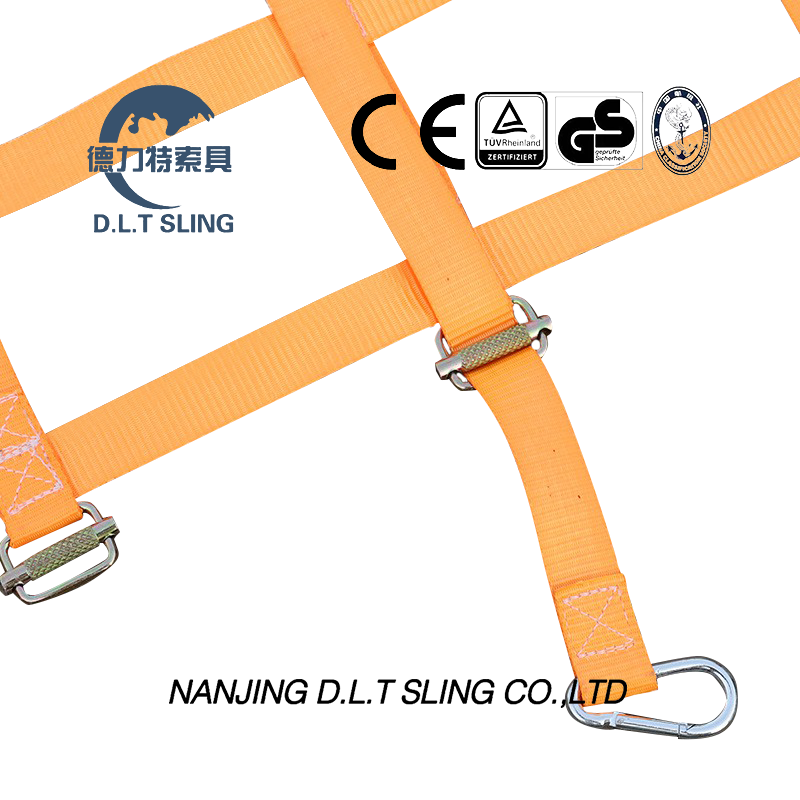
Proper lifting requires absolute mathematical accuracy from the rigging crew. You must define three critical weight categories before rigging begins. Logistics lifting hinges on understanding Net Weight, Tare Weight, and Gross Weight perfectly.
Net Weight represents the actual payload you need to lift. This is simply the cargo itself, such as a pallet of bricks or a steel generator. Next, you must determine the Tare Weight accurately. Tare includes the physical mass of the lifting net itself. Crucially, it also encompasses all connected rigging components above the payload. Spreader bars, heavy shackles, hoist hooks, and steel O-rings add substantial mass. Finally, Gross Weight is the combined total. It equals Net Weight plus Tare Weight. The crane and the master link must support this ultimate Gross Weight.
A common calculation failure point involves neglecting the rigging hardware. Teams often weigh the cargo precisely but ignore the massive steel components connecting it to the crane block. This oversight pushes loads dangerously close to the operational threshold. Sometimes, it pushes them completely beyond the approved capacity. Miscalculating the tare weight by just a small percentage can prove fatal during high-capacity hoists.
Consider a practical scenario. Suppose the payload weighs 4,500 pounds. The netting handles exactly 5,000 pounds safely. It looks like a compliant lift initially. However, adding 600 pounds of heavy steel shackles and spreader bars creates a severe 100-pound overload. You must document every single piece of hardware in your pre-lift calculations. Use calibrated load cells to confirm the actual total mass before the load leaves the ground.
Total weight is only one part of the safety equation. Even a lightweight payload can cause catastrophic material failures if positioned poorly. Understanding the physics of point-loading is absolutely essential. Point-loading occurs when dense, jagged, or irregularly shaped payloads apply disproportionate stress to individual webbing squares.
Imagine lifting a heavy steel block resting entirely on a single sharp corner. That specific contact point absorbs the entire force of the lift. It bypasses the broader mesh surface area entirely. This concentrated stress quickly slices through synthetic fibers. Crews must use protective edge sleeves or heavy dunnage. These buffers pad sharp corners and distribute pressure evenly across multiple webbing straps. Edge protection is a mandatory best practice for asymmetrical heavy loads.
The Center of Gravity (CoG) represents another critical success factor. We recommend following a strict step-by-step checklist to align the crane hook directly over the load's CoG:
Identify the precise center of mass for asymmetrical cargo before attaching any slings.
Position the primary crane hook perfectly plumb above this identified center mark.
Adjust the length of individual sling legs to compensate for uneven dimensions.
Perform a slow test lift, raising the load just two inches off the deck.
Observe the payload carefully for any signs of tilting or rapid shifting.
Lower the cargo and re-rig immediately if the load does not hang perfectly level.
Failing to center the hook causes a dangerous "basket effect." The payload shifts dramatically mid-air, sliding rapidly toward the lowest point. This sudden uneven tension can overload a single leg of the net, leading to immediate structural failure.
Additionally, you must evaluate mesh size against cargo size. The aperture, or hole size, dictates surface-area contact. Choose an aperture small enough so cargo cannot slip through during transit. Simultaneously, maximize the webbing width to ensure flat, even weight distribution across the payload's bottom surface.
Routine inspections prevent accidents before they happen on the job site. Your crew must follow a rigorous pre-lift protocol every time they prepare a hoist. Never skip these steps to save time.
Rule number one of lifting involves strict tag verification. You must verify the manufacturer tag for the cargo net load capacity before use. The identification tag must also prominently display the date of manufacture and the material type. Industry standards enforce a very simple rule: no legible tag equals no lift. Never guess the capacity of an untagged net based on its size, color, or physical appearance. Tags fade, so replace the gear immediately once illegible.
Next, conduct a thorough visual webbing check. Operators must scan every inch of the mesh fabric. Look for severe abrasion, especially along the outer load-bearing edges. Check for UV degradation. Excessive sun exposure makes brightly colored fibers look bleached and feel unusually stiff or brittle. Inspect the webbing for deep cuts, torn stitching patterns, and signs of chemical burns. Melted fibers in nylon or polyester netting indicate dangerous heat exposure and require immediate retirement.
Finally, perform a complete hardware assessment. Integrated hardware like master links and steel O-rings bear immense stress during operation. Inspect them carefully for physical deformation. Elongated rings indicate previous overloading incidents. Gouges, deep scratches, or heavy rust can severely compromise the lift. Discard any nets with compromised steel components immediately.
Selecting the correct material directly impacts operational longevity and safety. Nylon and polyester dominate the overhead lifting market, but they behave quite differently under tension. Nylon offers excellent shock absorption. It stretches under heavy loads, minimizing the impact of sudden jolts or crane movements. Nylon also provides strong resistance to certain alkaline chemicals. However, it absorbs water, which can weaken it temporarily and alter its stretch characteristics.
Polyester provides distinct low-stretch properties. It maintains strict dimensional stability during precision lifts where bouncing is unacceptable. Polyester also boasts superior resistance to UV degradation and moisture. This makes it ideal for marine logistics or extended outdoor storage environments. It resists acidic chemicals better than nylon.
Material Type | Stretch Characteristic | Best Environment Use | Key Advantage |
|---|---|---|---|
Nylon | High stretch (~10%) | Industrial indoors, dry sites | Superior shock absorption against jolts |
Polyester | Low stretch (~3%) | Marine, heavy outdoor sun | Moisture resistant and dimensionally stable |
When shortlisting vendors, evaluate custom versus standard sizing requirements. Standard off-the-shelf nets suffice for uniform pallets and conventional square boxes. They offer lower procurement costs and immediate availability. However, many operations require custom-engineered dimensions for specialized payloads. Asymmetrical machinery, aerospace components, or ultra-heavy infrastructure parts demand custom mesh designs tailored to specific lifting points. Do not force a standard net over an irregularly shaped asset.
Regulatory compliance remains non-negotiable during procurement. Ensure your short-listed vendors explicitly meet recognized safety guidelines. Look for strict compliance with ASME B30.9 standards for synthetic slings. Also, verify they adhere to relevant regional OSHA standards for overhead lifting operations. Reputable manufacturers gladly provide material certification documents and trace codes upon request.
Safe lifting relies on a systematic, mathematical approach rather than intuition. Proper execution requires accurate weight calculations that account for both Gross and Tare masses completely. It also demands strict adherence to verified WLL ratings rather than laboratory breaking strengths. Rigorous pre-lift inspections of tags, synthetic webbing, and metal hardware ensure maximum reliability on the job site. Never compromise on load distribution or center-of-gravity principles, as point-loading destroys even the strongest materials.
Take action today to protect your crew and expensive assets. Audit your current netting inventory immediately to ensure all compliance tags remain legible and intact. Remove any non-compliant or damaged gear from service right away. Contact your engineering or sales team to procure certified, load-tested cargo solutions tailored to your exact site requirements and unique payload dimensions.
A: Net size must account for the physical dimensions of the cargo plus the required wrap-around gathering area to secure the load fully. A flat net dimension must always be larger than the cargo's footprint. We recommend adding at least 25% extra length to both sides. This ensures the netting can safely gather around the load's top without straining the perimeter ropes.
A: Yes. An off-center load applies unequal tension to the lifting legs or slings. This means one side of the net may exceed its breaking threshold, even if the total gross weight technically remains under the stated capacity. You must always rig the hook directly over the true center of gravity to distribute forces evenly.
A: You must distinguish between two types of inspections. A mandatory pre-use visual inspection must be conducted before every single lift by the crane operator or rigger. Additionally, a periodic documented inspection must be performed at least annually by a qualified safety professional to check for hidden fatigue, UV damage, or hardware deformation.

