

close
Choose Your Site
Global
Social Media

Views: 0 Author: Site Editor Publish Time: 2026-09-09 Origin: Site


Operational reality in material handling is simple but often overlooked. A cargo net almost never fails in the center mesh panel. Instead, it typically fails precisely at the outer edges. Here, dynamic tension, intense load-bearing stress, and heavy tie-down hardware directly intersect. Procurement teams and fleet managers must pay close attention to these vital perimeters. Ordering nets lacking adequate border reinforcement creates major operational risks. You face dropped loads, severe safety non-compliance issues, and frequent replacement expenses. This guide breaks down exactly how you should evaluate edge integrity and specific reinforcement structures. We will show you how to specify the exact transport net for your unique load requirements. You can achieve maximum load security and extend equipment lifespan without overspending on unnecessary structural specifications.
Load limits are dictated by edge strength: The overall Working Load Limit (WLL) relies heavily on the reinforcement technique used at the perimeter.
Construction dictates application: Webbing borders offer high tension distribution, while heavy-rope borders provide maximum abrasion resistance.
Stitching matters as much as material: Look for UV-resistant thread and box-X stitching at high-stress intersection points.
Compliance requires documentation: A reputable manufacturer must provide clear WLL tags and verifiable testing data for cargo lifting net safety.
Every time you hoist heavy materials, physics take over completely. The center mesh simply contains the bulk items. The perimeter actually does the heavy lifting. A standard cargo lifting net transfers the entire weight of the load directly to its border edges. Those reinforced edges then push all physical force into the lifting eyes or corner loops. If these specific margins lack proper structural integrity, the entire lifting system becomes dangerously compromised. The perimeter essentially acts as the skeleton of your securement setup.
We see several common modes of failure in the field daily. First, heavy ratchet straps cause severe friction against unprotected hems. This repetitive rubbing leads to rapid material fraying. Second, metal grommets tear out entirely under pressure. Operators frequently overtension their straps during load securement. Single-ply borders cannot handle this extreme pulling force safely. The metal simply rips through the thin fabric. Third, ultraviolet exposure steadily degrades the border threads over time. The sun literally bakes the structural strength out of unprotected edge stitching.
Buyers need clear success criteria to avoid these costly pitfalls. A successful equipment purchase should guarantee specific, measurable operational results for your team.
Zero load-shift incidents during highway transport or overhead hoisting operations.
A proven structural lifespan exceeding three years under intense, daily industrial use.
Immediate, unquestionable compliance during strict safety audits or unexpected site inspections.
Meeting these strict criteria requires a deep dive into edge specifications. You must understand exactly what holds your safety netting together.
You must choose carefully between webbing borders and rope borders. Each material category serves a distinctly different industrial application. Choosing the wrong border material drastically reduces product lifespan.
Webbing borders work best for flatbed tie-downs and structured pallets. They provide exceptional tension distribution across a wide surface area. This prevents the net from biting into fragile cargo. You should always look for double-layered, industrial-grade polyester webbing. It resists stretching naturally and handles heavy ratcheting forces beautifully.
Rope borders excel primarily in heavy lifting environments. They suit irregular loads and highly abrasive environments perfectly. Construction sites and logging operations often favor thick rope perimeters. Thick nylon or polypropylene ropes can drag across rough concrete without snapping. They offer incredible flexibility around jagged or odd-shaped debris.
We must deeply evaluate specific cargo net edging and reinforcement techniques to ensure workplace safety.
Folded and stitched hems represent the absolute minimum manufacturing requirement. Manufacturers simply fold the raw mesh edge over and stitch it flat. This basic technique works strictly for light-duty applications. Do not use standard folded hems for heavy industrial loads. They simply lack the necessary bulk to resist sharp hooks.
Grommet integration requires highly careful engineering and precise manufacturing. Manufacturers must set brass or stainless steel grommets strictly into multi-ply webbing. You should never accept grommets punched directly into single-ply mesh panels. They will inevitably tear out under minimal tension. Strong, multi-layered borders distribute the localized grommet stress outward efficiently.
Integrated lifting loops or eyes are entirely essential for overhead lifting applications. These critical loops cannot be separate pieces merely tacked onto the corners. Quality loops form a continuous, unbroken line with the border reinforcement itself. This continuous flow prevents catastrophic corner separation under heavy loads.
Table 1: Webbing vs. Rope Border Capability Profile
Evaluation Feature | Webbing Borders | Rope Borders |
|---|---|---|
Primary Application Focus | Flatbed transport, uniform boxed loads | Overhead lifting, irregular job-site debris |
Tension Distribution Factor | Excellent across broad, flat surfaces | Highly concentrated at specific pull points |
Abrasion Resistance Level | Moderate (highly susceptible to sharp cuts) | Extremely high (handles concrete dragging well) |
Flexibility and Wrapping | Rigid structure, folds flat for storage | Highly flexible around sharp, odd shapes |
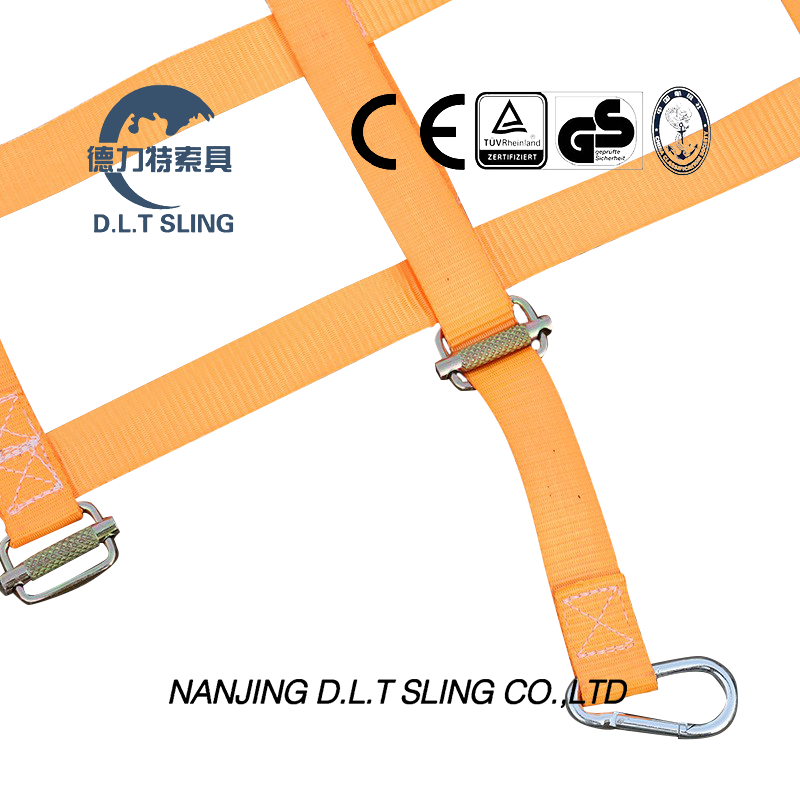
You cannot evaluate border strength by simply looking at the base material. You must rigorously examine how the manufacturer actually joins those materials together. Superior cargo net construction relies entirely on optimal stitching patterns, high-grade threads, and perfectly compatible hardware. These small details determine whether your equipment survives harsh conditions.
Stitching patterns directly dictate joint survival rates in the field. Standard straight stitches fail quickly under shifting industrial stress. When one small loop breaks, a basic straight stitch unzips completely. Manufacturers must feature Box-X or Diamond stitching at all vital webbing intersections. A Box-X pattern locks the heavy thread down in multiple intersecting directions. It strictly prevents catastrophic unzipping if a single thread snaps. This specific geometry distributes the pulling force evenly across the entire structural joint.
Thread quality matters just as much as the thick webbing itself. Cheap nylon thread absorbs rainwater quickly and rots from the inside out. You must demand bonded polyester or specialized Kevlar thread for industrial usage. Bonded polyester offers truly superior ultraviolet light resistance for outdoor fleets. It also actively fights off harsh chemical spills and road salts. Kevlar thread provides extreme heat resistance for specialized manufacturing environments. These specialized threads remain absolutely crucial for any outdoor material handling application.
Hardware compatibility often goes completely overlooked during the purchasing process. The thickness of your reinforced edging must match your standard industrial hardware perfectly. You likely use thick O-rings, D-rings, or heavy-duty snap hooks daily. If the border webbing is too thick, standard safety hooks will not close properly. This creates an immediate violation. If the border is too thin, rings slide excessively and cause rapid friction burns. The metal hardware should seat firmly against the reinforcement without causing fabric bunching. Uneven wear along the border quickly destroys the net's foundational integrity.
Industrial buyers face immense legal liability if a suspended heavy load falls. You absolutely cannot trust quick visual inspections alone. You must actively verify actual safety documentation before finalizing any major purchase. Compliance protects your workers and your bottom line equally.
First, you need to firmly understand Working Load Limit (WLL) versus Breaking Strength. Many cheap suppliers advertise a massive breaking strength to mislead unsuspecting buyers. The breaking strength marks the exact mathematical point of catastrophic product failure. The WLL indicates the maximum safe weight for normal, daily operation. The material handling industry requires a strict safety factor calculation. Overhead lifting applications typically demand a rigid 5:1 safety factor. If a net has a breaking strength of 10,000 pounds, the WLL sits at just 2,000 pounds. Ground transport nets usually utilize a 3:1 safety ratio instead.
Tagging and traceability are legally required across all industrial sectors. A fully compliant net must feature a legible, highly durable identification tag. This permanent tag must clearly detail the WLL, the specific material type, and the manufacturer date. Missing tags automatically equal failed inspections. Federal roadside inspectors will pull your transport equipment out of service immediately. You lose valuable transport time and money instantly when compliance fails.
Finally, you must actively investigate manufacturer testing methodologies. Reputable suppliers conduct rigorous, documented evaluations to validate their cargo lifting net safety performance claims. Advise your procurement team to ask suppliers for their specific testing data reports. Do they use dynamic drop tests? Do they rely solely on static pull tests? Static pull tests apply slow, consistent tension until the fabric rips. Dynamic drop tests simulate a sudden, violent load shift in mid-air. Real-world applications require both testing profiles to ensure true reliability. Verified testing guarantees the net performs safely under extreme, unexpected duress.
Moving from technical evaluation to actual procurement requires a highly structured approach. You need a reliable, step-by-step checklist to shortlist the best industrial suppliers. Hasty purchasing decisions usually result in poorly reinforced borders.
Assess your custom versus off-the-shelf needs carefully before requesting quotes. Standard dimensional sizes work incredibly well for uniform pallets or standard truck beds. However, unique heavy machinery demands a customized approach entirely. You should willingly pay a slight premium for custom edging when handling highly irregular loads. Custom configurations allow you to specify exact anchor point spacing. This specific spacing strictly prevents awkward tie-down angles and dangerous loose mesh sections.
When you finally speak with potential manufacturers, ask highly specific technical questions. Demand clear, evidence-based answers before issuing any formal purchase order.
"What is the exact ply-thickness of your primary reinforced borders?"
"Do you consistently provide official certificates of conformance for the stated WLL?"
"What specific testing standards do you follow inside your manufacturing facility?"
"What is your exact, written warranty policy against premature edge fraying and stitch failure?"
We highly recommend conducting pilot testing for large-scale operations. Never outfit an entire transport fleet or massive warehouse facility blindly. Order a single, representative unit first. Put it through a rigorous thirty-day field test with your toughest crew. Let your operators use it daily under normal rough conditions. Monitor the outer edges closely for early signs of fraying. Check the metal grommets for minor stretching or warping. Ensure the attached hardware fits your existing hooks perfectly without binding. A small, controlled pilot test prevents massive, costly procurement mistakes down the line.
Paying close, methodical attention to edging and reinforcement remains the most cost-effective way to ensure operational safety. Perimeter strength directly controls your securement equipment's overall longevity and daily reliability. To maximize your procurement investment safely, follow these final action steps:
Audit your existing fleet inventory immediately today. Pull any nets showing visible edge wear or frayed border stitching out of service immediately.
Calculate your maximum required Working Load Limit precisely based on your heaviest routine payload weight.
Document your specific fleet hardware constraints clearly. Ensure any new reinforced borders will fit your current hooks and rings flawlessly.
Contact a certified, reputable manufacturer to request a detailed custom quote based entirely on your precise load specifications.
Taking these proactive safety steps protects your crew constantly. It secures your valuable cargo perfectly and strictly eliminates unnecessary, premature replacement expenses.
A: The optimal material depends entirely on your specific industrial application. Heavy-duty polyester webbing works best for flatbed securing because it distributes tension evenly and resists UV degradation. Conversely, thick nylon or polypropylene rope borders excel in high-abrasion environments, like busy construction sites, where equipment frequently drags directly against rough concrete, sharp gravel, or exposed steel edges.
A: Strict industrial safety standards dictate exactly how we handle repairs. While professionals can sometimes patch minor mesh tears, compromised load-bearing borders usually require total replacement. Edge fraying clearly indicates structural weakness at the highest stress points. Patching these critical perimeters rarely restores the original Working Load Limit safely, leaving your operation exposed to severe safety liabilities.
A: You must first calculate the absolute maximum potential weight of your heaviest expected load. Then, ensure the net's officially rated Working Load Limit clearly exceeds that number. Always strictly remember the required safety factor. For overhead lifting applications, industry standards dictate a mandatory 5:1 ratio between breaking strength and WLL to ensure maximum operational safety.

