

close
Choose Your Site
Global
Social Media


In industrial rigging and material handling, the margin for error is zero. Improper sling application causes catastrophic load drops and severe safety incidents. Selecting the wrong lifting equipment or miscalculating hitch capacities leads to equipment damage, OSHA citations, and fatal accidents. Rigging professionals must balance load protection with strict adherence to mechanical tolerances. Field operators face daily challenges when securing irregular loads under tight deadlines. Relying on guesswork instead of verified load charts guarantees failure. This guide provides an evidence-based framework for deploying synthetic lifting equipment. It details hitch configurations, capacity calculations, and mandatory inspection protocols required for safe, compliant operations. You will learn how to properly specify equipment, calculate load angles, and prevent failures on the job site. By mastering these rigging principles, your crew ensures every lift meets strict engineering standards.
Capacity is Dynamic: A sling’s working load limit (WLL) changes drastically based on the hitch type and lifting angle; a basket hitch increases capacity, while a choker hitch reduces it.
Material Limitations: While highly flexible, synthetic fibers are highly susceptible to cuts and abrasion; mandatory edge protection is non-negotiable for sharp or abrasive loads.
Strict Compliance Standards: OSHA and ASME B30.9 standards dictate that any sling with a missing or illegible identification tag, or visible core yarn, must be immediately removed from service.
Configuration Dictates Stability: Proper load control requires calculating the center of gravity and maintaining sling angles above 60 degrees to prevent load shift and hardware stress.
A standard Polyester Round Sling consists of a continuous loop of load-bearing core yarns. A protective, non-load-bearing tubular jacket encloses these yarns. This dual-layer construction isolates the load-bearing fibers from direct surface contact. The internal core yarns handle the entire weight of the suspended load. The outer jacket simply acts as a shield against friction, dirt, and minor abrasions encountered during daily operations.
This design allows operators to rotate the sling before each lift. Shifting the contact points distributes wear evenly across the entire jacket. This rotation significantly extends the operational lifespan compared to fixed-eye alternatives. Synthetic fibers offer an exceptional weight-to-strength ratio. Riggers can easily maneuver high-capacity slings without the physical strain associated with heavy chain or wire rope. The continuous loop design also means there are no bulky splices or metal fittings permanently attached to the sling body, allowing it to slide easily under tight clearances.
Field crews often prefer these tools when handling finished or machined parts. The soft jacket prevents scratching or gouging the load surface. Unlike wire rope, synthetic fibers do not develop sharp broken wires that can injure riggers' hands. The flexibility of the core yarns allows the sling to flatten out slightly under tension, gripping the load securely without causing localized pressure damage.
Choosing between synthetic sling types requires analyzing the specific load profile. Web slings provide a flat, wide surface area. This wider contact distributes pressure effectively across fragile load surfaces. Round slings conform much tighter to irregular or cylindrical load shapes. When lifting a bundle of steel pipes, a round sling wraps around the contour, pulling the pipes tightly together. A flat web sling might bridge across the gaps, creating uneven tension.
Round slings deliver superior maneuverability. Their pliable nature makes them ideal for complex choker hitches. Web slings can sometimes fold or crease when forced into a tight choke, which damages the internal load-bearing fibers. We can analyze the performance differences across standard industrial environments to determine the best application for each tool.
Feature | Round Sling | Web Sling |
|---|---|---|
Load Conformity | Excellent on irregular shapes and bundles | Good on flat, wide surfaces |
Wear Distribution | Rotatable wear points extend lifespan | Fixed wear points at the eyes |
Choker Hitch Performance | Tight grip, highly flexible, no creasing | Can bind or crease at the eye under tension |
Surface Area Contact | Narrower footprint, higher localized pressure | Wider load distribution, lower localized pressure |
Storage and Handling | Coils easily, highly compact | Can be stiff, requires flat storage |
Cost-to-lifespan ratios depend heavily on the usage environment. In abrasive environments, both types require external protection. However, the ability to rotate a round sling means a single wear spot does not immediately ruin the tool. If a web sling develops a cut on its edge, you must retire it immediately. This rotational advantage often makes continuous loop designs more economical for high-volume rigging operations.
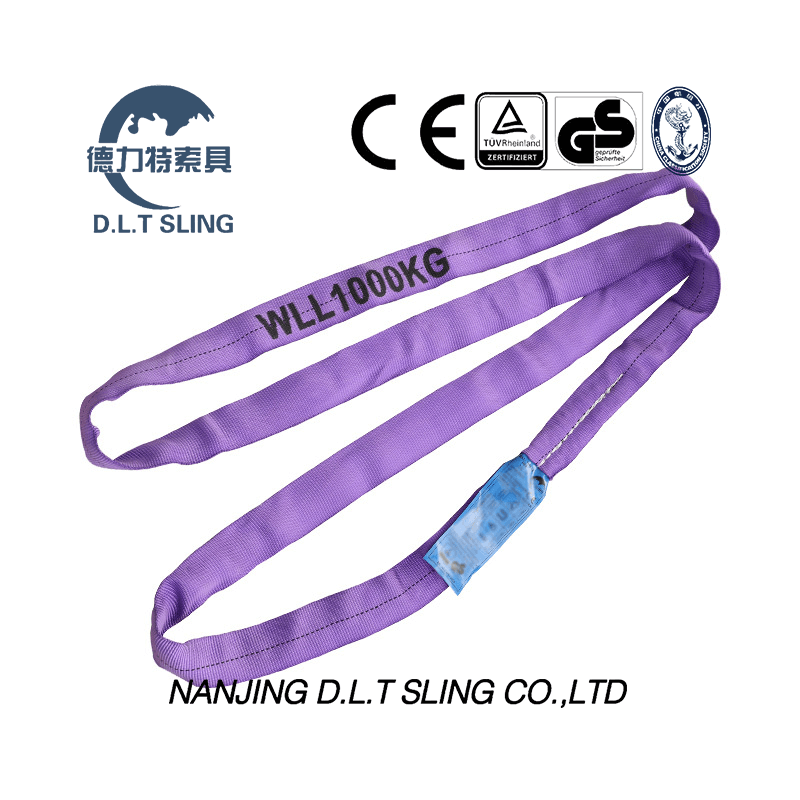
The lifting industry utilizes a universal color-coding system to identify Working Load Limits (WLL). This visual system helps riggers quickly select the appropriate equipment from the gang box. A purple jacket indicates a baseline 1 Ton Round Sling. Green indicates two tons, yellow indicates three tons, and capacities scale upward through gray, red, brown, and blue. This standardization prevents gross mismatching of equipment during fast-paced operations.
Color codes serve only as a quick reference. You must always verify the manufacturer's identification tag before executing a lift. Jacket colors can fade from UV exposure, dirt, or chemical washing. International standards occasionally cause color variations depending on the country of origin. The tag provides the only legally compliant capacity rating. If the tag is missing or unreadable, the color of the jacket means nothing, and you must remove the sling from service.
Jacket Color | Vertical Capacity (Lbs) | Choker Capacity (Lbs) | Basket Capacity (Lbs) |
|---|---|---|---|
Purple | 2,600 | 2,080 | 5,200 |
Green | 5,300 | 4,240 | 10,600 |
Yellow | 8,400 | 6,720 | 16,800 |
Tan/Gray | 10,600 | 8,480 | 21,200 |
Red | 13,200 | 10,560 | 26,400 |
Scaling up from a basic one-ton setup requires understanding how the physical dimensions change. Higher capacity slings have thicker jackets and significantly more core yarns. This increased bulk requires larger connecting hardware. You cannot force a high-capacity red sling into a small shackle designed for a purple sling. The resulting bunching will destroy the fibers under load.
Synthetic slings operate safely within specific temperature ranges. Standard operating temperatures span from -40°F to 194°F (-40°C to 90°C). Exceeding these thermal limits degrades the polyester fibers instantly. Rigging near furnaces, welding operations, or uninsulated steam pipes requires extreme caution. Even brief contact with a hot surface will melt the jacket and fuse the core yarns, destroying the structural integrity.
Chemical exposure presents a severe operational risk. Polyester resists most common acids effectively. However, it degrades rapidly when exposed to alkalis, strong bases, or active solvents. If your operation involves chemical baths, pickling tanks, or heavy solvent cleaning, you must verify material compatibility before rigging. Chemical damage is not always immediately visible. It can weaken the fibers internally, leading to a sudden failure below the rated capacity.
Prolonged UV exposure also breaks down synthetic materials. Leaving equipment outside in direct sunlight for months causes the jacket to become brittle and faded. You must store slings in dark, dry environments to prevent premature structural decay. A proper storage rack keeps the equipment off the ground, away from moisture, dirt, and accidental mechanical damage from forklifts.
A vertical hitch forms a straight line from the crane hook directly to the load attachment point. This straightforward configuration utilizes 100% of the equipment's rated capacity. You attach one end to the lifting hook and the other end to a rated lifting eye or shackle on the load. The tension distributes evenly across all the core yarns.
While strong, a single vertical hitch offers zero rotational control over the suspended load. The load can spin freely during transport, creating a hazard for riggers trying to guide it. Riggers typically use vertical hitches in pairs or multi-leg assemblies to maintain directional stability. When using multiple vertical legs, you must calculate the center of gravity to ensure each leg carries an equal share of the weight.
A choker hitch secures cylindrical or loose loads effectively. You pass one end of the sling through the other end, pulling it tight against the material. This creates a secure, self-tightening grip. As the crane lifts, the choke tightens, preventing loose materials like pipe or lumber from sliding out of the bundle.
This mechanical advantage comes with a strict trade-off. A standard choker hitch reduces the working load limit by approximately 20%. The angle of the choke dictates the exact capacity loss. Severe choke angles create extreme stress points, further derating the lifting capacity. When the angle of choke falls below 120 degrees, the capacity drops significantly. You must consult the manufacturer's derating chart when executing tight chokes.
Pass the sling around the load.
Thread one end through the opposite end.
Pull the standing part tight to set the choke.
Ensure the choke point sits on the sling body, not on a fitting or splice.
Verify the angle of choke exceeds 120 degrees for standard 80% capacity.
A basket hitch involves draping the equipment under the load in a U-shape. You then connect both ends directly to the lifting hook. A true vertical basket hitch doubles the baseline working load limit. The load weight distributes evenly between the two vertical legs. This hitch provides excellent stability for long loads when used in pairs.
Capacity decreases rapidly as the angle from the horizontal drops. You must maintain sling angles above 60 degrees. Shallow angles cause lateral slippage and create massive tension multiplier effects on the rigging hardware. At a 30-degree angle, the tension on each leg doubles compared to a vertical lift. This hidden tension frequently causes hardware failure even when the load weight seems within limits.
Sling Angle (Horizontal) | Tension Multiplier | Effective Capacity Loss |
|---|---|---|
90 Degrees | 1.000 | 0% |
60 Degrees | 1.155 | ~13% |
45 Degrees | 1.414 | ~30% |
30 Degrees | 2.000 | 50% |
You must never knot, twist, or splice synthetic lifting equipment together. Riggers sometimes attempt these prohibited methods to shorten a leg or adjust capacity. This violates all safety standards. If a sling is too long, you must select a shorter one or use a rated adjustable lifting beam. Twisting the sling to shorten it causes the core yarns to bind and cut into each other under tension.
Knotting causes severe mechanical degradation. A knot under tension reduces structural integrity by up to 50%. The fibers crush against each other, creating permanent internal damage that leads to sudden failure. Even after you untie the knot, the internal core yarns remain permanently deformed and weakened. Any sling found with a knot must be immediately removed from service and destroyed.
A "sharp edge" in rigging is any edge radius smaller than the sling's compressed thickness. Even seemingly dull steel beams can slice through synthetic fibers under high tension. When a Round Sling stretches under load, it drags slightly across the load surface. If that surface has an unprotected edge, it acts like a knife blade against the tensioned polyester.
Mandatory edge protection prevents catastrophic fiber failure. Use engineered solutions like magnetic corner protectors or rated synthetic sleeves. Never use non-compliant improvised padding like cardboard, rags, or scrap wood. Improvised materials fail instantly under industrial loads. Engineered protectors distribute the pressure over a wider radius, allowing the sling to slide safely without contacting the sharp corner.
Connecting hardware must match the physical dimensions of your lifting equipment. Use only rated alloy steel master links, hooks, and bow shackles. The hardware must provide a sufficient bearing surface. The bearing surface is the area where the sling contacts the metal fitting. If the fitting is too narrow, it pinches the synthetic material.
Insufficient bearing surfaces cause the "bunching" effect. The sling overlaps itself inside the fitting. Bunching causes uneven load distribution across the internal core yarns. The yarns on the outside of the bunch take all the tension, while the inner yarns remain slack. This overloads the active yarns, causing them to snap. Match the bow shackle width to the compressed width of the synthetic material to ensure flat, secure seating.
Measure the compressed width of the sling under tension.
Select a shackle or hook with a bearing surface wider than the compressed width.
Ensure the fitting has smooth, rounded edges with no burrs or gouges.
Seat the sling fully into the bowl of the shackle, never on the pin.
You must calculate the load's center of gravity before attaching any rigging. Position the crane hook directly above this center point. This prevents the load from swinging violently upon liftoff. A swinging load creates dynamic forces that multiply the stress on the rigging gear and the crane boom. If you miscalculate the center of gravity, the load will tilt, transferring the majority of the weight to a single sling leg.
Off-center lifting causes sudden load shifts and dynamic shock loading. In a multi-leg setup, uneven tension overloads individual legs. Establish strict safety limits to ensure weight remains evenly distributed across all active connection points. Use adjustable rigging blocks or chain falls in conjunction with synthetic slings to level unbalanced loads before hoisting them clear of the ground.
Rigging personnel must execute a mandatory visual inspection prior to every shift. This daily checklist prevents damaged equipment from entering the lifting zone. Lay the equipment flat in a well-lit area. Do not inspect slings while they are hanging in a dark storage container. You need clear visibility to spot minor abrasions or chemical stains.
Perform specific tactile and visual checks. Run your hands along the entire length of the jacket. Feel for internal lumps, hard spots, or broken core yarns. Inspect the cover for abrasive wear or chemical discoloration. A hard spot indicates that the internal fibers have melted or fused together due to heat or friction. If the jacket feels unusually thin in one area, the core yarns may be stretched or broken.
OSHA and ASME B30.9 standards dictate exact removal criteria. You must immediately retire equipment exhibiting specific damage markers. Do not attempt to repair damaged synthetic lifting gear. Once the structural integrity is compromised, the tool is garbage. Cut damaged slings in half before throwing them away to prevent someone else from pulling them out of the trash and using them.
Mandatory retirement conditions include:
Missing or illegible manufacturer identification tags.
Holes, tears, or snags in the cover exposing the internal core yarns.
Evidence of acid or caustic chemical burns.
Melting, charring, or weld splatter anywhere on the jacket.
Broken or worn stitching in the load-bearing splices.
Knots tied anywhere in the sling body.
Excessive abrasive wear that reduces the jacket thickness.
Audit all current rigging hardware to ensure bearing surfaces match your synthetic equipment dimensions.
Implement a mandatory, documented pre-lift inspection protocol for all rigging personnel.
Procure engineered edge protection devices for all loads with corners or abrasive surfaces.
Verify that all operators complete formal training on ASME B30.9 hitch derating and angle calculations.
A: Web slings are flat and provide a wider surface area for load stability. Round slings consist of continuous core yarns inside a tubular jacket, offering superior flexibility and the ability to rotate wear points.
A: In a true vertical basket hitch (legs at 90 degrees to the load), a 1-ton rated sling can theoretically lift 2 tons. However, as the angle of the legs decreases, the lifting capacity significantly reduces.
A: Synthetic fibers are highly vulnerable to cutting and abrasion under tension. Lifting a load with unprotected edges can instantly sever the core yarns, leading to a catastrophic dropped load.
A: No. Tying a knot in any synthetic sling drastically reduces its structural integrity and working load limit, violating OSHA and ASME safety standards.
A: Slings must undergo a visual inspection by the user before every single shift or lift. Additionally, a thorough, documented inspection by a designated competent person must occur at least annually.
A: The jacket color indicates the sling's standard Working Load Limit (WLL). For example, purple indicates 1 ton, green indicates 2 tons, and yellow indicates 3 tons. Operators must always verify capacity via the tag.
A: Rigging best practices dictate keeping sling angles (measured from the horizontal) above 60 degrees. Angles below 30 degrees are highly dangerous due to the massive increase in tension applied to the hardware.

