

close
Choose Your Site
Global
Social Media

Views: 0 Author: Site Editor Publish Time: 2026-08-12 Origin: Site


Improperly secured loads result in catastrophic transit failures, severe DOT penalties, and significant liability. Cargo securement requires a precise understanding of equipment capabilities and mechanical limits. Even premium securement hardware fails when operators misunderstand working load limits, use improper threading techniques, or select mismatched end fittings. This gap between purchasing equipment and deploying it safely creates hidden operational risks that compromise both the cargo and highway safety.
Establishing a systematic framework for evaluating, selecting, and correctly implementing securement devices ensures absolute load stability, regulatory compliance, and maximum equipment longevity. By mastering the mechanical principles behind tensioning devices, operators eliminate guesswork from cargo transport. We will detail the exact protocols for inspecting, threading, tensioning, and releasing these essential tools, providing a clear path to flawless load securement.
Working Load Limit (WLL) Dictates Deployment: Never base securement decisions on break strength; operational safety relies strictly on the WLL, which should be at least one-third of the break strength.
Hardware Matching is Critical: Selecting the correct end fitting—such as a Double J Hook Tie Down—is as important as the webbing itself for maintaining anchor point integrity.
Precision in Threading Prevents Failure: Inserting webbing through the mandrel slot correctly prevents mechanical jamming, slippage, and premature wear.
Proactive Risk Mitigation: Routine inspection for abrasions, UV degradation, and hardware deformation is mandatory before every deployment to maintain FMCSA/DOT compliance.
Understanding the anatomy of a securement system is the first step in preventing mechanical failure. The core components work together to create and maintain tension across the load. The ratchet handle provides the leverage necessary to apply force. The mandrel, or spool, collects the webbing and locks the tension in place. The release trigger disengages the locking pawl, allowing the mandrel to spin freely during unloading. The webbing acts as the flexible load-bearing element. Finally, the end fittings secure the entire assembly to the vehicle's anchor points.
A critical distinction exists between Working Load Limit (WLL) and break strength. Purchasing decisions and load calculations must be based exclusively on the WLL. Break strength represents the absolute maximum force a new, undamaged strap can withstand in a laboratory environment before failing. The WLL accounts for the dynamic forces experienced during transit, including hard braking, rapid acceleration, and sharp turning. Relying on break strength for operational planning guarantees equipment overload and inevitable failure.
Webbing material dictates the performance of the strap under environmental and mechanical stress. Polyester is the industry standard for rigid cargo securement due to its low stretch profile and high resistance to ultraviolet light and water absorption. Nylon, while strong, exhibits significantly higher stretch characteristics. This makes nylon generally unsuitable for securing heavy, rigid loads where maintaining constant tension is mandatory.
Material | Stretch Characteristics | Water/UV Resistance | Primary Application |
|---|---|---|---|
Polyester | Low (Minimal elongation under load) | High (Resists rot and sun damage) | Rigid cargo, flatbeds, heavy equipment |
Nylon | High (Stretches significantly) | Moderate (Absorbs water, degrades faster) | Recovery towing, dynamic load absorption |
When you evaluate a Ratchet Tie Down, you must inspect the gear teeth and the locking pawl. These metal components bear the entire force of the tensioned webbing. If the gear teeth are worn down or the pawl spring is weak, the mechanism can slip under load. Regular lubrication of the moving parts prevents rust buildup and ensures smooth operation during tensioning and release.
Defining the threshold for heavy-duty applications ensures that operators do not under-equip their vehicles. A Heavy-Duty Ratchet Strap typically features 2-inch to 4-inch webbing and a WLL exceeding 3,333 lbs. These straps are necessary for securing machinery, construction materials, and large palletized goods. Operators must weigh the trade-offs between the physical weight of the strap, its maneuverability in tight spaces, and the required tension force. Lighter utility straps are easier to handle but lack the structural integrity for highway-speed transport of dense materials.
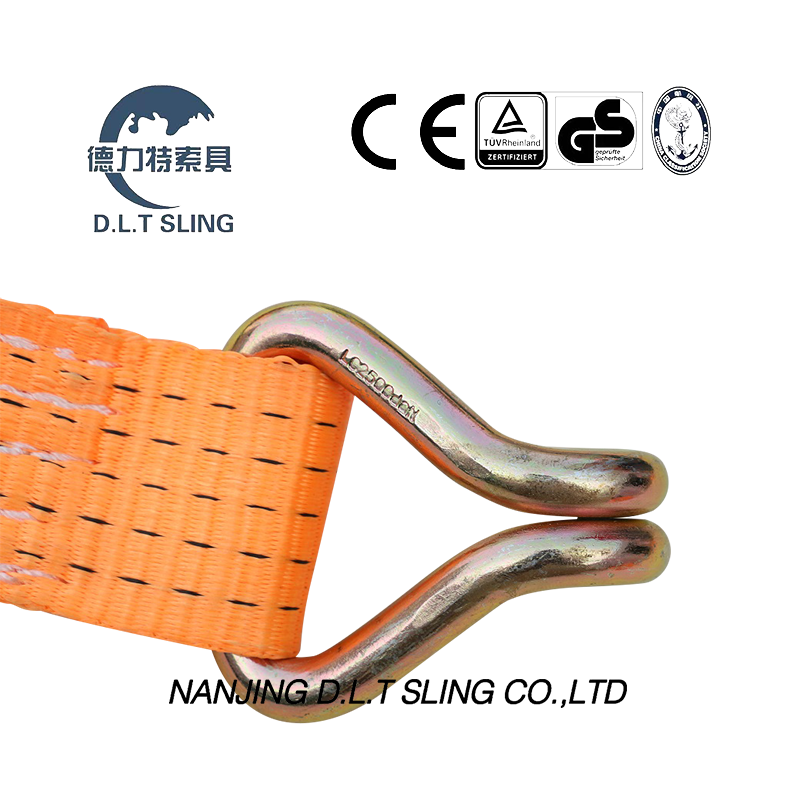
End fitting selection determines how effectively the strap connects to the vehicle. Evaluating a Double J Hook Tie Down against flat hooks, wire hooks, and S-hooks reveals distinct operational advantages. The Double J Hook provides superior engagement on D-rings and rub rails. Its design distributes the load across two points of contact. This significantly reduces the risk of twisting, bending, or accidental detachment under dynamic shifting loads compared to a standard S-hook.
Securing heavy or bulky loads on hand trucks and dollies requires specialized attention to localized transport dynamics. When hauling top-heavy appliances, industrial equipment, or bulky cargo on two-wheel material handling carts, standard utility straps often lack the necessary tensioning capability. Upgrading to heavier-duty options ensures the load remains pinned to the frame of the hand truck. This prevents lateral shifts that cause operators to lose balance and drop the cargo.
Standardizing strap lengths, WLLs, and hook types across a fleet simplifies inventory management and reduces operator error. When every truck is equipped with identical securement hardware, drivers do not have to guess the capacity of the strap they pull from the toolbox. Scalability relies on predictable equipment performance, making standardization a core component of risk management.
You must also consider the specific anchor points available on your transport vehicle. Flatbed trailers typically utilize rub rails and stake pockets, which pair well with flat hooks. Enclosed trailers often feature E-track systems, requiring specialized E-track fittings. Matching the end fitting to the anchor point is non-negotiable for maintaining the rated WLL of the entire securement assembly.
Mandatory pre-deployment inspection is the primary defense against transit failure. Before every use, operators must check the webbing for cuts, frayed edges, and melted fibers. The ratchet mechanism itself must be inspected to ensure it is free of rust, dirt, and debris that could prevent the locking pawl from fully engaging the gear teeth.
Anchor point verification is equally critical. Operators must select structural anchor points on the vehicle, trailer, or hand truck frame that meet or exceed the WLL of the strap. Attaching a high-capacity strap to a weak sheet metal rail guarantees failure. Ensure anchor points on hand trucks are rigid frame members rather than moving axles or handles.
Threading the mandrel requires an exact mechanical sequence to prevent jamming. Follow these steps for proper threading:
Open the ratchet handle to access the mandrel slot.
Feed the webbing through the slot from the bottom up.
Pull the slack through the slot until the webbing is completely taut against the cargo.
Leaving too much slack in the webbing before ratcheting will cause the spool to overfill and jam. Achieving optimal tension requires wrapping the webbing around the mandrel exactly 2 to 4 times. Fewer than two wraps risk slippage under load, as there is not enough friction to hold the webbing. More than four wraps will cause the webbing to bind against the frame, leading to mechanism failure and an inability to release the tension.
When securing heavy, upright loads on transport dollies, ensure the strap runs precisely across the load's center of gravity to prevent tipping during tight turns. Securing excess webbing is a mandatory final step. Tying off or securing the tail end of the strap prevents wind-whip damage. Webbing left to flap in the wind at highway speeds will rapidly degrade, fray, and create a dangerous road hazard for other drivers.
Sudden tension release presents a severe risk of load shift and operator injury. Before disengaging the mechanism, operators must physically check load stability. Cargo can settle or shift during transit. Releasing the tension might cause the load to instantly collapse off the side of the trailer or hand truck.
Disengaging the mechanism requires a specific sequence of actions to ensure safety and prevent equipment damage:
Pull and hold the release trigger located on the handle.
Open the handle fully flat to 180 degrees until it locks into the release position.
Pull the webbing free from the mandrel to release the cargo tension.
This action lifts the locking pawl out of the gear teeth and allows the mandrel to spin freely. If the mechanism is jammed due to over-spooling, you may need to apply significant force to the webbing while keeping the handle in the fully open position.
Unspooling and storage best practices dictate the lifespan of the equipment. Straps must be stored dry and away from direct sunlight. Neatly rolling the webbing prevents tangles and operational delays during the next use. Storing wet straps in a closed toolbox promotes mildew and degrades the polyester fibers rapidly.
Federal Motor Carrier Safety Administration (FMCSA) and DOT cargo securement rules dictate the minimum number of tie-downs based on cargo length and weight. The general rule requires one tie-down for every 10 feet of cargo, plus additional securement for loads exceeding specific weight thresholds. Compliance is not optional. Failure to meet these standards results in immediate out-of-service violations.
Excessive force applied during tensioning can damage fragile cargo, bend anchor points, or prematurely stress the mechanical components. Operators must apply enough tension to secure the load without crushing it or warping the trailer rails. Using cheater bars on the handle to gain more leverage is strictly prohibited and indicates the wrong equipment is being used for the job.
Edge protection is a strict requirement when webbing passes over sharp or abrasive cargo edges. Using corner protectors or edge guards prevents catastrophic mid-transit severing. A sharp edge on a steel beam can slice through a tensioned strap in a matter of miles due to road vibration.
Clear, objective criteria determine when to permanently remove a strap from service. Straps must be retired immediately if they have missing WLL tags, cuts exceeding a specific percentage of the width, or deformed hardware. A bent hook or a cracked handle compromises the entire system and cannot be repaired.
Defect Type | Rejection Criteria | Action Required |
|---|---|---|
Missing/Illegible Tag | WLL cannot be verified | Remove from service immediately |
Webbing Cuts/Tears | Exceeds DOT allowable limits | Destroy and discard webbing |
Hardware Deformation | Bent hooks, cracked ratchets | Replace entire assembly |
Successful cargo securement requires a combination of high-quality hardware, strict adherence to WLL ratings, and precise mechanical execution. Operators cannot rely on guesswork when public safety and cargo integrity are on the line. Proper threading, tensioning, and inspection protocols form the foundation of a safe transport operation. Procurement teams and operators must audit their current loads and match the WLL and end fittings to their specific anchor points. Investing in heavy-duty options where dynamic forces dictate ensures that the equipment will not fail under stress.
Conduct a comprehensive audit of your current securement inventory to identify damaged or non-compliant equipment.
Discard any frayed straps, bent hooks, or assemblies with missing WLL tags immediately.
Standardize your procurement specifications to ensure all operators use uniform, high-capacity hardware.
Implement mandatory pre-trip inspection checklists for all cargo securement devices.
A: You must wrap the webbing around the mandrel 2 to 4 times. This ensures enough friction to grip the strap securely without overfilling the spool, which causes mechanical jamming and prevents release.
A: Break strength is the maximum force a new strap can withstand before failing in a lab. WLL is the maximum safe operational weight for daily use, typically calculated as one-third of the break strength to account for dynamic transit forces.
A: Jams are usually caused by over-spooling the mandrel with too much webbing or rust in the mechanism. To release it, pull the release trigger, open the handle completely flat to 180 degrees, and pull the webbing forcefully.
A: Use a Double J Hook when securing loads to D-rings or specific wire-style trailer rails. They provide two points of contact, reducing twisting, whereas flat hooks are designed specifically for flatbed rub rails.
A: Yes, but you must match the application properly. For heavy appliances, a heavy-duty strap prevents lateral shifting. However, specialized integrated hand truck straps are often safer and easier to deploy for localized transport.
A: Replacement is based entirely on the physical condition of the strap and the presence of legible WLL tags, not a strict chronological timeline. Replace them immediately if you find cuts, burns, or deformed hardware.
A: No. Tying a knot in the webbing reduces the strap's overall strength by up to 50% and is a direct violation of DOT cargo securement regulations. Damaged straps must be permanently removed from service.

