

close
Choose Your Site
Global
Social Media

Views: 0 Author: Site Editor Publish Time: 2026-08-04 Origin: Site


Selecting the incorrect sling type compromises load integrity, site safety, and regulatory compliance on any job site. Lifting loads with irregular geometries, delicate finishes, or cylindrical shapes presents specific challenges where traditional wire rope, chain, or flat web slings risk load damage or inadequate grip. The continuous-loop synthetic Round Sling serves as the engineered solution for these specific lifting scenarios. Its unique construction distributes wear and conforms to complex load profiles, ensuring secure material handling. When riggers face a polished turbine shaft or a bundle of structural steel, rigid rigging gear often fails to provide the necessary surface contact. Synthetic continuous loops solve this by flattening against the load, spreading the lifting force over a wider area. This prevents point-loading and surface gouging while maintaining absolute control over the suspended load.
Optimal Use Cases: Round slings are the industry standard for lifting irregular, cylindrical, or fragile loads requiring tight choker hitches without surface damage.
Material Dominance: The polyester round sling is the most common variant, offering minimal stretch (approx. 3%) and high resistance to acidic environments compared to nylon.
Wear Distribution: The endless loop design allows users to rotate the bearing point with each use, significantly extending the operational lifespan compared to fixed-eye slings.
Ergonomic Efficiency: Synthetic round slings offer an exceptional strength-to-weight ratio, reducing rigger fatigue and handling hazards compared to heavy wire rope or chain.
Safety Imperative: Despite their high capacity, synthetic slings are highly vulnerable to cutting; mandatory edge protection and strict adherence to ASME B30.9 inspection standards are required.
Understanding the internal structure of a synthetic sling dictates how you use it in the field. The equipment features a dual-component design consisting of load-bearing internal yarns, known as the core, enclosed in a non-load-bearing woven tubular jacket. The internal core yarns provide the actual lifting strength. These yarns are wound continuously in a loop. The outer jacket protects these critical fibers from abrasion, dirt, and ultraviolet degradation. This separation of load-bearing and protective elements allows the sling to maintain structural integrity even if the outer cover sustains minor surface scuffing from rough steel or concrete.
When comparing materials, the Polyester Round Sling demonstrates distinct mechanical advantages over nylon alternatives. Polyester exhibits exceptionally low elongation under load, typically stretching only about 3% at its rated capacity. This minimal stretch provides superior control during precision lifts, preventing the load from bouncing or shifting unexpectedly when the crane takes the weight. Furthermore, polyester offers high tolerance to acidic environmental conditions, whereas nylon is better suited for alkaline environments. Riggers must verify the chemical exposure risks on site before selecting the core material.
Material Comparison: Polyester vs. Nylon | ||
Characteristic | Polyester | Nylon |
|---|---|---|
Stretch at Rated Capacity | Approx. 3% | Approx. 8-10% |
Acid Resistance | Excellent | Poor |
Alkali Resistance | Poor | Excellent |
Water Absorption | Low (retains strength) | High (loses some strength when wet) |
The endless loop configuration fundamentally changes how wear accumulates on the equipment. Because the design is continuous, riggers can rotate the sling with every lift. This rotation prevents localized wear at the crane hook or the load contact points, distributing friction evenly across the entire length of the jacket. Fixed-eye slings force the user to load the exact same bearing points repeatedly, leading to premature retirement. The continuous loop design directly extends the operational lifespan of the rigging gear.
Material weight significantly impacts handling ergonomics on the job site. Synthetic fibers provide an exceptional strength-to-weight ratio. Deploying a high-capacity synthetic sling requires far less physical exertion than maneuvering an equivalent-capacity wire rope or alloy chain sling. This reduction in weight minimizes rigger fatigue, decreases the likelihood of musculoskeletal injuries, and accelerates the setup and teardown phases of complex lifting operations. A single rigger can easily carry a synthetic loop rated for 20,000 pounds over their shoulder, whereas an equivalent chain would require a forklift just to move it across the yard.
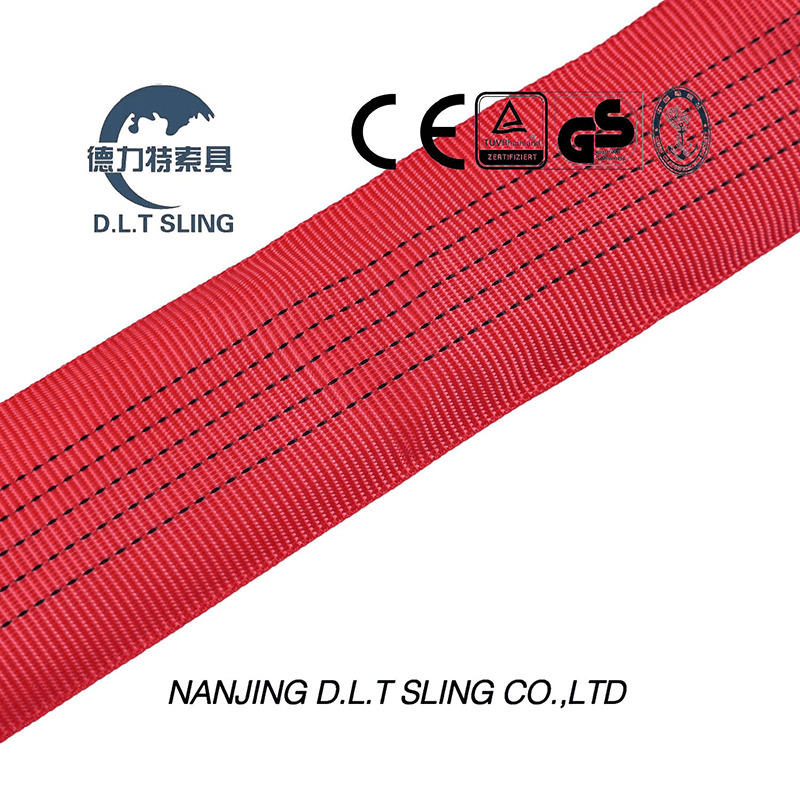
The primary advantage of this rigging equipment lies in its ability to conform to irregular and cylindrical geometries. When tension is applied, the tubular jacket flattens out, allowing the internal yarns to spread and grip around non-uniform shapes. This mechanical action creates a wide bearing surface against pipes, machined parts, and structural steel. Traditional wire ropes tend to point-load on irregular surfaces, which can cause the load to slip or induce crushing forces on the material being lifted. The flattening effect also increases the friction coefficient between the sling and the load, providing a much more secure grip on smooth surfaces like PVC piping or milled steel shafts.
Protecting delicate and finished surfaces is another critical application. The soft, non-marring nature of the synthetic jacket makes it the specified choice for lifting painted equipment, polished metal shafts, or easily crushed composite loads. Chain slings and wire ropes easily scratch, gouge, or dent finished products, leading to costly rework or rejected materials. The pliable synthetic cover acts as a buffer, distributing the lifting force without compromising the surface integrity of the payload. For example, when lifting a freshly painted generator housing, a synthetic loop ensures the coating remains intact from the factory floor to the installation pad.
Executing choker hitches at tight lifting angles requires equipment that can bend sharply without sustaining internal damage. The inherent flexibility of the continuous loop allows for a highly secure, 360-degree grip in a choker hitch. Stiff wire ropes resist bending and often fail to choke down tightly against the load, while wide web slings can bunch up and experience uneven tension across their width. The tubular design naturally adapts to shallow, tight lifting angles, ensuring even tension distribution across all internal core yarns.
Pass the sling around the load to be lifted.
Thread one end of the loop through the other end to create the choke.
Pull the free end tight to ensure the jacket flattens evenly against the load surface.
Adjust the choke point so it sits naturally without twisting the internal yarns.
Apply slow tension with the crane to set the hitch before executing the full lift.
The interface between synthetic fibers and steel rigging hardware demands careful evaluation. Synthetic slings behave differently than steel slings when paired with hooks, shackles, and master links. Because the sling flattens under load, the connection point must provide adequate width and a smooth bearing surface to prevent the internal yarns from bunching, crossing, or experiencing uneven tension. If the hardware is too narrow, the outer yarns take the brunt of the load while the inner yarns remain slack, severely reducing the actual breaking strength of the assembly.
Shackle selection directly impacts safety and wear. Bow-Type shackles are highly recommended because their wide, rounded bell accommodates the flattened body of the sling. Conversely, narrow Pin-Type or D-shackles force the synthetic material into a restricted space. This restriction creates a severe risk of "pin pinch," a condition where the sling is crushed or bunched against the shackle threads or the sharp shoulders of the pin. Pin pinch concentrates the entire load onto a fraction of the core yarns.
Proper configuration is required when seating slings in the bowl of a crane hook or within a dedicated master link assembly. Overcrowding the hook with multiple slings causes the synthetic jackets to ride up onto the hook's latch or sit on the sharp edges of the hook profile. Riggers must use intermediate hardware, such as a master link, to consolidate multiple sling legs cleanly before connecting to the crane hook. When using a master link, ensure the internal diameter of the link is large enough to allow the synthetic material to spread out naturally under tension.
The D/d ratio dictates the safe bend radius limits for the equipment. This metric represents the ratio of the diameter of the curvature of the rigging hardware (D) to the nominal diameter of the sling (d). Ignoring minimum hardware diameters forces the internal yarns to bend too sharply around a narrow pin or hook. This sharp bend causes the outer yarns to stretch excessively while the inner yarns compress, leading to internal yarn failure well below the rated capacity. Always consult the manufacturer's specifications for the minimum allowable hardware diameter for the specific tonnage you are lifting.
Industrial applications require different internal configurations based on the load weight and the operational risk profile. Single-path designs consist of one continuous core of load-bearing yarns encased in a single jacket. These are standard for general industrial lifts, providing reliable performance for daily material handling tasks. However, for extreme capacities, a Heavy Lifting Round Sling often utilizes a multi-path design.
Multi-path configurations feature separate, redundant load-bearing cores housed within the outer jacket. This engineered redundancy provides a critical safety margin during complex, high-tonnage lifts. If one internal path fails due to localized damage or overload, the remaining intact paths retain enough residual strength to prevent an immediate catastrophic drop. This allows the rigging crew to safely abort the lift and lower the load to the ground. Many multi-path designs also incorporate fiber optic tell-tails or overload indicator yarns that protrude from the jacket. If the sling is overloaded, these indicator yarns snap and retract inside the cover, providing a clear visual warning that the equipment has been compromised.
Load capacity is visually communicated through an industry-standard color-coding system. Standard colors include Purple, Green, Yellow, and Tan, each corresponding to a specific tonnage range. This system allows riggers and safety inspectors to quickly identify the general capacity of the equipment from a distance. However, color codes are strictly a visual aid. The manufacturer's identification tag attached to the sling is the only legal verification of the Working Load Limit (WLL). If the tag is missing or illegible, the equipment must be removed from service immediately, regardless of its color.
Standard Color Coding for Synthetic Round Slings | ||
Color Code | Approx. Vertical WLL (lbs) | Typical Application |
|---|---|---|
Purple | 2,600 | Light machinery, small pipe bundles |
Green | 5,300 | Standard construction materials, motors |
Yellow | 8,400 | Heavy structural steel, mid-sized equipment |
Tan | 10,600 | Large concrete forms, heavy industrial components |
Red | 13,200 | Heavy machinery, large diameter pipes |
Selecting between tubular and flat synthetic rigging depends on flexibility and load conformity requirements. The tubular, pliable nature of the continuous loop conforms exceptionally well to tight angles and irregular shapes. Flat web slings possess a rigid, rectangular profile that does not easily adapt to complex geometries. When choked around a cylindrical load, a flat web sling may fold over on itself, causing uneven stress distribution across its width. The tubular design avoids this folding entirely, maintaining a consistent grip regardless of the load's contour.
Wear and tear dynamics differ significantly between the two designs. Web slings expose their load-bearing fibers directly to the load and the rigging hardware. Any surface abrasion, cut, or friction directly degrades the lifting capacity of a web sling. In contrast, the continuous loop design protects its core load-bearing fibers inside a sacrificial jacket. Surface scuffs on the jacket do not immediately compromise the internal yarns, providing a buffer against daily industrial wear. You can drag a tubular jacket across rough concrete, and while the cover may fray, the core yarns often remain untouched.
Procurement decisions must weigh the initial cost against the expected operational lifespan of the equipment. While flat web slings may present a lower initial purchase price, the rotatable nature of the continuous loop often yields a much longer operational lifespan in high-frequency lifting environments. Because the wear points can be shifted with every lift, the equipment degrades at a slower rate, reducing replacement frequency and downtime. Rigging superintendents often find that investing in tubular designs reduces their annual rigging replacement budget simply because the gear survives longer in harsh field conditions.
The primary failure mode for synthetic rigging is cutting under tension. The critical need for edge protection cannot be overstated. Synthetic fibers offer zero resistance to sharp edges when loaded. Round slings must never be used on sharp, abrasive, or unprotected edges without engineered cut-resistant sleeves or heavy-duty corner pads. A "sharp edge" is defined not just as a razor edge, but any edge with a radius smaller than the required specification for the sling being used. Even the seemingly dull edge of an I-beam can slice through a fully loaded synthetic jacket in seconds.
Environmental limitations dictate where and how the equipment can be deployed. Standard polyester materials have a maximum temperature threshold of 194°F (90°C). Exposure to heat sources above this limit causes the fibers to melt, fuse, or lose tensile strength. Additionally, prolonged UV exposure degrades synthetic fibers over time, causing them to become brittle. Riggers must also verify chemical incompatibilities, as certain solvents, bleaches, or concentrated acids will rapidly destroy the load-bearing yarns. Always store synthetic gear in a cool, dry, dark rigging locker when not in use.
Strict adherence to OSHA and ASME B30.9 inspection criteria is mandatory. Riggers must perform a pre-use inspection before every lift. The inspector must look for specific damage indicators that compromise the structural integrity of the gear.
Verify the presence and legibility of the manufacturer's tag, ensuring the WLL is clearly stated.
Inspect the entire length of the jacket for holes, tears, or snags that expose the internal core yarns.
Check for any evidence of acid or caustic burns, which appear as discolored or brittle patches.
Look for melting, charring, or weld spatter on the cover.
Feel along the length of the sling for hard spots or brittle areas that indicate internal heat damage or chemical degradation.
Examine the stitching on the cover for broken or worn threads.
If the core yarns are visible through the jacket, the sling is dead. There is no repair process for a compromised core. The equipment must be cut in half to prevent accidental reuse and thrown in the dumpster.
To ensure safe implementation, consult the manufacturer's specific load charts for angle reductions. Audit your current lifting applications to identify potential edge hazards and procure appropriate cut-resistant protection. For extreme tonnage or highly critical lifts, contact a certified rigging specialist to design custom multi-path sling configurations.
A: A web sling features a flat, woven construction where the load-bearing fibers are exposed directly to the load. A round sling utilizes a tubular jacket that encloses and protects the internal load-bearing core yarns. The tubular design offers greater flexibility and conforms better to irregular shapes.
A: Yes, they are highly effective in choker hitches because their pliable nature allows them to grip the load tightly. However, using a choker hitch significantly reduces the Working Load Limit compared to a vertical hitch. Always consult the manufacturer's tag for the choked capacity.
A: Retire the equipment immediately if the manufacturer's tag is missing or illegible. Other critical rejection criteria include holes or tears in the jacket that expose the core yarns, chemical burns, melting, charring, or broken stitching in the cover.
A: Bow-Type shackles are the preferred hardware. The wide, rounded bell of a Bow-Type shackle accommodates the flattened width of the synthetic material under load, preventing the bunching and pinching that occurs when using narrow Pin-Type shackles.
A: The D/d ratio is the diameter of the rigging hardware (D) divided by the nominal diameter of the sling (d). Maintaining a proper bend radius prevents the internal yarns from bending too sharply, which can cause uneven tension and premature fiber failure.
A: Yes, they are engineered for extreme capacities. Multi-path designs offer redundant load-bearing cores for added safety during heavy lifts. However, they are highly susceptible to cutting and must always be used with engineered edge protection.
A: The colors represent an industry-standard coding system used to quickly identify the general capacity of the equipment. While helpful for quick visual identification, the manufacturer's tag is the only legal verification of the Working Load Limit.

