

close
Choose Your Site
Global
Social Media

Views: 0 Author: Site Editor Publish Time: 2026-08-05 Origin: Site


Miscalculating rigging equipment dimensions leads to severe operational consequences on any job site. Load imbalances, structural rigging failures, and dropped loads often trace back to a single sizing error made before the lift even begins. A widespread industry problem is the confusion between measuring a synthetic sling's circumference versus its actual working length. This fundamental misunderstanding routinely leads to critical procurement errors, expensive project delays, and highly compromised lift plans that put personnel at risk.
Rigging professionals require a standardized, evidence-based framework for measuring, specifying, and verifying every piece of lifting equipment. Implementing strict measurement protocols ensures compliance with ASME B30.9 and OSHA standards. By mastering these techniques, you guarantee precise lift geometry, maintain equipment integrity, and protect your crew during complex overhead lifts. Accurate measurement is not just a purchasing requirement; it is the foundation of safe rigging geometry.
Effective Working Length (EWL) is the Standard: A round sling is always measured from bearing point to bearing point (tip-to-tip when laid flat), never by its total circumference.
Circumference Causes Sizing Errors: Ordering an endless round sling based on circumference will result in receiving a sling that is exactly half the required length.
Hitch Types Dictate Length Requirements: The required round sling length changes drastically depending on whether the application uses a vertical, choker, or basket hitch.
Manufacturing Tolerances Exist: ASME standards allow for slight length variances during manufacturing; understanding these tolerances prevents false non-compliance rejections.
Verification is a Compliance Requirement: Routine measurement verification against the manufacturer’s identification tag is mandatory for safe rigging operations and equipment lifecycle management.
Effective Working Length (EWL) is the definitive measurement standard for synthetic slings. You define EWL as the linear distance between the two pull-to-pull bearing points when the sling is under tension or laid completely flat. This measurement dictates the actual reach of the sling during a vertical lift. Relying on any other metric introduces dangerous variables into your rigging geometry. When you plan a lift, the distance from the crane hook to the load attachment point relies entirely on this specific measurement.
To understand why EWL matters, you must examine the anatomy of an Endless Round Sling. These tools consist of a continuous loop of load-bearing, high-tenacity polyester core yarns. An outer protective jacket surrounds these core yarns. Manufacturers use single or double-wall covers to protect the internal fibers from abrasion, dirt, and UV degradation. Because this jacket fits loosely over the core yarns, it often bunches up or shifts during handling. This loose fit confuses physical measurement attempts if you do not pull the sling taut first. The jacket itself bears no load; it simply protects the internal yarns that do the actual lifting.
The circumference fallacy remains the most common error in rigging procurement. Mathematically, the circumference of a continuous loop is exactly double its EWL. If a lift planner specifies a 20-foot circumference instead of a 20-foot EWL, the supplier will deliver a sling with a 10-foot reach. This procurement failure renders the sling entirely useless for the planned lift, forcing crews to halt operations while waiting for replacement equipment. In the field, this mistake happens frequently when workers use a tape measure to wrap around the entire loop rather than measuring end-to-end.
Consider a scenario where a crew needs to lift a large generator. The lift plan calls for four slings, each with a 12-foot reach to maintain a 60-degree horizontal sling angle. If the purchasing department orders slings with a 12-foot circumference, the riggers will receive slings with a 6-foot EWL. When they attempt to rig the generator, the slings will be too short. If they force the connection, the horizontal sling angle will drop significantly, multiplying the tension on each sling and potentially exceeding their rated capacity. This demonstrates why understanding the difference between EWL and circumference is a critical safety requirement.
Furthermore, the internal construction of these slings means that the load-bearing yarns must share the weight equally. When you measure by EWL, you are measuring the functional length of those yarns when they are aligned and tensioned. The outer jacket's length is irrelevant to the sling's lifting capability. Riggers must train their eyes to ignore the bunching of the jacket and focus entirely on the bearing points where the sling contacts the hardware.
Industry standards, including ASME B30.9, explicitly define sling length as the distance between bearing points. Manufacturers build, test, and tag their products based on this definition. When a tag states a length of 10 feet, it means the sling has a 10-foot EWL. Any deviation from this understanding creates a disconnect between the manufacturer's specifications and the rigger's application, leading to inevitable failures on the job site.
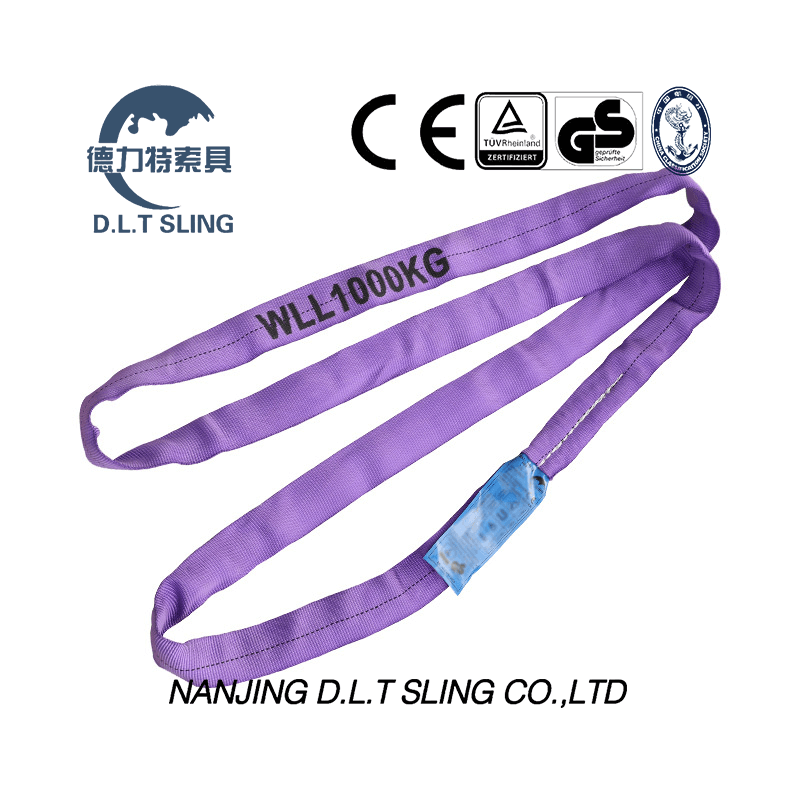
Accurate measurement requires proper preparation and a controlled environment. Always clear a flat, clean surface before measuring your equipment. This prevents the protective jacket from snagging on debris, absorbing dirt, or suffering chemical contamination from shop floors. Conduct a strict pre-measurement visual inspection. Check for jacket tears, exposed core yarns, heat damage, weld splatter, and illegible identification tags. If the tag is missing or unreadable, remove the sling from service immediately. You cannot verify a measurement against a missing tag.
The "tip-to-tip" flat measurement method is the industry standard for verifying Round Sling Length in the field. Follow these exact steps to achieve an accurate reading:
Lay the sling completely flat on the prepared ground surface, ensuring no twists exist in the body.
Pull the sling taut from both ends to remove any slack in the outer jacket. Ensure the internal load-bearing yarns are perfectly straight and aligned.
Measure the linear distance from the extreme outer edge of one end (the tip) directly to the extreme outer edge of the opposite end using a calibrated measuring tape.
Record the measurement and compare it directly to the length stated on the manufacturer's identification tag.
You can also measure the sling under tension between two hardware connection points, such as a crane hook and a shackle. When using this method, measure from bearing point to bearing point. You must account for the diameter of the connecting hardware. Subtract the hardware dimensions from your total measurement to isolate the sling's actual EWL. This method is often preferred for used slings, as applying a light load helps straighten internal yarns that may have taken a set during previous lifts.
Riggers must also navigate standard manufacturing tolerances. Synthetic materials naturally settle and shift during the manufacturing process. ASME B30.9 standards allow for slight length variances. These tolerances typically range from ± 1% to 2% of the nominal length, or a set number of inches for shorter slings. When you verify a brand-new sling, check if the measured length falls within these acceptable parameters before rejecting it for non-compliance.
For example, a new 20-foot sling might measure 20 feet and 2 inches. This falls within a standard 1% tolerance and is perfectly acceptable for use. However, if you are performing a multi-leg lift where precise load leveling is required, you must match slings that have the exact same measured length, regardless of the allowable manufacturing tolerance. Always measure slings in pairs or sets if they will be used together in a single rigging arrangement.
Environmental factors can also affect physical measurements. High humidity or exposure to water can cause the protective jacket to shrink slightly, making the sling appear shorter when laid flat. Conversely, heavy use can cause the internal yarns to stretch. This is why measuring under a light load often provides the most accurate representation of the sling's true EWL during a lift. Always document your measurement methods and results in your equipment inspection logs.
Different rigging configurations demand specific length calculations. The hitch type you select drastically alters how the sling interacts with the load and the overhead lifting device. You must calculate the required length based on the exact geometry of your planned hitch. A sling that works perfectly in a vertical hitch may be far too short for a basket hitch on the same load.
Hitch Type | Length Calculation Impact | Rigging Considerations |
|---|---|---|
Vertical Hitch | Direct 1:1 correlation with EWL. | Provides the full rated reach of the sling from hook to load attachment point. |
Choker Hitch | Reduces effective reach significantly. | Must account for the choke angle and the sling wrapping back on itself around the load diameter. |
Basket Hitch | Distributes EWL across two legs. | Factor in load diameter, contact angles, and the vertical distance from the hook to the load. |
Multi-Leg Bridle | Requires precise matching of EWL. | Sling length determines the horizontal sling angle, which directly affects the tension on each leg. |
You must also account for sling stretch and material properties during critical lifts. Standard polyester slings stretch approximately 3% to 5% at their rated capacity. If you face tight headroom constraints, this stretch can cause the load to bottom out or strike surrounding infrastructure. In low-clearance scenarios, consider high-performance fibers like HMPE or Aramid, which offer significantly lower stretch percentages (typically under 1%).
When calculating for a choker hitch, remember that the sling must wrap around the load and pass through itself. This consumes a significant portion of the EWL. If you need a 10-foot reach from the crane hook to the top of the load, and the load is 3 feet in diameter, a 10-foot sling will not work. You must add the circumference of the load (or the portion being wrapped) to your required reach to determine the correct EWL to order.
Protective sleeves and wear pads require careful sizing. Specify the length of sliding sleeves to adequately cover all critical contact points and sharp edges on the load. Ensure these sleeves do not restrict the sling's natural movement. Improperly sized fixed protection can distort the measured EWL and create uneven tension across the core yarns during rigging configurations. If a sleeve is sewn too tightly, it prevents the internal yarns from adjusting to the load, leading to premature failure.
Always consider the hardware compatibility when specifying sling length. The bearing points of the sling must fit properly within the bowl of the shackle or the saddle of the crane hook. If the hardware is too small, it will bunch the sling, reducing its capacity and altering its effective length. If the hardware is too large, it can flatten the sling excessively. The length of the sling must accommodate the required hardware without compromising the integrity of the connection points.
Failing to measure slings accurately alters your entire rigging geometry. A sling that is too short increases the horizontal tension factor. This drastically multiplies the load forces applied to both the sling and the attached rigging hardware. Exceeding the rated capacity due to severe sling angles frequently leads to catastrophic structural failures. Riggers must understand that a shorter sling does not just change the reach; it changes the physics of the entire lift.
Mismatched sling lengths create severe load imbalance and Center of Gravity (CoG) issues. In multi-leg lifts, using slings of unequal EWL forces the shorter leg to bear a disproportionate amount of the total weight. This unequal load distribution causes sudden center-of-gravity shifts. The load may tilt, slip, or shock-load the remaining rigging components, endangering everyone on the job site. Even a difference of a few inches between two slings in a bridle configuration can overload one leg beyond its breaking strength.
Measurement failures also lead to compliance and tagging violations. OSHA 1910.184 and ASME B30.9 strictly mandate accurate sling identification tags. If a physical measurement no longer matches the stated length on the manufacturer’s tag, you face a critical safety issue. Unexplained elongation often indicates severe stretch, heat exposure, or internal structural damage. You must remove these slings from service immediately for professional inspection and destruction.
Consider the impact of a dropped load due to a measurement error. The immediate danger to personnel is the primary concern, but the secondary effects are also devastating. Damaged loads, destroyed surrounding equipment, and extended project downtime cost companies heavily. Regulatory investigations following an incident will immediately focus on the rigging equipment and the lift plan. If investigators find that a Round Sling was improperly measured or specified, the liability falls squarely on the site management.
Furthermore, using slings that have stretched beyond their allowable limits compromises the safety factor built into the equipment. Manufacturers design slings with a 5:1 design factor, meaning the breaking strength is five times the rated capacity. However, if a sling has stretched significantly, the internal yarns have likely suffered microscopic damage, reducing that safety factor. Regular measurement verification is the only way to detect this hidden damage before it results in a failure.
Field modifications to compensate for incorrect lengths are strictly prohibited. Riggers must never tie knots in a synthetic sling to shorten it, nor should they twist the sling to reduce its reach. These actions destroy the alignment of the core yarns and drastically reduce the sling's capacity. If a sling is the wrong length, the only safe action is to procure the correct equipment for the job.
Standardizing your measurement protocols eliminates costly procurement errors. Establish internal Standard Operating Procedures (SOPs) for your rigging teams. Require all personnel to request replacement slings using standardized EWL terminology. Ban the use of circumference measurements on all purchase orders, lift plans, and inventory logs. Clear communication between the field, the purchasing department, and the supplier is essential for acquiring the right equipment.
Translate your specific lift requirements clearly into manufacturer specifications. Use a strict checklist when ordering new equipment. Specify the exact EWL required. Detail the necessary vertical, choker, and basket capacities, noting the standardized color-coding requirements. Choose the appropriate jacket construction, opting for double-wall covers in abrasive environments. Always communicate environmental considerations, such as high heat, chemical exposure, or prolonged UV risk, as these factors dictate the material required.
Evaluate supplier competence rigorously before purchasing. Partner with manufacturers who utilize both digital and manual yarn counting. This dual-verification process guarantees the internal capacity matches the specified length perfectly. Confirm that your chosen manufacturer strictly complies with ASME B30.9 testing, manufacturing tolerances, and labeling standards. Request proof of proof-testing for critical lift equipment.
When receiving new equipment, implement a strict intake inspection process. Do not simply place new slings into the rigging gangbox. Have a qualified person measure the EWL of every new sling to verify it matches the purchase order and the identification tag. Check the manufacturing tolerances. If a sling falls outside the acceptable variance, return it to the supplier immediately. This intake process prevents incorrect equipment from ever reaching the job site.
Maintain detailed records of all rigging equipment. Track the date of purchase, the specified EWL, the manufacturer, and the results of all periodic inspections. This documentation is crucial for lifecycle management. When a sling approaches the end of its useful life, or when it shows signs of excessive stretch during a routine measurement, you can reference its history to make informed decisions about retirement and replacement.
Finally, invest in training for your procurement staff. Buyers who understand the difference between EWL and circumference are less likely to make ordering mistakes. Provide them with visual guides and technical documentation that clearly explain how rigging equipment is sized and specified. When the purchasing department speaks the same language as the riggers in the field, the entire procurement process becomes safer and more efficient.
Accurate measurement of a round sling relies entirely on understanding Effective Working Length (EWL) and abandoning circumference-based estimates. By standardizing your measurement approach, you eliminate procurement errors and ensure safe, balanced lift geometry.
Conduct an immediate audit of your current rigging inventory to verify that physical tip-to-tip measurements match the identification tags.
Update all internal procurement templates to explicitly require EWL specifications and ban circumference measurements.
Establish a pre-lift inspection checklist that requires riggers to verify sling length and account for material stretch in low-headroom environments.
Evaluate your current rigging suppliers and prioritize those who adhere strictly to ASME B30.9 manufacturing tolerances and provide clear technical documentation.
A: Lay the sling completely flat on a clean surface, pull it taut to remove any jacket slack, and measure the distance from one extreme end to the other. This tip-to-tip measurement is the Effective Working Length (EWL).
A: EWL is the linear distance between the two bearing points of a sling when it is under tension or laid flat. It represents the actual pull-to-pull reach of the sling during a vertical lift.
A: No. Measuring by circumference is a common procurement mistake that will result in ordering a sling that is exactly half the size you need. Always measure bearing point to bearing point (EWL).
A: Under ASME B30.9 guidelines, manufacturing length tolerances vary by manufacturer but typically range between ±1% to ±2% of the nominal tag length (or a minimum tolerance of ±1 to 2 inches depending on overall length).
A: No, sliding protective sleeves do not alter the EWL because they can move freely along the body of the sling. However, fixed or sewn protection must be factored in during custom fabrication to avoid restricting the bearing points.
A: Yes, standard polyester round slings typically stretch between 3% and 5% of their total length when loaded to their maximum rated capacity.

