

close
Choose Your Site
Global
Social Media

Views: 0 Author: Site Editor Publish Time: 2026-08-28 Origin: Site


Improper cargo securing carries massive operational and financial stakes. Load shifting, transit damage, and severe liability in commercial logistics are direct results of failing to secure freight correctly. The gap between basic strap application and compliant, secure tensioning is where most accidents occur. Equipment failure is rarely due to the hardware itself. Instead, incorrect threading, over-tensioning, or mismatched load capacities cause the vast majority of incidents on the road. Understanding the mechanical function of a Ratchet Tie Down is the first step toward safe transport. This guide serves as a definitive Standard Operating Procedure for deploying tensioning devices safely. You will learn how to evaluate commercial-grade equipment, execute proper threading techniques, calculate load limits, and ensure compliance with international safety standards. By following these protocols, you protect your cargo, your personnel, and your operation from preventable failures.
Proper Threading is Non-Negotiable: The mandrel requires exactly two to three wraps of webbing to maintain tension without jamming the spool.
WLL and LC Dictate Application: Never base securing decisions on Break Strength; the Working Load Limit (WLL) and Lashing Capacity (LC) are the only legal and safe metrics for load calculation.
Certification Mitigates Liability: Utilizing a GS Certified ratchet strap ensures the hardware has passed rigorous, independent safety and fatigue testing.
Continuous Monitoring is Required: Loads settle during transit; tension must be re-evaluated within the first 50 miles of transport and at regular intervals thereafter.
Users cannot safely operate or troubleshoot tensioning devices without understanding the mechanical function of each component. A standard assembly relies on multiple interacting parts that must function flawlessly under extreme stress. When you are out in the field, knowing how these parts interact allows you to identify wear before it leads to a catastrophic failure.
The core of the system is the tensioning device itself. The handle provides the leverage necessary to apply force. Commercial handles are typically stamped from heavy-gauge steel or cast from aluminum to resist bending under high torque. The release lever, or pawl, is a spring-loaded mechanism that engages with the gear teeth to lock the strap in place. The slotted spool, known as the mandrel, is the rotating cylinder where the webbing is threaded and wound.
As you pump the handle, the gear and pawl system locks tension incrementally. The pawl prevents the mandrel from spinning backward, capturing the kinetic energy and holding the load firmly in place. Dirt, ice, and grease can foul the pawl spring. If the spring fails to push the pawl fully into the gear teeth, the mechanism can slip under load. Regular inspection of this specific interaction is mandatory before every trip.
Commercial straps utilize high-tenacity polyester webbing. Polyester is preferred over nylon for static cargo securing because it has a significantly lower elongation rate under load. Nylon stretches up to 10% under tension, which can cause loads to shift during transit. Polyester maintains its dimensional stability, stretching only 2% to 3%, ensuring the tension applied at the dock remains consistent on the road.
Industry standards use color coding on the manufacturer tags to indicate material composition and chemical resistance properties. Blue labels denote polyester, which is highly resistant to mineral acids. Green labels indicate polyamide or nylon, which resists alkalis. Brown labels signify polypropylene, which offers broad chemical resistance but is highly susceptible to UV degradation. Knowing these colors helps you select the right strap for specific environmental hazards, such as hauling batteries or chemical totes.
Selecting the correct end fitting is critical to prevent hook rollout and point-loading. You must match the end fitting to the specific anchor point on the trailer or flatbed. Forcing a flat hook into a small D-ring causes point-loading. The stress concentrates on a single point of the hook rather than spreading evenly across the bearing surface, severely reducing its structural integrity.
Fitting Type | Best Application | Common Risks |
|---|---|---|
Wire J-Hook | Narrow D-rings and recessed pan fittings. | Prone to twisting if the anchor point is too wide. |
Flat Hook | Flatbed trailers with side rub rails. | Can slip sideways if the rub rail is damaged or bent. |
S-Hook (with latch) | Light to medium duty utility trailers. | Will roll out of the anchor if tension is lost without a latch. |
E-Track Fitting | Enclosed dry vans with interior wall rails. | Fails if the wall rail itself is improperly riveted to the trailer studs. |
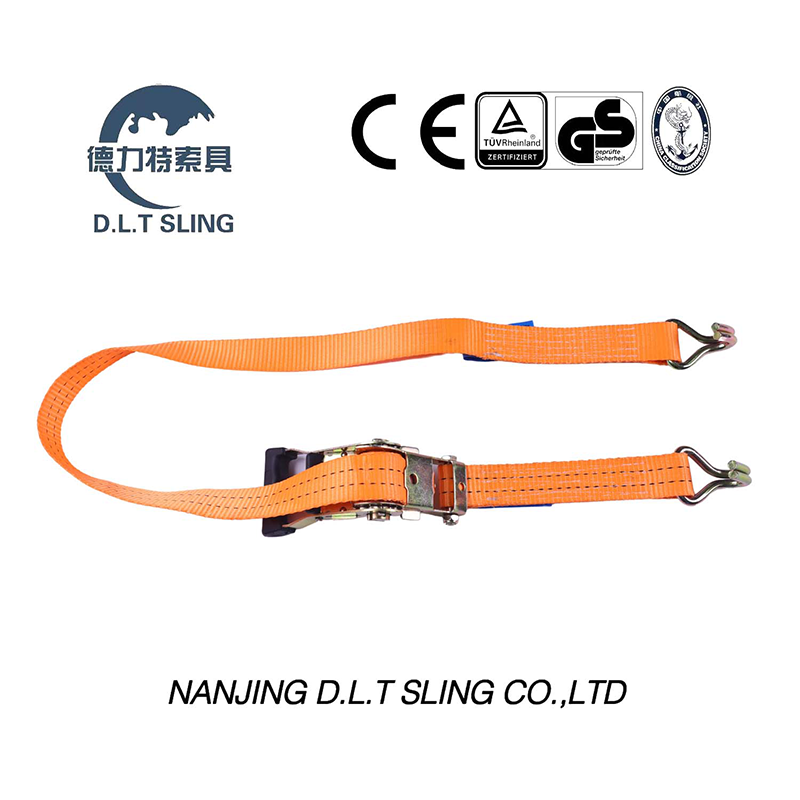
Applying tension safely requires a strict, sequential procedure. Deviating from these steps introduces slack, creates jams, or compromises the securing force. Field operators must memorize this sequence to ensure consistency across every load.
Before threading, inspect the webbing for abrasions, cuts, chemical damage, or UV degradation. Follow the 10% rule: if a cut or tear exceeds 10% of the webbing's width, discard the strap immediately. Do not attempt to repair or splice damaged webbing. Verify that the anchor point's Working Load Limit meets or exceeds the strap's WLL. A heavy-duty strap attached to a weak anchor point provides a false sense of security. The entire system is only as strong as its weakest component.
Proper threading prevents the mandrel from binding. Follow these exact steps every time you deploy a strap:
Open the ratchet handle completely until it sits at a 180-degree angle.
Verify the mandrel slot is facing straight up and is clear of debris.
Feed the raw end of the webbing up through the bottom of the mandrel slot.
Pull the webbing over the top of the spool and back toward the load.
Pull all excess slack through the mandrel completely by hand.
Ensure the webbing lies flat and is not twisted anywhere along the load path.
Operate the handle back and forth to wind the webbing onto the mandrel. Follow the rule of two to three wraps. Exactly two to three layers of webbing must wrap around the spool to lock the strap securely. Fewer than two wraps can allow the webbing to slip under heavy loads because there is not enough friction against the spool. More than three wraps will overfill the mandrel, jamming the mechanism against the frame and making it impossible to release.
Do not over-torque the handle. Applying excessive force can crush fragile cargo, bend the vehicle's anchor points, or permanently damage the gear mechanism. If you need more tension than you can apply with one hand, you need a larger strap, not a cheater bar.
Once the desired tension is achieved, push the handle down until it is closed completely flat against the frame. This engages the safety lock, preventing the pawl from accidentally releasing during transit due to road vibrations. If the handle does not sit flat, the mechanism is not locked, and the load is not secure.
Releasing tension improperly can cause severe injury due to stored kinetic energy or result in permanently jammed equipment. Operators must control the release mechanism carefully to prevent the handle from snapping back.
When a strap is fully tensioned, it stores significant force. Keep a firm grip on the handle while pulling the release lever. Open the handle a full 180 degrees to disengage the pawl from the gear teeth. This action pops the mechanism into the fully open, unlocked position, releasing the tension instantly. Keep your face and hands clear of the handle's path. Wear heavy leather gloves to protect your fingers from pinch points between the handle and the frame.
Jams usually occur because the operator pulled too much slack into the spool during tensioning, creating an over-filled spool. The webbing binds against the frame, preventing the mandrel from turning or releasing. Dirt and ice can also freeze the pawl in place.
To free a locked mandrel without cutting the webbing, use pliers to pull back on the release pawl while manually forcing the handle open. If the tension is too high, apply a secondary backup strap next to the jammed one. Tension the backup strap to take the load off the jammed mechanism. This transfers the kinetic energy to the new strap, providing enough slack to disengage the original pawl safely. Never use a hammer to strike the release lever, as this will shatter the cast components.
Selecting the correct Cargo Lashing System depends entirely on load weight, dimensions, and the legal metrics governing transport. Guessing capacities leads to DOT fines and catastrophic accidents.
Minimum Break Strength (MBS) is the point of catastrophic failure under controlled laboratory test conditions. It is a theoretical maximum. Working Load Limit (WLL) is the maximum safe load that can be applied to the equipment in everyday use. In North America, WLL is typically one-third of the Break Strength. You must base all securing decisions on the WLL, as it is the only metric used for legal compliance by transportation authorities. If a strap has a 10,000 lb MBS, its WLL is 3,333 lbs.
Under European lashing standards (EN 12195-2), Lashing Capacity (LC) is used instead of WLL, expressed in decanewtons (daN). Standard Tension Force (STF) measures the residual force pressing down on the cargo after releasing the handle of the ratchet. STF plays a critical role in frictional lashing, where the goal is to increase the friction between the cargo and the vehicle bed to prevent sliding.
Lashing Angle | Effective Downward Force | Adjustment Required |
|---|---|---|
90 Degrees (Vertical) | 100% of STF | None. Optimal securing angle. |
60 Degrees | 85% of STF | Add 15% more straps to compensate. |
45 Degrees | 70% of STF | Add 30% more straps to compensate. |
30 Degrees | 50% of STF | Double the number of straps used. |
Securing complex freight requires mathematical calculation. The aggregate WLL of all tie-downs used must equal at least 50% of the cargo's total weight. If you are hauling a 20,000 lb machine, the combined WLL of your straps must be at least 10,000 lbs. Differentiate between Frictional Lashing, which presses the load down against the bed, and Direct Lashing, which fixes the load to the vehicle in the direction of travel. Strap angles significantly impact effective tension. A strap pulling straight down provides maximum downward force. As the angle decreases, the effective downward force drops rapidly, requiring additional straps to maintain safety margins.
Navigating the regulatory landscape of cargo securing requires equipment you can trust. Independent validation separates professional gear from substandard alternatives. Relying on unverified hardware exposes your operation to massive legal risks.
The Geprüfte Sicherheit (Tested Safety) mark is a voluntary German certification indicating that equipment meets strict European safety requirements. A GS Certified Ratchet Strap undergoes rigorous third-party testing. Laboratories test tensile strength, fatigue resistance over thousands of cycles, chemical resistance, and the overall quality management systems of the manufacturer. This certification guarantees that the strap will perform exactly as rated under extreme field conditions.
Standardizing your fleet on certified equipment protects your operation from liability in the event of an accident or a DOT inspection. Inspectors look for the manufacturer's tag to verify compliance. You must know how to read this tag, which displays the traceability code, WLL/LC, material composition, elongation factor, and date of manufacture. If a tag is missing, torn, or illegible, the strap is legally void for commercial use and must be removed from service immediately. Do not risk a massive fine over a missing five-cent piece of fabric.
Maximizing the lifespan and safety of your equipment requires proactive management of environmental and physical risks. Straps do not last forever, but proper care extends their operational life significantly.
Sharp cargo edges slice polyester webbing under tension. Even a slightly rough edge on a steel beam or concrete block can cause catastrophic failure through abrasion. Integrate plastic corner protectors, wear sleeves, or heavy-duty rubber guards wherever the webbing contacts the cargo. Cardboard is not an acceptable edge protector for heavy freight.
Loads settle, and webbing stretches slightly during the initial phase of transport, leading to a dangerous loss of tension. Establish a strict protocol for stopping to re-tension straps after the first 50 miles of transit. Continue to check and adjust tension every 150 miles or every 3 hours of driving thereafter. Air ride suspensions can cause loads to bounce, creating momentary slack that allows hooks to disengage if tension is not maintained.
UV exposure, road salts, grease, and moisture break down webbing fibers over time. Wash off salts and grime with mild soap and water. Never use bleach or harsh solvents. Dry the straps thoroughly before storage to prevent mold and mildew, which rot the core yarns. Store equipment in dry, dark environments in rolled webbing configurations to prevent tangling and UV damage. Throwing wet straps into a sealed toolbox guarantees premature failure.
Conduct an immediate physical audit of all current tie-downs, discarding any straps with missing tags, severe abrasions, or cuts exceeding 10% of the width.
Upgrade to certified lashing systems for all high-liability freight to ensure regulatory compliance and mitigate legal risks.
Implement a mandatory training session for all operators focusing on proper threading techniques and the strict two-to-three wrap rule.
Establish a mandatory maintenance log requiring drivers to check and record strap tension after the first 50 miles of every trip.
A: The webbing should wrap exactly two to three times around the mandrel. This provides enough friction to lock the strap securely without overfilling the spool, which causes jamming.
A: Break Strength is the theoretical point where the strap fails under laboratory conditions. WLL is the maximum safe load for everyday use, typically calculated as one-third of the Break Strength. Always use WLL for load calculations.
A: Lashing Capacity (LC) is the European equivalent of WLL, expressed in decanewtons (daN). It denotes the maximum force the strap is designed to sustain in a direct pull during use.
A: Use pliers to pull back the release pawl while manually forcing the handle open to 180 degrees. If it remains stuck under load, apply a secondary strap to take the tension off the jammed mechanism before releasing it.
A: While not strictly legally mandated in all regions outside Europe, using them provides documented proof of independent safety testing, which heavily mitigates liability during inspections or accident investigations.
A: Inspect straps before every single use. Replace them immediately if the manufacturer tag is missing or illegible, or if there are cuts, burns, or abrasions exceeding 10% of the webbing width.

