

close
Choose Your Site
Global
Social Media

Views: 0 Author: Site Editor Publish Time: 2026-08-24 Origin: Site


Securing high-value or heavy-duty cargo is a high-liability operation where equipment failure can result in catastrophic load shifts, property damage, or severe safety hazards. Many operators and procurement teams treat tie-downs as commodity items, failing to understand the mechanical limits, proper operational procedures, and material variances that dictate performance under dynamic loads. Understanding exactly how a ratchet tie down functions mechanically is the critical first step in evaluating hardware quality, ensuring regulatory compliance, and selecting the correct cargo securing strap for specific logistical requirements. You cannot rely on guesswork when hauling thousands of pounds of steel, lumber, or machinery at highway speeds. You need to know exactly how the gear teeth engage, how the webbing handles friction, and what the working load limits actually mean in the field. We will break down the exact mechanics of these tools so you can spec the right gear for your fleet and keep your loads pinned to the deck.
Mechanical Advantage: Ratchet mechanisms utilize a gear and pawl system to multiply human force, allowing for micro-adjustments in tension that static ropes or cam buckles cannot achieve.
Capacity Metrics: A strap’s operational viability is dictated by its Working Load Limit (WLL)—which is strictly one-third of its total Break Strength (BS)—not its physical size.
Failure Prevention: The majority of strap failures stem from improper threading (over-spooling), lack of edge protection, or environmental degradation of the webbing, rather than hardware snapping.
Compliance is Mandatory: Commercial applications require strict adherence to Department of Transportation (DOT) and Web Sling & Tie Down Association (WSTDA) standards, necessitating legible tags and specific hardware ratings.
To evaluate the quality of a tie-down, buyers must first understand the individual components and how their manufacturing quality impacts the overall system. A standard Ratchet Tie Down is an assembly of precision hardware and engineered textiles working in unison. Identifying the strengths and weaknesses of each component allows operators to select the appropriate tool for their specific load requirements. You need to inspect these parts daily before throwing a strap over a load.
The hardware is the engine of the securing system. The handle and grip act as the lever used to generate tension. When evaluating this component, you must consider the length and the grip material. Longer handles provide more leverage. This makes it easier to apply high tension with less physical effort. Grip materials vary significantly across manufacturers. Knurled aluminum offers durability in harsh weather and resists impact damage if dropped on concrete. Rubberized grips provide better ergonomics for bare hands but often degrade, crack, or peel under intense UV exposure or contact with grease.
The core locking mechanism consists of the gear, often called the cogwheel, and the pawl, or latch. The pawl engages the teeth of the gear to prevent backward rotation. When inspecting a ratchet, you must evaluate the depth of the gear teeth and the spring tension of the pawl. Shallow teeth or a weak spring lead to slippage under dynamic loads. The rotating axle where the webbing is threaded and wraps around itself is the mandrel. The diameter and slot width of the mandrel determine how much webbing you can safely spool before jamming occurs.
Hardware Component | Field Inspection Criteria | Failure Indicator |
|---|---|---|
Handle Assembly | Check for bending or twisting along the lever arm. | Handle does not sit flush against the frame when closed. |
Gear Teeth | Inspect for rounded edges or sheared metal shavings. | Pawl slips under moderate tension. |
Pawl Spring | Test the snap-back action manually. | Sluggish return or failure to seat deeply in the gear. |
Mandrel Slot | Look for burrs or sharp edges inside the slot. | Webbing shows premature fraying at the insertion point. |
The textile component bears the direct tension of the load. The material composition of a Ratchet Lashing Belt drastically affects its performance on the road. Polyester is the industry standard. It offers low stretch characteristics and high UV resistance. This ensures the load remains tight over long distances without requiring constant roadside retensioning. Nylon possesses high stretch properties. This makes it entirely unsuitable for rigid cargo where you must prevent all shifting. Polypropylene offers a low-cost alternative but suffers from rapid degradation when exposed to sunlight and abrasion. Never use polypropylene for heavy highway hauling.
Stitch patterns dictate the structural integrity of the anchor points. Reinforced box-stitching distributes stress evenly across the webbing width. Standard linear stitching concentrates stress on a few threads. This increases the risk of a tear under sudden load shifts, like hard braking. High-quality straps always utilize heavy-duty thread in a dense, cross-hatched pattern at all connection points.
Inspect the entire length of the webbing for cuts, burns, or holes.
Check the box-stitching at the hook ends for broken or pulled threads.
Feel the webbing for stiff, brittle sections indicating chemical damage.
Verify the manufacturer tag is legible and securely attached.
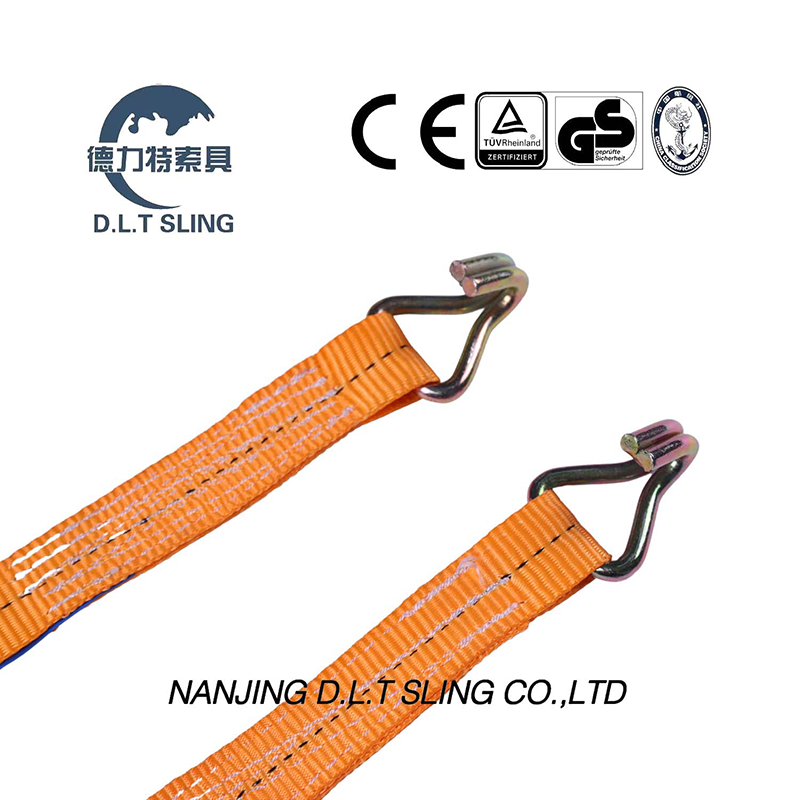
The connection points anchor the system to the transport vehicle. Hardware variations exist to accommodate different anchor points on flatbeds, step-decks, and enclosed trailers. Flat hooks are designed specifically for flatbed rub rails. Their wide surface area distributes load tension evenly along the rail, preventing damage to the trailer. Wire J-hooks fit perfectly into D-rings and recessed floor anchors. Their narrow profile allows them to hook into tight spaces where a flat hook cannot fit. Chain anchors provide extreme abrasion resistance. You use these primarily for securing heavy machinery where the anchor point might cut through standard webbing.
Metallurgy plays a massive role in hardware longevity. Zinc-plated steel is the standard for commercial use. It offers adequate rust resistance for typical highway transport. Stainless steel is mandatory for marine environments or highly corrosive applications. Road salts and moisture rapidly degrade standard zinc plating, leading to rust that seizes the gear mechanism.
Detailing the step-by-step mechanical process establishes a baseline for proper operational training and equipment evaluation. Understanding the physics behind the tool prevents user error and maximizes the lifespan of the equipment. You cannot just crank the handle and hope for the best. You need to execute a specific sequence to lock the load down safely.
The correct physical threading path is non-negotiable for safe operation. You must place the strap behind the reel, feed it up inside the mandrel, and thread it down through the slot. This specific routing path allows the reel to bind on itself with just a quarter-turn. The overlapping webbing creates a friction lock. This secures the strap instantly under tension without relying solely on the anchor stitching. If you thread it backward, the strap will slip as soon as you hit a bump.
Managing slack is a critical operational step. You must pull all excess slack through the mandrel before you start ratcheting. Emphasize pulling 5 to 6 inches of slack through the front and slipping it under the ratchet mechanism before starting to crank. This ensures a tight, clean initial wrap around the mandrel. It prevents the webbing from bunching up and jamming the gears.
The physics of the handle actuating the gear relies entirely on leverage. As the operator pulls the handle, the lever rotates the gear. Each click of the pawl locks the gear in place. This holds the kinetic energy generated by the operator. This mechanical advantage prevents the mandrel from reversing under the load's resistance. The gear-and-pawl system multiplies human force. It allows a single operator to apply thousands of pounds of tension to the load with one arm.
Action | Mechanical Result | Operator Feedback |
|---|---|---|
Pulling Handle Up | Lever rotates gear, winding webbing onto mandrel. | Resistance increases as load compresses. |
Pawl Clicking | Spring forces pawl into gear teeth, locking rotation. | Audible click confirms tension is held. |
Pushing Handle Down | Handle resets for next pull without releasing tension. | Handle moves freely back to starting position. |
Once you achieve the desired tension, the locking phase secures the mechanism for transit. You must close the handle completely flat against the base. The closed position engages the primary safety lock. This physical barrier prevents accidental release during transit vibrations. It ensures the pawl remains firmly seated in the gear teeth regardless of rough road conditions. If the handle is sticking up even an inch, the lock is not engaged.
Releasing the tension requires a specific sequence to protect the operator. You start by pulling the release trigger. This disengages the pawl from the gear teeth. The operator must then open the handle to a full 180 degrees. A sudden release of kinetic energy occurs at this exact moment. Safety protocols dictate keeping your hands clear of the spinning mandrel. You must discharge tension slowly on heavy loads to prevent the handle from snapping back violently and breaking your wrist.
Translating mechanical features into procurement criteria ensures that fleets operate safely and efficiently. Evaluating a Cargo Securing Strap involves understanding load limits, standardizing equipment, and assessing environmental durability. You cannot buy straps based on price alone. You must buy them based on the math of your heaviest loads.
The most critical metric for any tie-down is its Working Load Limit. WLL is the maximum safe operational weight the strap can handle under normal conditions. Industry standards strictly mandate that the WLL is always one-third of the Break Strength. If a strap has a Break Strength of 15,000 lbs, its WLL is 5,000 lbs. You base all your securement math on the WLL.
The aggregate WLL calculation is required for securing a specific load weight. Securing a 10,000 lb load requires multiple straps whose combined WLL exceeds 10,000 lbs. If you use 5,000 lb WLL straps, you need at least two just to meet the weight requirement, plus additional straps to meet length regulations. Relying on the Break Strength for operational calculations is a dangerous error that leads to catastrophic failures and massive DOT fines.
Standardizing strap sizes across a fleet provides massive operational benefits. Standardizing on 2-inch or 4-inch webbing ensures predictable WLL calculations for all operators. It guarantees interchangeable hardware. Drivers can mix and match straps and ratchets without compromising safety. Consistent equipment simplifies training for new hires. It reduces the likelihood of a driver accidentally deploying an underrated strap for a heavy load because all straps in the truck box have the same rating.
Exposure to the elements degrades polyester over time. UV rays break down the synthetic fibers, reducing the strap's tensile strength. Road salts and petrochemicals accelerate this degradation. They stiffen the webbing and cause micro-abrasions deep within the fibers. This reality necessitates regular replacement cycles regardless of usage frequency. Operators must visually inspect webbing for fading, stiffness, or chemical stains. You must retire compromised straps immediately. A faded strap is a weak strap.
Address the operational realities and user errors that lead to system failure. Even the highest quality equipment will fail if deployed incorrectly. Drivers make mistakes when they are tired or rushing. You need strict protocols to catch these errors before the truck leaves the yard.
Leaving too much slack before ratcheting causes the webbing to build up on the mandrel. This risk, known as over-spooling or bird-nesting, jams the mechanism and prevents a secure lock. The pawl cannot engage the gear teeth fully if the webbing overflows the spool. The mitigation strategy is the "2 to 4 wraps" rule. Ensure only enough webbing is spooled to create a friction lock without exceeding the mandrel's capacity. This provides maximum holding power while keeping the gears clear.
Pull all slack through the mandrel by hand.
Leave exactly enough slack to allow 2 to 4 full rotations of the mandrel.
Begin ratcheting and watch the spool to ensure the webbing stacks neatly.
Stop immediately if the webbing touches the pawl or gear teeth.
Placing the ratchet mechanisms on the driver’s side of the vehicle exposes the operator to active highway traffic if they must pull over to adjust or inspect the load. The mitigation is the Passenger-Side Rule. Position the physical ratchet mechanism on the passenger side of the vehicle during initial setup. This ensures any roadside checks or tension adjustments occur safely on the shoulder side, away from active traffic lanes. This simple rule saves lives.
Tensioned webbing running over sharp 90-degree cargo edges will slice under dynamic transit loads. The vibration of the road acts like a saw against the tight fabric. Mandatory implementation of edge protectors is required. You must use plastic or rubber corner guards, or heavy-duty protective sleeves. These accessories distribute the friction and protect the structural integrity of the webbing. Never run a bare strap over raw steel edges or rough lumber.
Failing to close the handle completely leaves the pawl partially engaged. This risk allows the handle to vibrate loose on the highway, instantly releasing the load tension. Mitigation requires strict visual and tactile inspection protocols post-tensioning. Operators must physically verify that the handle is locked flat and the pawl is seated deep within the gear teeth before moving the vehicle. Slap the handle. If it bounces, it is not locked.
Aligning equipment choices with regulatory frameworks is a legal requirement for commercial transport. DOT inspectors look for specific violations. You need to know the rules better than they do to keep your trucks on the road.
The Federal Motor Carrier Safety Administration (FMCSA) dictates strict requirements for cargo securement. The regulations dictate the minimum number of tie-downs based on load length and weight. Generally, you need one tie-down for every 10 feet of cargo length, plus an additional tie-down for any fraction thereof. Compliance ensures that the cargo remains secured even under extreme braking or evasive maneuvers. Failure to meet these standards results in severe fines, points against your safety record, and immediate out-of-service violations.
The Web Sling & Tie Down Association (WSTDA) requires legible manufacturer tags displaying the WLL on every strap. These tags are the only legally recognized proof of a strap's capacity. The critical rule for all operators is absolute: if the tag is missing or illegible, the strap is legally rated at 0 lbs. It will fail a DOT inspection immediately. Regular auditing of tags is a mandatory maintenance procedure. Cut up and throw away any strap with a missing tag. Do not keep them as spares.
Inspection Item | DOT Requirement | Action if Failed |
|---|---|---|
WLL Tag | Must be attached and fully legible. | Remove from service immediately. |
Webbing Integrity | No cuts exceeding 3/4 inch on a 4-inch strap. | Destroy and discard strap. |
Hardware Condition | No cracks, severe pitting, or bent components. | Replace hardware or entire assembly. |
Audit your current inventory of tie-downs for illegible tags, frayed webbing, or corroded ratchets, and discard non-compliant items immediately.
Establish a standardized procurement spec sheet based on your heaviest routine loads and environmental exposure to ensure consistency across your fleet.
Implement mandatory training for all operators focusing on the "2 to 4 wraps" rule and the Passenger-Side setup protocol.
Stock vehicles with edge protectors and mandate their use on all loads with sharp or abrasive corners.
A: You should aim for 2 to 4 full wraps of webbing around the mandrel. This amount ensures a secure friction lock that holds the tension effectively without overfilling the spool and jamming the gear mechanism.
A: Jamming is typically caused by over-spooling excess webbing into the mandrel, which blocks the pawl from engaging the gear teeth. It can also result from a lack of lubrication on the moving metal parts, causing rust or debris buildup.
A: A ratchet utilizes a gear mechanism to multiply force, making it ideal for high-tension, heavy loads. A cam buckle relies on a simple pull-to-tighten friction lock, which is better suited for fragile or lighter loads where over-tensioning could cause damage.
A: To release a jammed strap safely, pull the release trigger and open the handle fully flat to 180 degrees. Once open, manually pull the webbing from the non-anchor side to break the tension and free the spool.
A: While polyester webbing and zinc-plated hardware are water-resistant, prolonged exposure to rain and moisture leads to hardware corrosion and UV degradation of the strap. Store them in a dry environment when not in active use.

