

close
Choose Your Site
Global
Social Media

Views: 0 Author: Site Editor Publish Time: 2026-08-31 Origin: Site


Securing high-value or heavy-tonnage cargo relies entirely on the mechanical integrity of the fastening system; equipment failure is not an option. Improperly specified or incorrectly operated securement devices lead to load shifts, damaged freight, severe safety liabilities, and Department of Transportation (DOT) compliance violations. Understanding the precise mechanical operation of a Ratchet Tie Down is critical for evaluating equipment quality, ensuring proper operator application, and selecting the correct specifications for commercial cargo control.
The core mechanism relies on a gear-and-pawl system that converts manual pumping action into high-tension spooling, locking the webbing securely in place.
Procurement decisions must be dictated by the Working Load Limit (WLL), which is legally required to be one-third of the strap’s total break strength.
Proper threading—specifically feeding the strap from the bottom of the mandrel—is non-negotiable to prevent slippage and mechanical jamming under load.
Strategic placement, such as positioning the ratchet mechanism on the passenger side of the vehicle, mitigates roadside adjustment risks.
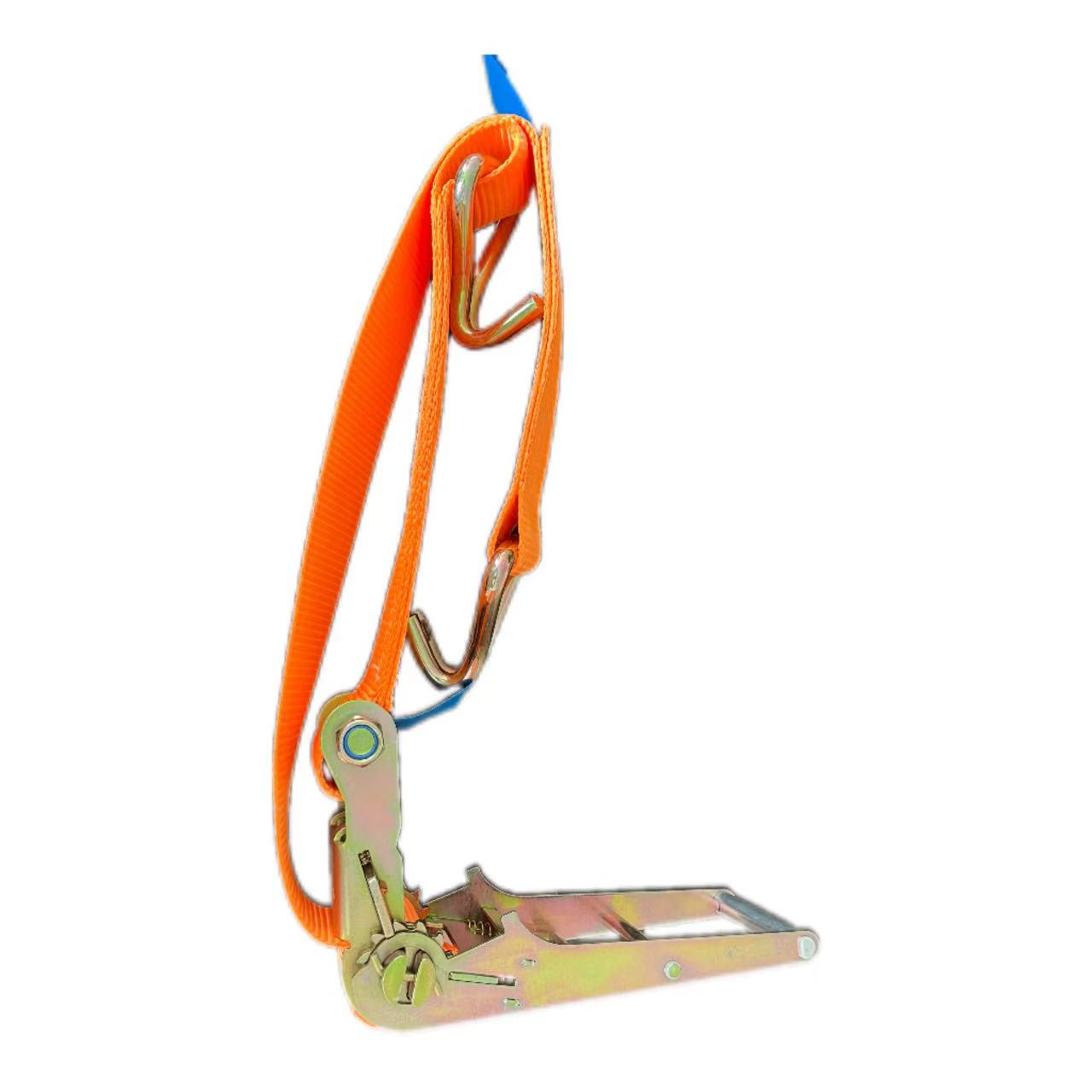
A standard cargo securement system utilizes a two-part design to maximize versatility across different load profiles. The short, fixed end contains the primary tensioning mechanism. It features a heavy-duty metal buckle and an integrated end fitting, such as a wire hook, flat hook, or chain extension. This section anchors the assembly to one side of the transport vehicle and is typically kept short—usually 12 to 18 inches—so the tensioning device remains easily accessible to the operator standing on the ground. The long, adjustable strap consists of high-tenacity webbing, often ranging from 27 to 30 feet for standard flatbed operations. It features a loose feed end for threading through the buckle and a dedicated end fitting on the opposite side. This dual-component structure allows operators to span various load sizes, from low-profile steel coils to stacked lumber, while keeping the mechanical tensioning unit within safe reach.
The mechanical core of the system is the Ratchet Buckle Strap mechanism. It consists of a handle, a rotating split-mandrel, twin gear wheels, and a spring-loaded release lever called a pawl. The split-mandrel acts as a spool or slot where the webbing feeds through. When the operator pumps the handle, the pawl engages the teeth of the twin gear wheels. This engagement prevents backward unspooling. It maintains unidirectional tension, ensuring the strap only gets tighter with each pump. The mechanical advantage generated by the handle length allows a single operator to apply thousands of pounds of downward force onto the cargo with minimal physical exertion. Heavy-duty models often feature wider, rubberized handles to provide better grip and leverage during inclement weather.
Commercial tie downs predominantly use high-tenacity polyester webbing rather than nylon or polypropylene. Polyester offers a remarkably low stretch coefficient, typically elongating only 2% to 3% under maximum working loads. This prevents the strap from loosening when subjected to road vibrations, sudden braking, and load shifts. Furthermore, polyester provides high resistance to UV degradation and exhibits minimal water absorption. These material properties prevent the webbing from rotting, freezing into stiff blocks during winter transit, or snapping under stress.
Material Type | Stretch Under Load | UV Resistance | Water Absorption | Primary Application |
|---|---|---|---|---|
Polyester | 2% - 3% | High | Low | Heavy-duty flatbed and dry van cargo control. |
Nylon | 10% - 15% | Medium | High | Recovery towing and dynamic lifting (not ideal for static tie downs). |
Polypropylene | Moderate | Low | Zero | Light-duty marine applications; degrades quickly in sunlight. |
Matching the correct end fitting to the vehicle's anchor point is essential. Incompatible fittings can cause structural bending, point-loading on the hook, or accidental detachment under tension. Operators must evaluate the trailer configuration before selecting the hardware.
Flat Hooks: Designed specifically for flatbed trailers equipped with side rub rails. They distribute the load across a wider surface area to prevent gouging the aluminum or steel rails.
Wire Hooks and J-Hooks: Ideal for attaching to heavy-duty D-rings recessed into the trailer deck. Their narrow profile allows them to hook securely into tight anchor points.
E-Track Fittings: Engineered to lock directly into the E-track rails mounted on the interior walls of enclosed dry vans, providing modular securement for palletized freight.
Chain Anchors: Used for extreme heavy-haul applications requiring abrasive resistance, typically hooking into stake pockets or heavy-duty spool anchors.
A common user pain point involves hooks slipping off anchor points before tension is applied. To prevent this, pull the adjustable strap taut by hand immediately after attaching both end fittings. Maintaining constant light tension on the hooks keeps them seated properly in the D-rings or rub rails. This allows the operator to prepare and thread the buckle without the hooks falling out of the anchor points, which is especially problematic on windy days or when working with long 30-foot straps across high loads.
Threading the buckle correctly prevents mechanical jamming and ensures the webbing locks down on itself. Incorrect threading can lead to the strap slipping through the mandrel under heavy braking.
Open the handle fully to expose the slot in the split-mandrel.
Insert the feed end of the strap directly through the bottom of the mandrel slot, pushing it upward.
Pull the strap back through the front, slipping it over the top of the mandrel and back toward the operator.
Pull all excess slack through the assembly by hand until the webbing is tight against the cargo.
Leave approximately 5 to 6 inches of slack to create a secure initial wrap without overcrowding the spool.
Tensioning relies on the physics of a simple pumping motion. Lifting and lowering the handle rotates the spool, drawing the strap tight around the load. Operators must find the optimal tension zone. You need adequate downward pressure to secure the cargo completely and prevent lateral movement. However, you must avoid crushing fragile loads, damaging the edges of drywall or lumber, or maxing out the spool capacity, which can warp the internal gears and bend the mandrel.
The final locking phase secures the load for transit. Close the handle completely flat against the strap. This engages the primary safety lock, forcing the pawl deep into the gear teeth. A partially open handle leaves the gear vulnerable. Vibration from the road can cause an open handle to bounce, disengaging the pawl and leading to sudden tension loss and dangerous load shifts at highway speeds.
Releasing the tension requires a specific two-step process. First, pull the release trigger or pawl toward the handle to disengage it from the gear teeth. Second, push the handle open to a full 180-degree flat position. This rotates the cam profile and disengages the gears entirely, allowing the mandrel to spin freely. Operators must anticipate a sudden release of kinetic energy. Keep hands clear of the mandrel and gear teeth to prevent pinch injuries during rapid unspooling.
Understanding load ratings is mandatory for safe procurement and legal compliance. The ultimate break strength is the point at which the strap catastrophically fails under laboratory testing. The Working Load Limit (WLL) is the maximum safe weight the strap can handle continuously in real-world conditions. By law, the WLL is exactly one-third of the break strength. When securing a load, the aggregate WLL of all tie downs used must equal at least 50% of the total weight of the cargo.
Cargo Weight | Minimum Aggregate WLL Required (50%) | Number of 5,400 lb WLL Straps Needed |
|---|---|---|
10,000 lbs | 5,000 lbs | 1 strap (minimum based on weight, length rules may require more) |
20,000 lbs | 10,000 lbs | 2 straps |
40,000 lbs | 20,000 lbs | 4 straps |
Evaluate the corrosion resistance of all metal components before outfitting a fleet. Zinc-plated hardware offers excellent protection against rust for long-term outdoor exposure and is the industry standard for flatbed operations. Stainless steel hardware provides superior durability in highly corrosive environments, such as marine transport or hauling road salt, though it comes at a higher weight penalty. Assess the webbing for edge protection. Abrasion resistance features, such as reinforced polymer edges or the addition of sliding wear sleeves, are necessary for securing sharp or irregular loads without slicing the polyester fibers.
Standardizing equipment across a commercial fleet reduces operator error and simplifies DOT inspections. Maintain consistent strap lengths, WLL ratings, and end fittings across all trucks. This streamlines inventory management and replacement cycles. It also ensures that drivers always have the correct, compatible equipment on hand for any standard load profile, eliminating the dangerous practice of mixing and matching mismatched straps with different stretch coefficients.
Over-spooling is a frequent operational error. Wrapping too much webbing around the mandrel jams the mechanism entirely. This prevents the pawl from locking into the gear teeth, rendering the assembly unsafe for transit. Friction wear and micro-tears in the webbing significantly reduce load capacity. UV rot also degrades the polyester over time, leading to unexpected failures under heavy tension. Operators must look for faded webbing, which is a primary indicator of UV degradation.
The Federal Motor Carrier Safety Administration (FMCSA) enforces strict rules regarding any Cargo Control Tie Down used on public highways. The regulations dictate the minimum number of straps required based on cargo length and weight. For example, articles of cargo measuring 5 feet or less and weighing over 1,100 pounds require at least two tie downs. Furthermore, there is a legal requirement for legible WLL tags. Straps without readable tags are automatically downgraded to a default capacity based on width (e.g., 1,000 lbs per inch of width) or deemed completely out-of-service by DOT inspectors, resulting in fines and delayed shipments.
Positioning the ratchet mechanism strategically enhances operator safety. Always place the ratchet on the passenger side of the vehicle when possible. If mid-transit tension adjustments are required, this placement protects the operator from active highway traffic. It mitigates severe roadside risks during load inspections and ensures the driver has a safe working area on the shoulder of the road.
Conduct a comprehensive physical audit of all existing cargo control equipment, checking for legible WLL tags and hardware integrity.
Discard and destroy any straps exhibiting frayed webbing, edge cuts exceeding 3/8 of an inch, or bent mandrel slots to maintain DOT compliance.
Source high-grade polyester replacements tailored specifically to your fleet's primary anchor points and maximum load profiles.
Implement a mandatory driver training program focused on proper threading techniques to eliminate mandrel jamming and ensure consistent tensioning.
A: Aim for 2 to 3 full wraps of webbing around the mandrel. This provides enough friction to grip the strap securely without overcrowding the spool and jamming the mechanism.
A: A ratchet strap uses a high-tension gear mechanism to forcefully tighten the webbing. A cam buckle relies on a pull-to-tighten friction grip, suitable only for lighter, fragile loads.
A: Common causes include over-spooling the webbing, severe rust on the gears, or failing to pull the release pawl fully while opening the handle to a flat 180 degrees.
A: Inspect them before every single trip. Look for cuts, burns, frayed edges, damaged hardware, and illegible tags. Remove defective straps from service immediately.
A: Never tie knots in the webbing. Knots create stress points that reduce the Working Load Limit (WLL) by up to 50% and violate DOT safety standards.
A: The WLL is the maximum safe weight the strap can handle under normal operational conditions. It is legally required to be exactly one-third of the strap's total break strength.

