

close
Choose Your Site
Global
Social Media

Views: 0 Author: Site Editor Publish Time: 2026-08-05 Origin: Site


Miscalculating rigging equipment dimensions is a primary catalyst for unbalanced loads, catastrophic drops, and severe workplace safety incidents. Procurement and rigging teams frequently confuse a sling's total circumference with its working length. This fundamental error leads to incorrect equipment selection, compromised hitch configurations, and immediate OSHA and ASME compliance violations on the job site. When a lift plan specifies a precise headroom requirement, a sizing error of even a few inches can shift the center of gravity, placing extreme stress on individual rigging components and endangering the entire crew.
This guide provides a technical framework for accurately measuring a Round Sling. We will distinguish between circumference and effective length, evaluate dimensional tolerances, and establish protocols to ensure safe, compliant overhead lifting operations. By standardizing measurement practices, you eliminate guesswork and protect personnel from the hazards of mismatched rigging gear.
Measurement Standard: The industry standard for sizing is the Round Sling Effective Length (EWL), measured end-to-end when the sling is laid flat, not the total circumference of the loop.
Configuration Impact: Accurate length measurement is critical for calculating sling angles and tension multipliers, particularly in basket and choker hitches where length directly dictates load capacity.
Compliance Protocol: ASME B30.9 standards dictate strict tolerances for length variations; slings that stretch beyond manufacturer specifications or lack legible sizing tags must be removed from service immediately.
Material Variables: Polyester core yarns exhibit minimal stretch (typically 3%), but this elongation must be factored into headroom calculations for precision lifts.
To measure rigging equipment accurately, you must first understand its internal construction. An Endless Round Sling is manufactured using a continuous loop of load-bearing core yarn, typically made from high-tenacity polyester. This continuous loop design provides exceptional strength and flexibility, allowing the sling to conform tightly to the load. Because the core yarns are wound continuously, the sling has no fixed wear points. The user can rotate the bearing points with each lift to distribute wear evenly and extend the equipment's operational lifespan.
The relationship between the internal core and the outer jacket is critical for measurement and inspection. The woven tubular jacket serves only to protect and consolidate the core yarns; it bears no load during a lift. Therefore, any measurement taken must reflect the behavior and extension of the internal load-bearing fibers, not just the outer casing. If the jacket bunches up or twists during measurement, it can artificially shorten the apparent length of the sling, leading to inaccurate data that compromises the lift plan.
Industry standards utilize a universal color-coding system to indicate the Working Load Limit (WLL) of synthetic slings. While this color-coding provides a quick visual reference for load capacity, it offers no information regarding the sling's dimensions. Relying solely on color for selection ignores the geometric requirements of the lift. Accurate measurement dictates application suitability, ensuring the sling provides the necessary reach and maintains safe lifting angles.
Jacket Color | Vertical Capacity (lbs) | Choker Capacity (lbs) | Basket Capacity (lbs) |
|---|---|---|---|
Purple | 2,600 | 2,080 | 5,200 |
Green | 5,300 | 4,240 | 10,600 |
Yellow | 8,400 | 6,720 | 16,800 |
Tan | 10,600 | 8,480 | 21,200 |
Red | 13,200 | 10,560 | 26,400 |
Understanding these capacities is only half the equation. A yellow sling rated for 8,400 lbs vertically is useless if it is too short to reach the attachment points while maintaining a safe horizontal sling angle. The physical dimensions must align perfectly with the load weight and the spatial constraints of the lifting environment.
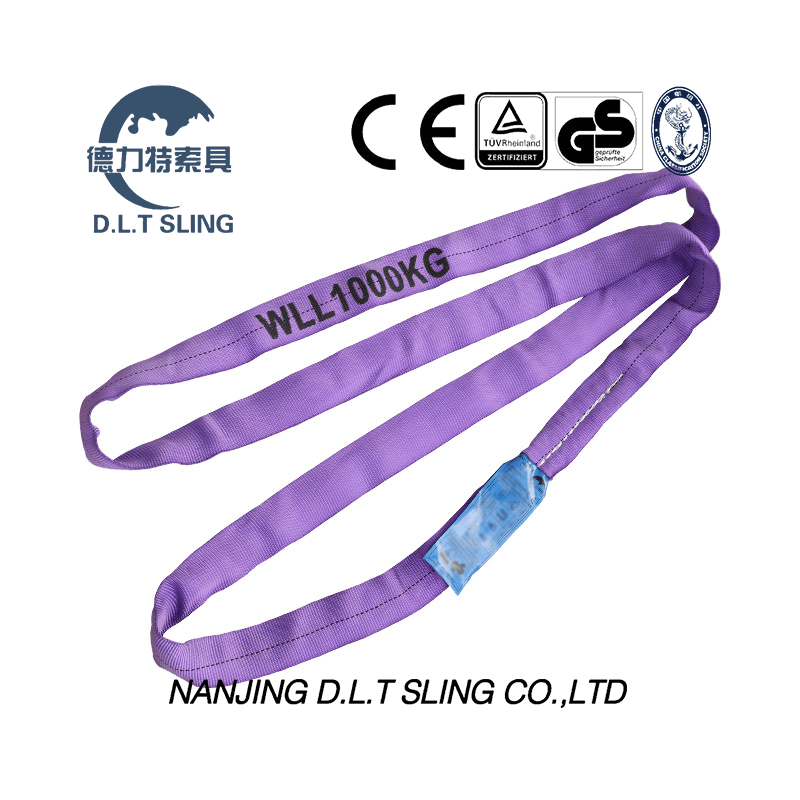
The most common and dangerous error in rigging procurement is confusing circumference with effective length. Round Sling Effective Length (EWL) is defined as the distance between the bearing points of the sling when laid flat and pulled taut. Mathematically, the EWL is exactly half of the total circumference. When rigging a vertical hitch, the EWL represents the actual reach of the sling from the crane hook to the load attachment point.
The circumference trap occurs when personnel order equipment based on the total length of the loop rather than the working length. If a rigger needs a sling with a 10-foot reach and orders a "10-foot circumference" sling, they will receive a product with an effective length of only 5 feet. This operational error immediately halts lifting procedures, causes costly project delays, and forces crews to improvise with inadequate equipment, which severely compromises site safety.
To eliminate vendor miscommunication and internal errors, operations must establish strict success criteria for procurement. Standardize all internal purchase orders, inventory audits, and lift plans to explicitly specify "Effective Length." Train all purchasing agents and tool crib managers to verify this metric upon receipt of new equipment. By universally adopting EWL as the sole dimensional metric, organizations prevent the dangerous mismatch of rigging gear and ensure every lift begins with the correct hardware.
Measurement Type | Definition | Application in Rigging | Common Error |
|---|---|---|---|
Effective Length (EWL) | Distance from bearing point to bearing point when laid flat. | Used to calculate reach, headroom, and sling angles. | Assuming EWL is the total length of the material. |
Circumference | Total continuous length of the loop (2x EWL). | Manufacturing metric; rarely used in field calculations. | Ordering by circumference when reach is needed. |
Clear communication between the field and the procurement office is mandatory. When a rigger requests a 12-foot sling, the purchasing agent must confirm whether that means a 12-foot EWL or a 12-foot circumference. Establishing a standardized vocabulary across the organization mitigates these risks entirely.
Accurate measurement requires the right environment and the right tools. Attempting to measure a sling while it hangs loosely from a hook or while it sits in a pile will yield inaccurate results. You need a clean, debris-free inspection area with a flat surface large enough to accommodate the entire length of the sling. Required tools include a calibrated steel measuring tape and, for larger capacity slings, tensioning pins or hooks to hold the ends securely while pulling the sling taut.
Execute the flattened measurement technique using these specific steps to guarantee accuracy:
Clear a flat, clean surface long enough to support the entire sling without any overhang or bending.
Lay the sling completely flat on the surface.
Align the seams of the outer jacket and smooth out the material to ensure there are no twists, knots, or bunches in the internal core yarns.
Insert a tensioning pin or hook into one end of the loop to establish a fixed bearing point.
Pull the opposite end of the sling firmly to remove all slack from the core yarns.
Measure in a straight line from the extreme inside edge of the first bearing point to the extreme inside edge of the opposite bearing point using a certified steel tape.
Record the measurement and compare it against the manufacturer's tag and the required lift specifications.
Inspectors frequently encounter obstacles that skew measurements. The most prevalent is the slack error. Failing to pull the sling fully taut leaves microscopic bends in the core yarns, resulting in a measurement that appears shorter than the actual EWL. Another common issue is the twisted jacket trap. If the outer cover twists around the core, it constricts the yarns and prevents them from laying flat, masking the true length. Finally, using incorrect tooling, such as flexible fiberglass or fabric tailor's tapes, introduces unacceptable variance. These tapes stretch over time; always use a certified steel measuring tape for rigging inspections.
When evaluating the measurement, you must account for standard manufacturing tolerances. Synthetic materials are not machined steel; slight variations occur during the weaving and sewing processes. The standard allowable length variance is typically ± 1 inch or 1% of the stated sling length, whichever is greater. If a newly purchased sling falls outside this tolerance, reject it. If an in-service sling exceeds this tolerance due to stretching, it indicates potential overload and requires immediate evaluation for retirement.
The effective length behaves differently depending on the hitch configuration used for the lift. In a straight vertical hitch, the sling utilizes its exact EWL to connect the hook to the load. However, in a basket hitch, the sling passes under the load, meaning the EWL must accommodate the width of the load plus the distance back up to the crane hook. A choker hitch reduces the usable reach even further, as a portion of the sling's length is consumed by wrapping around the load and passing through its own loop to create the choke.
Sling length directly impacts the horizontal angle of the lift, which in turn dictates the tension applied to the rigging. When using multiple slings to lift a single load, inadequate length creates shallow horizontal angles. As the angle between the sling and the horizontal plane decreases, the tension on the sling increases exponentially. A sling rigged at a 30-degree angle experiences twice the tension of a sling rigged vertically. Accurately measuring and selecting the correct EWL ensures the rigging maintains an angle of 60 degrees or greater, minimizing stress on the equipment.
Hitch Type | Length Utilization | Impact on Reach | Capacity Multiplier (Approx.) |
|---|---|---|---|
Vertical | Full EWL utilized. | Maximum reach achieved. | 1.0x |
Choker | EWL minus the circumference of the choked load. | Significantly reduced reach. | 0.8x |
Basket (90 deg) | EWL must cover load width and return to hook. | Reach is roughly half the EWL minus load width. | 2.0x |
Multi-leg sling assemblies demand the highest level of measurement precision. When rigging two-, three-, or four-leg bridle configurations, the effective lengths of all slings must be identical. If one leg is even slightly shorter than the others, it will bear a disproportionate share of the load weight. This imbalance shifts the center of gravity, causing the load to tilt dangerously and potentially overloading the shorter sling beyond its breaking strength. Always measure and match slings prior to assembling a multi-leg bridle.
Measuring a sling is not just for initial procurement; it is a critical component of periodic safety inspections. By measuring a used sling and comparing it against the original length printed on its identification tag, inspectors can detect permanent elongation. Synthetic polyester yarns stretch slightly under load (typically around 3%) but should return to their original length once the tension is released. Permanent stretch is a primary indicator of shock loading or exceeding the Working Load Limit. If a sling has permanently elongated beyond the manufacturer's allowable tolerance, it has lost its structural integrity and must be destroyed.
Compliance with ASME B30.9 and OSHA regulations hinges on proper identification. Every synthetic sling must feature a permanently affixed, durable identification tag detailing the manufacturer, the material, the Working Load Limits for various hitches, and the effective length. If this tag is missing, torn, or illegible, the sling is non-compliant. The physical condition of the sling is irrelevant in this scenario; without a legible tag to verify its specifications, the sling must be removed from service immediately.
While measuring the length, personnel must simultaneously conduct a tactile and visual inspection of the jacket integrity. The jacket protects the load-bearing core. Look for snags, punctures, tears, chemical burns, weld spatter, or severe UV degradation. If the jacket is compromised to the point where the internal core yarns are exposed, the sling is no longer safe to use. Core exposure means the load-bearing fibers are vulnerable to abrasion and cutting, drastically reducing the sling's capacity.
To maintain control over your rigging inventory, implement a formal rigging registry and verification log. Establish a baseline by recording the initial measured EWL of every new sling upon receipt, before it enters service. Implement a serial-tracked periodic inspection schedule, requiring competent persons to measure and log dimensional deviations over time. This data-driven approach standardizes the threshold for immediate retirement, removing subjective guesswork from safety inspections.
Accurately measuring rigging equipment is a non-negotiable prerequisite for safe overhead lifting. Relying on assumptions about circumference versus effective length introduces unacceptable risk to your personnel and your load. By understanding the anatomy of synthetic lifting gear and applying strict, standardized measurement techniques, you ensure that every lift utilizes the correct hardware configured to the proper angles.
When evaluating your current rigging inventory, prioritize equipment from manufacturers that provide highly durable, permanently affixed identification tags with clear EWL specifications. Clear tagging prevents field errors and streamlines the inspection process. Take the following actions to secure your lifting operations:
Conduct an immediate audit of all active rigging equipment to verify tagged lengths against actual physical measurements.
Quarantine and destroy any slings lacking legible identification tags or showing permanent elongation beyond allowable tolerances.
Establish a standardized training protocol for all personnel involved in lift planning, focusing on the distinction between circumference and effective length.
Update all procurement documentation to explicitly require "Effective Length" specifications for future orders.
A: The effective length, or EWL, is the distance between the two bearing points of the sling when it is laid completely flat and pulled taut. It represents the actual working reach of the sling and is exactly half of the total circumference of the continuous loop.
A: To calculate the circumference, measure the effective length (EWL) by laying the sling flat and measuring from end to end. Multiply this measurement by two. For example, a sling with a 10-foot effective length has a 20-foot circumference.
A: Polyester core yarns typically stretch about 3% at their maximum rated Working Load Limit (WLL). This minimal stretch helps absorb minor shock loads, but riggers must account for this elongation when calculating precise headroom requirements for tight lifts.
A: The standard industry tolerance for length variance is generally ± 1 inch or 1% of the stated sling length, whichever is greater. When matching slings for multi-leg bridles, they must fall within this tight tolerance to prevent unbalanced loading.
A: Determine the required effective length by measuring the distance from the crane hook down to the load, across the bottom width of the load, and back up to the hook. The total required EWL must accommodate this entire path while maintaining safe lifting angles.
A: No. If the outer protective jacket is torn, punctured, or abraded enough to expose the internal load-bearing core yarns, the sling must be removed from service and destroyed immediately. Field repairs of the jacket are strictly prohibited by safety standards.
A: A sling may measure shorter than its tagged length if it is not pulled completely taut during measurement, or if the internal core yarns have bunched up due to a twisted outer jacket. Ensure the sling is laid flat, smoothed out, and tensioned before measuring.

