

close
Choose Your Site
Global
Social Media

Views: 0 Author: Site Editor Publish Time: 2026-08-07 Origin: Site


Miscalculating lifting sling dimensions introduces severe safety and operational risks to any rigging operation. A minor measurement error on the shop floor or job site can cause catastrophic load imbalance, equipment damage, and fatal accidents. The core problem stems from widespread industry confusion between a sling's circumference and its Effective Working Length (EWL). This misunderstanding frequently results in procurement errors, failed safety inspections, and compromised rigging configurations where the load center of gravity shifts unexpectedly.
To prevent these issues, rigging professionals must adopt a standardized, evidence-based framework for measuring endless and configured slings. Accurately calculating required lengths for complex hitches ensures compliance with ASME B30.9 and OSHA standards during procurement and daily operations. Understanding how to measure a Round Sling properly is the first step in building a safe, predictable, and efficient lifting environment.
Standardized Measurement: The industry standard for measuring a round sling is the Effective Working Length (EWL), measured tip-to-tip when laid flat, not the total circumference.
Configuration Nuances: An Eye-Eye Round Sling requires specific bearing-point to bearing-point measurements to ensure accurate load distribution.
Hitch Impact on Length: Required sling length is dictated by the hitch type (vertical, choker, basket) and the sling angle; improper length calculations directly reduce the sling's rated capacity.
Compliance and Verification: Relying solely on manufacturer tags is insufficient for older slings; physical verification of length is a mandatory component of pre-use inspection to detect core yarn stretch or jacket damage.
Standardizing terminology across procurement and rigging teams prevents ordering errors that stall projects. When teams use different definitions for length, the wrong equipment arrives on site. A rigger asking for a "ten-foot sling" might mean a ten-foot reach, while the purchasing agent might order a sling with a ten-foot total circumference. This disconnect leads to dangerous field modifications and project delays.
Circumference is the total continuous loop of the endless sling. This measurement is exactly double the EWL. Ordering by circumference leads to receiving a sling half the required size. If a rigger needs a 10-foot reach and orders a 10-foot circumference sling, the actual reach will only be 5 feet. The internal load-bearing core yarns run continuously in this loop, protected by the outer tubular jacket. Measuring the entire loop is useful for manufacturing, but useless for field rigging calculations.
Effective Working Length (EWL) is the distance between the two bearing points when the sling is under tension or laid completely flat. This is the measurement that dictates how far the sling will reach from the crane hook to the load attachment point. EWL is the only metric you should use when planning a lift, calculating headroom, or ordering new rigging gear.
Required Reach (EWL) | Total Circumference | Common Application |
|---|---|---|
3 Feet | 6 Feet | Tight clearance machinery lifts |
6 Feet | 12 Feet | Standard warehouse material handling |
10 Feet | 20 Feet | Construction site steel erection |
20 Feet | 40 Feet | Heavy industrial module lifting |
Standard industry tolerances typically range from +/- 1% to 2% of the stated length. These variances impact multi-leg lifting assemblies. When using multiple slings to lift a single load, even a slight difference in length can shift the center of gravity, causing the load to tilt or placing excessive stress on one leg. For a 20-foot sling, a 2% tolerance means the sling could be nearly 5 inches longer or shorter than the tag states. Riggers must account for this when pairing slings for balanced lifts.
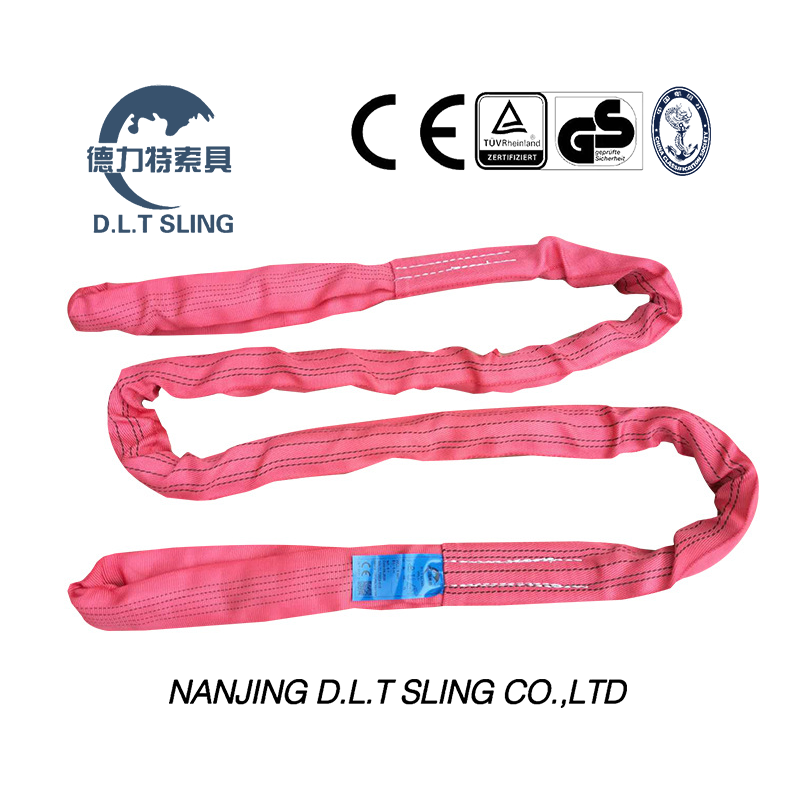
Accurate measurement requires specific techniques and tools. Following a standardized process ensures consistency and safety across your entire rigging fleet.
Clean the sling and lay it on a flat, clean surface. Dirt, grease, and debris obscure damage and prevent the sling from laying completely flat, which skews the measurement. Check the identification tag against physical measurements to verify if the sling has stretched beyond safe limits. If the measured length significantly exceeds the tagged length, the internal core yarns have likely suffered shock loading or permanent elongation, and the sling must be removed from service immediately.
Clear a large, flat area on the shop floor or inspection table.
Lay the sling down and pull it fully taut to eliminate all slack in the protective outer jacket.
Ensure the internal core yarns are aligned and not bunched up inside the cover.
Measure straight from the outer tip of one folded end to the outer tip of the opposite end.
Record this bearing point to bearing point measurement as the accurate EWL.
An Eye-Eye Round Sling features structural differences, with distinct loops formed at each end. You do not measure from the extreme outer tips for this configuration. Instead, measure from the inside bearing point of the top eye to the inside bearing point of the bottom eye. This reflects the actual distance between the shackle pin and the crane hook, providing the true working reach.
Soft Tape Measures: This is the best practice for flexible synthetics. Soft fiberglass tapes trace contours without compression, providing an accurate reading of the fabric's actual length without kinking or bending.
Rope or String Field Method: Use a non-stretch rope or piece of string wrapped around the rigging configuration. Mark or cut it at the overlap, and measure it flat to determine the exact required EWL for irregular loads like pipe bundles or asymmetrical machinery.
Rigid Tape Limitations: Using rigid metal tape measures on flexible synthetics introduces errors. Metal tapes do not conform to the sling's shape, often resulting in an underestimation of the true length, especially on longer slings where the tape sags or bends.
Physical length calculations connect directly to the math of balanced lifting. Properly calculating the required length ensures safe sling angles and optimal load distribution across all attachment points.
To calculate the exact minimum sling length needed to achieve safe sling angles (aiming for 60 degrees or greater from the horizontal), you must define the variables: Load Width (W), Headroom/Height (H), and Number of Legs. The geometric formula uses these variables to determine the necessary reach. For a simple two-leg lift, the length is the hypotenuse of the right triangle formed by the headroom and half the load width.
For example, if you have a load with pick points 10 feet apart (W=10), and you want the crane hook to be exactly 10 feet above the load (H=10). Half the load width is 5 feet. Using the Pythagorean theorem (a² + b² = c²), you calculate 5² + 10² = 25 + 100 = 125. The square root of 125 is approximately 11.18 feet. Therefore, you need slings with an EWL of at least 11.2 feet to maintain that specific headroom and angle.
Vertical Hitch: Provides direct 1:1 length utilization. The sling hangs straight down from the hook to the load attachment point. A 10-foot sling provides exactly 10 feet of reach.
Choker Hitch: The choke point consumes physical length and reduces both effective reach and capacity, typically by 20%. The sling passes around the load and back through itself. You must account for the circumference of the load when calculating the required EWL for a choker hitch.
Basket Hitch: Passing the sling under the load effectively halves the reach while doubling the capacity, depending on the D/d ratio (the ratio of the load diameter to the sling diameter). A 20-foot EWL sling used in a true vertical basket hitch will only provide 10 feet of reach from the hook to the bottom of the load.
Sling angles dictate the required length to maintain a safe center of gravity. Lower angles (closer to horizontal) drastically increase the tension on each sling leg. The trigonometry of lifting uses the formula: Reach = Headroom / Cosine of the angle. This provides a decision framework for specifying the correct sling length for any given lift. Riggers must always verify that the selected sling length does not create an angle less than 30 degrees from the horizontal, as the tension multiplier becomes dangerously high.
Standard warehouse slings differ significantly from heavy-duty construction variants. The harsh environment, abrasive materials, and the unpredictable nature of job site loads dictate specific measurement and procurement requirements.
Measuring a continuous-filament round sling differs from measuring flat polyester webbing slings. A Construction Round Sling forms a continuous loop of core yarns, while webbing slings often feature specific eye configurations sewn into the ends, like flat, twisted, or tapered eyes. These eye types affect how the bearing points align under tension. Round slings conform to the load and the hook much better than flat web slings, but their tubular nature means they can bunch up if not measured under slight tension.
Exposure to moisture, UV radiation, and extreme temperatures affects the jacket material. Over time, these environmental factors can alter the measurable length and degrade the internal fibers. A sling left out in the mud and sun will stiffen, making it difficult to lay flat for an accurate EWL measurement. Regular cleaning and proper storage are mandatory to maintain dimensional stability.
Polyester elongates differently than high-performance fibers like HMPE or Dyneema under load. Polyester typically stretches around 3% at rated capacity, while high-performance fibers stretch less than 1%. This elasticity must factor into the initial length specification to ensure the load remains balanced once lifted. If you are lifting a rigid, precision-machined component, the 3% stretch of a long polyester sling might cause unacceptable tilt during the initial pick.
Adding wear pads or edge protection sleeves bulks up the sling. This added thickness requires slight adjustments in length calculations, especially for tight clearance lifts where every inch matters. The sleeve consumes a small portion of the sling's flexibility and can slightly alter the bearing point geometry when wrapped around a sharp corner.
Procurement errors lead to significant safety risks on the job site. Implementing strict protocols mitigates these dangers and ensures the rigging gear matches the engineered lift plan.
Mismatched Slings in Multi-Leg Lifts: Using slings with varying EWLs due to uneven stretch or different manufacturing batches leads to unequal load distribution. One leg may bear the entire load, causing it to fail catastrophically.
Missing or Illegible Tags: Using a sling where the length and capacity tag is unreadable violates safety regulations. Regardless of physical measurement, an untagged sling must be removed from service immediately.
Incorrect Hitch Application: Ordering a sling based on vertical reach but using it in a choker hitch without accounting for the lost length results in the crane block bottoming out before the load clears the ground.
Establish a strict protocol for matching serial numbers and batch testing for multi-leg assemblies. This ensures all legs have identical stretch characteristics and lengths straight from the factory.
Implement routine proof-testing and recalibration of measurements during annual inspections to catch any elongation or degradation early.
Require all procurement personnel to specify "Effective Working Length (EWL)" on every purchase order, eliminating the circumference confusion entirely.
Weigh the upfront cost of custom-length slings against the operational efficiency and safety guarantees of having exact-fit rigging hardware. Custom lengths prevent the need for awkward rigging configurations, eliminate the use of dangerous cheater chains, and reduce the risk of accidents caused by improvised load balancing.
Audit your current rigging inventory immediately to identify and remove any slings with missing tags or length discrepancies.
Update your procurement documentation to explicitly require Effective Working Length (EWL) measurements for all future sling orders.
Consult engineered load charts and calculate exact headroom requirements before executing complex multi-leg lifts.
Contact a certified rigging specialist to design custom sling specifications when standard lengths force unsafe sling angles.
A: The industry standard is to measure by Effective Working Length (EWL), not total circumference. EWL is the distance from bearing point to bearing point when laid flat.
A: Measure an eye-eye configuration from the inside bearing point of the top eye to the inside bearing point of the bottom eye while the sling is laid flat.
A: The acceptable manufacturing variance is typically +/- 1% to 2% of the stated length. This tolerance must be considered when assembling multi-leg lifts.
A: A choker hitch consumes physical length as the sling wraps around the load and passes through itself, reducing the effective reach and lowering the rated capacity.
A: ASME B30.9 standards dictate removal criteria. If permanent elongation exceeds the manufacturer's allowable limits, the sling must be removed from service.
A: OSHA and ASME regulations require the immediate removal of any sling lacking a legible identification tag, regardless of its physical condition or measured length.
A: Yes, high-performance fibers like HMPE stretch significantly less (under 1%) compared to standard polyester (around 3%) under load, affecting length calculations during lifts.

