

close
Choose Your Site
Global
Social Media

Views: 0 Author: Site Editor Publish Time: 2026-07-31 Origin: Site


Industrial rigging carries massive operational stakes. Equipment failure or improper technique directly results in catastrophic accidents, severe liability, and operational downtime. Matching the correct lifting apparatus to specific load geometries, calculating dynamic tension, and maintaining strict compliance with safety standards like OSHA and ASME present complex challenges on site. Operators must account for shifting centers of gravity, sharp edges, and environmental degradation before tension is ever applied to the crane hook. This guide provides a systematic, evidence-based framework for selecting, inspecting, and safely deploying a lifting sling. We focus on risk mitigation and technical execution, ensuring you have the practical knowledge to calculate load limits accurately, choose the right materials, and execute lifts without compromising safety or load integrity.
Load Calculation is Non-Negotiable: Sling capacity is not static; Working Load Limits (WLL) drastically decrease as the angle of the lift decreases.
Avoid Single-Point Lifting on Unstable Loads: Using a single lifting sling on long, shifting, or unbalanced loads increases slip and rotation risks; multi-leg configurations or spreader beams are mandatory for load control.
Material Specificity Dictates Application: Choosing between a Polyester Lifting Sling, wire rope, or chain requires evaluating environmental exposure (chemicals, UV, temperature) and load fragility.
Pre-Lift Inspection Prevents Failure: Missing identification tags, micro-tears, or chemical burns mandate immediate removal from service.
Edge Protection is Mandatory: Synthetic slings require engineered edge protection to prevent severing under tension, regardless of the load's perceived sharpness.
The primary objective of a safe lift involves maintaining absolute load control, preventing material failure, and ensuring the center of gravity is accurately identified before tension is applied. A successful operation requires mapping out the physical characteristics of the load and matching them against the mechanical limitations of your rigging hardware. You must evaluate the load weight, dimensions, structural integrity, and the environmental conditions of the lift zone.
Working Load Limit calculations dictate the survival of the rigging setup. You must first identify the total weight of the load using shipping manifests, engineered drawings, or industrial scales. Never guess the weight. Once the total weight is confirmed, divide this number by the number of sling legs actively bearing the load. This provides the baseline tension per leg before factoring in angles.
Locating the center of gravity prevents shifting or sliding out of the hitch. The crane hook must be positioned directly above the center of gravity. If the load is asymmetrical, the sling legs will bear unequal portions of the weight. The leg closest to the center of gravity will carry a significantly higher percentage of the load, requiring adjustments in sling length or capacity. Riggers must calculate these unequal forces to prevent overloading a single leg.
Relying on a single sling for long or unbalanced loads creates a dangerous pivot point. This single-point lifting method causes tipping, rotation, and catastrophic slippage. A single choker or basket hitch cannot control a load that tends to shift dynamically during transit. Even a slight breeze or crane movement can induce an uncontrollable spin.
Transitioning to multi-leg bridle slings or utilizing spreader bars becomes mandatory to maintain a level, stable plane during lifting. Multi-leg configurations distribute the weight across multiple anchor points, locking the load's orientation. Spreader bars prevent the sling legs from crushing fragile loads by keeping the lifting forces completely vertical. This setup isolates the compressive forces to the spreader bar itself, protecting the payload.
Synthetic materials offer distinct technical trade-offs compared to steel wire rope or alloy chain. Synthetics mold to the shape of the load and absorb shock better than steel, but they are highly susceptible to cuts and heat. Steel provides rugged durability and high-temperature resistance but can crush delicate surfaces and is heavy to maneuver.
A Polyester Lifting Sling serves specific use cases perfectly. It is the standard for handling delicate surface loads like machined parts or painted equipment. It operates safely in non-sparking environments and provides an exceptionally high strength-to-weight ratio, reducing rigger fatigue during setup. Polyester also exhibits lower stretch characteristics compared to nylon, offering better load control during the initial hoist.
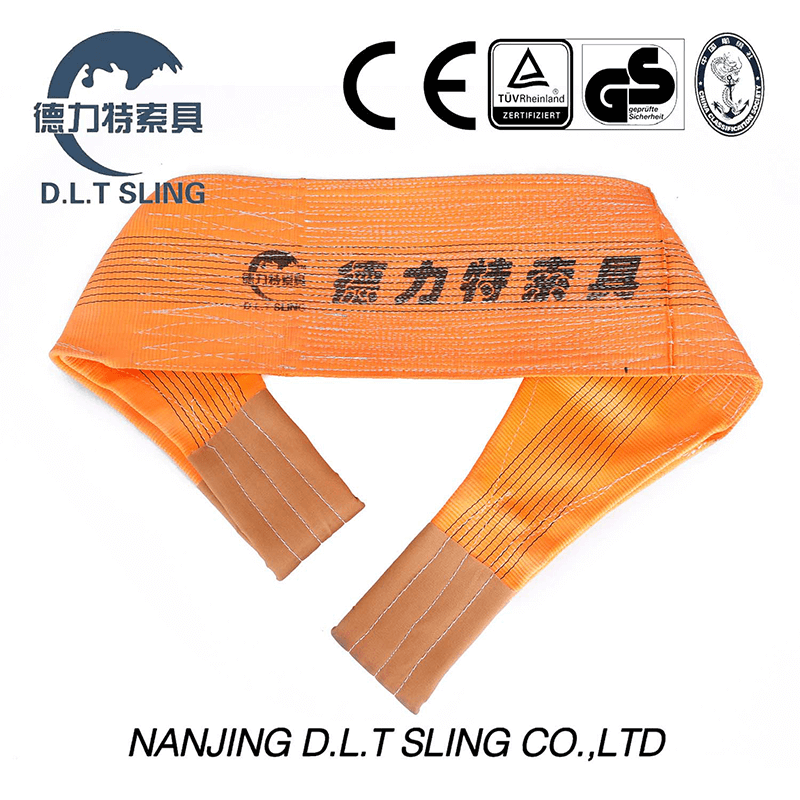
A Flat Webbing Sling provides a wide surface area that excels at load distribution. This broad contact patch prevents localized crushing on fragile loads. However, the flat woven edges are highly susceptible to friction and edge damage if not properly protected. Operators must inspect the selvedge edges closely for wear.
Round slings feature a continuous loop of load-bearing yarn encased in a protective tubular jacket. This construction allows the user to rotate the wear points between lifts, extending the equipment's lifespan. Round slings offer superior performance in choker hitches because the pliable jacket conforms tightly around the load without creasing. The internal yarns slide independently, adjusting to the load contour.
The method used to attach the sling to the load drastically alters its lifting capacity. Operators must understand how different hitches and angles multiply tension forces. Ignoring these multipliers leads to immediate hardware failure.
The three primary hitch configurations are vertical, choker, and basket. Each interacts with the load differently and provides varying levels of control and capacity.
Vertical Hitch: Connects directly from the crane hook to the load, utilizing 100% of the rated capacity. It provides no rotational control.
Choker Hitch: Wraps around the load and passes through its own eye. This configuration pinches the material, generally reducing the WLL by 20%. It provides better control but stresses the sling at the choke point.
Basket Hitch: Cradles the load by passing under it, with both eyes attaching to the crane hook. When the legs are perfectly vertical, a basket hitch can double the WLL of a single leg.
The physics of sling angles dictate that as the angle between the sling leg and the horizontal plane decreases, the tension on each leg increases exponentially. A 10,000-pound load lifted by two vertical legs places 5,000 pounds of tension on each leg. If those legs are spread to a 30-degree horizontal angle, the tension on each leg doubles to 10,000 pounds.
Industry calculation sheets use the vertical sling angle—the angle between the sling leg and the vertical crane hook line—to verify actual working tension. Horizontal angle metrics are also standard. The formula for calculating horizontal tension involves dividing the load weight per leg by the sine of the horizontal angle. The strict industry standard requires operators to avoid lifting with sling angles less than 30 degrees to the horizontal to prevent catastrophic tension overload.
Horizontal Angle | Tension Multiplier | Effect on 1,000 lb Load (Per Leg, 2-Leg Setup) |
|---|---|---|
90 Degrees (Vertical) | 1.000 | 500 lbs |
60 Degrees | 1.155 | 577 lbs |
45 Degrees | 1.414 | 707 lbs |
30 Degrees | 2.000 | 1,000 lbs |
Executing a safe lift requires strict adherence to procedural checklists. Skipping steps during preparation directly leads to hardware failure. Field execution demands discipline and constant situational awareness.
A mandatory visual and tactile inspection process must occur before every lift. Run your bare hands along the entire length of the synthetic material to feel for hardened spots or embedded debris. Discard criteria are absolute. You must remove the equipment from service immediately if you find illegible manufacturer tags, acid or caustic burns, melting or charring, snags, punctures, or broken stitching.
Position the lifting hardware perfectly over the center of gravity to ensure a level lift. Once positioned, you must implement engineered edge protectors. Sleeves, corner pads, or magnetic edge guards prevent the synthetic material from snapping against sharp load edges. Cardboard or rags are not acceptable edge protection. The protection must be rated to withstand the friction and compression forces of the lift.
Raise the load slightly—just a few inches off the ground. This test lift verifies load balance, confirms the center of gravity, and tests the crane's brake function. If the load tilts, lower it immediately and adjust the rigging. Establish strict safety perimeters. Ensure absolutely no personnel stand under, near, or within the potential fall zone of the suspended load.
Verify rated capacities for the specific hitch configuration being used.
Perform 360-degree pre-lift tactile checks on all synthetic materials.
Ensure crane hook latches close completely and smoothly.
Never pull or drag rigging hardware from under a heavy load resting on the ground.
Never knot, twist, or splice slings together to shorten their length.
Never place the seam or splice directly on a bearing point or within a hook.
Even perfectly calculated lifts can fail if environmental factors or dynamic forces are ignored. Mitigating these risks requires proactive management of the rigging environment and strict operational controls.
Prolonged UV exposure breaks down synthetic fibers, causing them to become brittle and lose tensile strength. Extreme temperatures also pose severe risks. Synthetic materials should never be exposed to environments above 194°F (90°C). Chemical exposure requires careful matching; polyester resists acidic environments well but degrades rapidly when exposed to alkalis or caustic substances. Always consult the manufacturer's chemical compatibility charts before rigging in industrial processing areas.
Shock loading occurs during the sudden acceleration or deceleration of the load. Jerking the crane hoist, dropping the load rapidly and catching it, or slipping rigging can instantly multiply the gravitational force. Shock loading can instantly exceed the WLL and cause catastrophic failure. Crane operators must use smooth, controlled movements, gradually applying tension to the rigging before hoisting. Communication between the rigger and the operator must be clear and continuous.
Proper storage extends equipment lifespan and maintains safety compliance. Store all rigging hardware in cool, dry, dark environments. Hang them on designated racks away from mechanical operations, welding sparks, or chemical storage areas. Keeping them off the ground prevents moisture absorption and mechanical damage from forklifts. Implement a strict check-in/check-out system to track usage and ensure damaged gear is quarantined immediately.
Safe lifting operations rely entirely on accurate mathematical load calculations, rigorous pre-use inspections, and the correct application of hitches and angles. Procurement and safety teams must build their inventory based on load fragility, environmental hazards, and required WLL, ensuring a mix of flat webbing and round slings are available for versatile operational readiness.
Conduct a comprehensive audit of all current rigging hardware in your facility.
Destroy and replace any slings with missing, illegible, or damaged identification tags.
Procure engineered edge protection rated for your specific load types.
Schedule standardized, documented rigging training for all crane operators and floor personnel.
A: First, determine the total weight of the load. Divide this total weight by the number of sling legs actively bearing the load. Finally, apply the specific angle multiplier based on the horizontal or vertical sling angle to determine the actual tension per leg. Angles closer to horizontal drastically increase the tension.
A: Immediate discard is required if you find missing or illegible identification tags, cuts, holes, snags, chemical burns, melting, charring, or broken stitching in the load-bearing splices. Any sign of abrasive wear that exposes core yarns also mandates removal from service.
A: As the angle between the sling leg and the horizontal plane decreases, the tension on the sling increases exponentially. Smaller angles closer to horizontal effectively reduce the safe lifting capacity of the hardware. Lifts should never be performed with horizontal angles less than 30 degrees.
A: Yes, but only if engineered cut-resistant edge protection or corner pads are properly installed between the sling and the load. The synthetic material must never make direct contact with a sharp edge, as it will sever under tension.
A: A single sling does not prevent load rotation, tilting, or sliding out. For long, loose, or unbalanced loads, a single pivot point creates dynamic instability. A multi-sling configuration or spreader bar is required to maintain control and keep the load level.
A: A round sling features a continuous internal yarn loop encased in a protective tubular jacket, allowing wear points to be rotated. A flat webbing sling has a woven, flat surface that provides a wider contact area, which is excellent for distributing pressure on fragile loads.
A: A visual and tactile inspection by the user is required before every single use. Additionally, documented periodic inspections must be conducted by a qualified professional at least annually, or more frequently depending on the severity of service conditions.

