

close
Choose Your Site
Global
Social Media

Views: 0 Author: Site Editor Publish Time: 2026-08-03 Origin: Site


Improper use of synthetic web slings leads to catastrophic load drops, severe safety hazards, and immediate OSHA compliance violations. Industrial rigging leaves zero margin for error. Riggers and safety managers must match the correct sling configuration, hitch type, and load capacity to complex load geometries without exceeding the Working Load Limit (WLL) or causing synthetic material degradation. Selecting the wrong equipment or miscalculating hitch capacities directly threatens job site safety and operational integrity.
We outline the technical framework for evaluating, inspecting, and deploying web slings, moving from pre-lift compliance checks to the execution of standard hitch formations in accordance with ASME B30.9 and OSHA standards. You will learn how to identify the right synthetic configuration for specific loads, calculate tension based on sling angles, and implement mandatory edge protection protocols. Understanding these operational mechanics ensures every lift is executed with precision, control, and absolute regulatory compliance.
Hitch Selection Dictates Capacity: A basket hitch can double a sling's capacity compared to a vertical hitch, while a choker hitch significantly reduces it; precise calculation is non-negotiable.
Configuration Matching: Selecting between a flat webbing sling and an endless lifting sling depends entirely on load shape, wear points, and required choke capabilities.
Mandatory Edge Protection: Synthetic materials are highly susceptible to cutting; OSHA mandates verified padding or edge guards when slings contact sharp or abrasive load edges.
Strict Removal Criteria: Missing identification tags, acid burns, melting, or visible red core warning yarns require immediate removal from service.
Identifying the correct synthetic sling type based on the physical dimensions, weight distribution, and surface sensitivity of the load is the first step in rigging. Aligning equipment selection with standard industry classifications under ASME B30.9 ensures that the physical properties of the rigging gear match the demands of the lift. Using the wrong configuration often leads to uneven wear, load instability, or material failure.
Constructed from tightly woven polyester or nylon, the Flat Webbing Sling features reinforced sewn eyes at both ends. These slings fall into two primary designs. Type 3, known as the Flat Eye, features eyes that lie in the same plane as the main sling body. Type 4, the Twisted Eye, features eyes sewn at a 90-degree angle to the sling body. This twisted design facilitates easier choker hitches by allowing the eye to sit naturally on the crane hook and pass smoothly through the opposing eye.
When evaluating dimensions and application suitability, these slings handle directional pulls and standard choker or basket hitches well. Their flat profile makes them significantly easier to extract from beneath a landed load compared to bulkier alternatives. However, trade-offs exist. The fixed wear points located at the bearing points of the eyes can lead to localized degradation over time. Because the lifting stress repeatedly concentrates on the same sections of the eye, riggers must monitor these specific areas closely for abrasion and broken stitches.
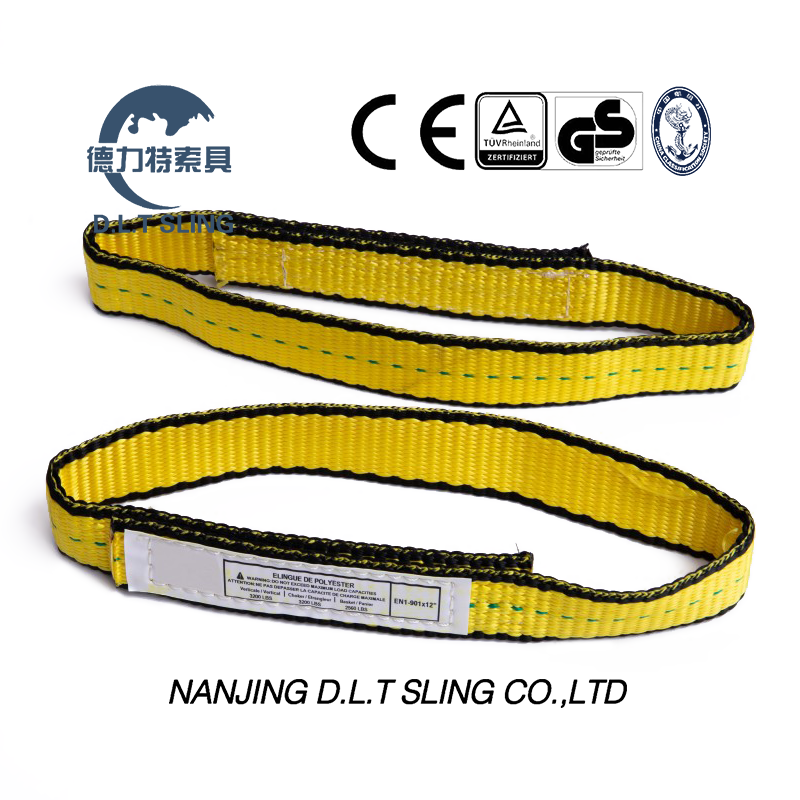
Designated as Type 5 (EN), the Endless Lifting Sling consists of a continuous loop of synthetic material. This category includes both round slings and endless web slings. The absence of fixed sewn eyes fundamentally changes how the equipment interacts with the load and the crane hook.
The primary advantage of this configuration is its extreme versatility. The continuous loop allows the user to rotate the sling before each lift, distributing wear evenly across the entire length of the material. This rotation significantly extends the operational life of the equipment. On the downside, these continuous loops can be bulkier in tight clearance areas compared to a standard flat profile. They also require careful arrangement to prevent twisting during a basket hitch, as twisted fibers experience uneven tension that can compromise the Working Load Limit.
Specialty web slings feature alloy steel end fittings rather than synthetic sewn eyes. Type 1 slings utilize a triangle fitting on one end and a slotted choker fitting on the other, allowing the sling to pass through itself for a secure choke. Type 2 slings feature standard triangle fittings on both ends, primarily used for basket or vertical hitches.
These configurations deploy in heavy-duty applications where rapid hitching is required and standard synthetic eyes would wear out too quickly due to friction against the crane hook or load hardware. The metal fittings absorb the brunt of the hardware-to-hardware contact, preserving the synthetic web body for a longer service life under demanding conditions.
Executing a lift safely requires selecting the appropriate hitch. The method used to attach the lifting sling to the load drastically alters its lifting capacity and control dynamics. Riggers must understand the execution, capacity impact, and implementation risks associated with the three primary hitches.
A vertical hitch involves a direct, straight-line connection from the crane hook to a single attachment point on the load. This is the simplest rigging configuration available.
This hitch utilizes exactly 100% of the equipment's rated Working Load Limit (WLL). If the tag states a vertical capacity of 5,000 pounds, the setup can safely lift 5,000 pounds. However, the implementation risk is high when lifting unguided materials. A single vertical hitch provides zero load control against rotation. The load can easily spin, twist, or swing. You must never use a single vertical hitch for lifting loose, unbalanced, or unwieldy materials that lack inherent stability.
Execution of a choker hitch involves passing one end of the sling through the opposite eye, or through the loop of an endless configuration, and pulling it tight around the load. This creates a gripping action that tightens as tension is applied by the crane.
The capacity impact is significant. A standard choker hitch reduces the base vertical capacity by approximately 20%, depending on the exact angle of the choke. The implementation risks require strict attention. The choke point must be pulled down tight before the lift begins to ensure a secure grip. Furthermore, the eye or the sew joint must never be positioned directly on the load's corner or at the exact point of the choke, as the severe angle and crushing force will destroy the stitching and synthetic fibers.
A basket hitch cradles the load by passing the material under the object and attaching both ends to the crane hook. This distributes the weight across two legs.
When executed correctly, a basket hitch can achieve up to 200% of the single-leg WLL. This maximum capacity is only valid provided the sling legs are perfectly vertical, meaning they sit at 90 degrees to the load. The primary implementation risk is load shifting. The load's center of gravity must remain strictly below the lifting points. Additionally, the legs must not slide along the load during elevation. If the load is unbalanced, it can slip out of the basket entirely, resulting in a catastrophic drop.
Understanding rigging physics is non-negotiable for safe operations. The physical forces acting on suspended materials dictate how the load will behave once it leaves the ground. Mastering load control prevents accidents and protects personnel.
The fundamental rigging principle states that the lifting hook must be positioned directly above the load's Center of Gravity (CoG). If the hook is offset, the load will immediately shift, tilt, or swing violently upon lift-off as it seeks its natural balance point beneath the hook.
Establishing a stability framework requires careful planning. Riggers often use a multi-leg system or dual-basket hitches to distribute weight evenly. By securing attachment points at equal distances from the CoG, the rigging team prevents load rotation and ensures the object remains perfectly level during the entire path of travel.
Load manipulation must never rely on personnel physically pushing or pulling suspended materials. Taglines are mandatory tools attached to the load to control rotation and guide the path of travel. They allow riggers to steer the object from a safe distance.
Operational control heavily depends on taglines to prevent wind and rotational inertia from twisting the synthetic fibers. When a load spins uncontrollably, it can twist the rigging gear, which damages the internal fibers or triggers accidental de-reeving where the hitch loosens and fails.
Rigging requires precise mathematical calculations. Guesswork leads to equipment failure. Riggers must accurately interpret manufacturer specifications and calculate the exact tension applied to the rigging gear based on the angles of the lift.
Compliance standards set by OSHA 1910.184 and ASME B30.9 require all synthetic rigging equipment to have a permanently affixed, legible identification tag. If the tag is missing or unreadable, the equipment must be removed from service immediately.
The tag provides specific data points. Riggers must extract the material type (nylon or polyester), the manufacturer's name, the stock number, and the specific Working Load Limits for vertical, choker, and basket hitches. These numbers form the baseline for all capacity calculations.
Technical evaluation of a lift must account for sling-to-load angles. As the angle between the sling leg and the horizontal plane of the load decreases, the tension on the synthetic material increases exponentially. A shallower angle creates massive horizontal forces that pull against the rigging gear.
The calculation framework relies on load angle factors. For example, lifting a load with legs positioned at a 30-degree angle to horizontal effectively doubles the tension on each leg compared to a vertical lift. Risk mitigation best practices dictate maintaining angles greater than 45 degrees, with 60 degrees being the preferred minimum, to prevent overloading the synthetic fibers and causing a sudden snap.
Sling Angle (to horizontal) | Tension Multiplier (Load Angle Factor) | Capacity Impact |
|---|---|---|
90 Degrees | 1.000 | 100% Capacity |
60 Degrees | 1.155 | Slight Tension Increase |
45 Degrees | 1.414 | Moderate Tension Increase |
30 Degrees | 2.000 | Double Tension (High Risk) |
Safety relies on rigorous inspection protocols. Synthetic materials degrade through mechanical wear, chemical exposure, and environmental factors. Identifying defects before a lift is a strict regulatory requirement.
OSHA enforces a strict pre-use mandate requiring a competent person to inspect the rigging equipment before every single shift. This is not a casual glance; it is a systematic evaluation of the material's integrity.
Lay the sling flat on a clean surface in a well-lit area.
Inspect the entire length for broken stitches, severe abrasion, and snags.
Check for UV degradation, which manifests as bleaching or stiffness in the fibers.
Look for weld spatter and chemical burns that compromise the structural integrity of the web.
Verify the identification tag is present and fully legible.
The sharp edge problem is the leading cause of synthetic rigging failure. Synthetic fibers will sever rapidly under high tension if exposed to unprotected corners, abrasive surfaces, or rough metal edges.
Mitigation strategies demand the use of engineered edge guards. Riggers must utilize magnetic corner protectors, engineered sleeves, or heavy-duty wear pads of sufficient strength and thickness to withstand the cutting force. Cardboard, carpet remnants, or thin rags are not compliant, offer zero real protection, and create a false sense of security that leads to fatal accidents.
Establishing the "Red Zone" is a necessary administrative control. Safety managers must define clear physical boundaries using barricades or hazard tape to keep all personnel at a safe distance from suspended loads. No one should ever walk, stand, or work beneath a suspended object.
Communication protocols must be airtight. The lifting operation must rely on standardized hand signals or dedicated radio channels. Designating a single, highly trained signal person to coordinate directly with the crane operator eliminates confusion and prevents erratic crane movements.
Strict criteria govern the removal of rigging equipment. If a sling exhibits missing or illegible tags, it is immediately disqualified. The exposure of red core warning yarns indicates that the outer protective jacket has worn through, and the load-bearing core is compromised. Cuts exceeding manufacturer allowances, any signs of melting, charring, or acid burns also mandate removal.
The actionable step upon discovering a defective sling is immediate destruction. The compromised equipment must be physically cut in half or otherwise rendered completely unusable to prevent another worker from accidentally pulling it out of a bin and using it for a lift.
Evaluating why a facility would choose synthetic webbing over alloy chain or wire rope requires understanding the conceptual trade-offs of the materials. Each type of rigging gear serves distinct operational environments.
The pros of synthetic materials are substantial. They are non-marring, meaning they protect finished, painted, or highly machined parts from scratches and gouges during the lift. They are incredibly lightweight, which significantly reduces rigger fatigue and speeds up the rigging process. Their flexibility allows them to conform tightly to irregular load shapes, providing excellent grip in choker hitches.
The cons revolve around environmental vulnerabilities. Synthetic webbing has a high susceptibility to heat, typically failing or melting at temperatures exceeding 180°F (82°C). They possess chemical vulnerabilities; nylon reacts poorly to acids, while polyester degrades in the presence of strong alkalis. Furthermore, they offer significantly lower durability against severe abrasion and cutting compared to alloy steel chains or thick wire rope.
Safe and effective use of synthetic rigging equipment requires a rigorous understanding of load geometry, hitch capacity reductions, and strict adherence to inspection protocols. Ignoring the physics of sling angles or bypassing edge protection leads directly to catastrophic failures.
Audit your current rigging hardware immediately to ensure all tags are legible.
Implement mandatory, documented pre-shift inspection logs for all crews.
Procure and mandate the use of engineered edge protection for all synthetic rigging operations to eliminate cut-related failures.
Destroy and discard any slings showing signs of red core warning yarns or chemical burns.
A: A flat webbing sling features fixed, reinforced sewn eyes at each end, making it ideal for standard directional pulls. An endless lifting sling is a continuous loop of synthetic material. This continuous design allows the user to rotate the sling before each lift, distributing wear evenly across the entire length rather than concentrating it at fixed eye points.
A: Type 1 (TC) has a triangle and choker metal fitting. Type 2 (TT) has triangle fittings on both ends. Type 3 (EE) features flat sewn eyes. Type 4 (EE) has twisted sewn eyes for easier choking. Type 5 (EN) is an endless continuous loop. Type 6 (RE) features reversed eyes built from multiple layers of webbing for heavy-duty applications.
A: A standard choker hitch generally reduces the base vertical capacity of the sling by approximately 20%. However, this reduction can be much more severe if the angle of the choke is less than 120 degrees. Always consult the manufacturer's tag for exact capacity limits.
A: As the angle between the sling leg and the horizontal plane decreases, the tension on the sling increases exponentially. A 30-degree angle effectively doubles the tension on the synthetic material compared to a straight vertical lift. Failing to calculate this added tension easily causes the load to exceed the sling's Working Load Limit.
A: You must use engineered edge guards, magnetic corner protectors, or heavy-duty synthetic wear pads specifically rated for rigging. Materials like cardboard, carpet remnants, or thin rags do not provide adequate friction mitigation and will fail under load, leading to the sling severing.
A: Equipment must be removed from service immediately if it has missing or illegible identification tags, visible red core warning yarns, cuts or snags exceeding manufacturer limits, broken load-bearing stitches, acid or caustic burns, or any signs of melting and charring from heat exposure.

