

close
Choose Your Site
Global
Social Media

Views: 0 Author: Site Editor Publish Time: 2026-08-01 Origin: Site


Overhead lifting operations carry immense risk. Equipment failure or improper rigging execution results in catastrophic accidents, facility downtime, and severe liability. Procuring high-quality rigging equipment is only the first step. Operators must possess a standardized, physics-based understanding of load dynamics, hitch capacities, and environmental degradation factors to ensure safety. Simply attaching a strap to a hook fails basic safety protocols. A safe lift requires a systematic framework covering pre-lift load calculations, correct hitch execution, edge protection, and mandatory compliance inspections based on OSHA and ASME standards. This guide details how to use a lifting sling correctly, ensuring your rigging crew understands the mechanics behind every lift. We cover load calculations, hitch execution, and mandatory compliance inspections.
Capacity is Dynamic: A lifting sling’s Working Load Limit (WLL) drastically changes based on the hitch type (vertical, choker, basket) and the angle of the lift.
Material Dictates Application: Synthetic options like an Industrial Webbing Sling offer flexibility and load protection but require strict edge protection compared to alloy chain or wire rope.
Inspection is Mandatory: Pre-use visual inspections are legally required to identify cuts, abrasions, chemical damage, or missing identification tags before any lift.
Safety Zones Save Lives: Rigging crews must enforce strict exclusion zones; personnel must never stand under or near a suspended load during lift execution.
Center of Gravity Controls the Lift: Proper rigging requires identifying and securing the load's center of gravity to prevent shifting, slipping, or uneven tension distribution.
The Working Load Limit (WLL) represents the maximum weight a sling can safely handle under normal working conditions. You must always read the manufacturer identification tags before use. These tags specify the WLL for different hitch types. Never exceed these limits under any circumstances. Rigging requires exact math, not guesswork. You calculate the total weight of the load, including all attached rigging hardware like shackles, hooks, and hoist rings, to ensure the sling handles the combined weight at the specific lift angle.
Sling angles drastically affect tension. Decreasing the horizontal angle of a sling exponentially increases the tension and stress on the rigging hardware. This phenomenon is known as the Sling Angle Factor. A sling lifting a load at a 30-degree angle experiences significantly more stress than one at a 60-degree angle. When the angle drops, the tension multiplies. You must account for this multiplier before signaling the crane operator.
Horizontal Angle (Degrees) | Tension Multiplier (Load Factor) | Operational Impact |
|---|---|---|
90° | 1.000 | Standard vertical lift. 100% capacity retained. |
60° | 1.155 | Safe working angle. Minor tension increase. |
45° | 1.414 | Moderate tension increase. Requires careful WLL verification. |
30° | 2.000 | Tension doubles. Highly restricted lifting angle. |
Choosing the right material dictates the success of the lift. An Industrial Webbing Sling made of synthetic polyester or nylon works perfectly for fragile loads or finished parts. It will not scratch or mar the surface of machined components. However, synthetics remain susceptible to heat, sharp edges, and UV degradation. You must deploy edge protection when lifting steel plates or concrete blocks.
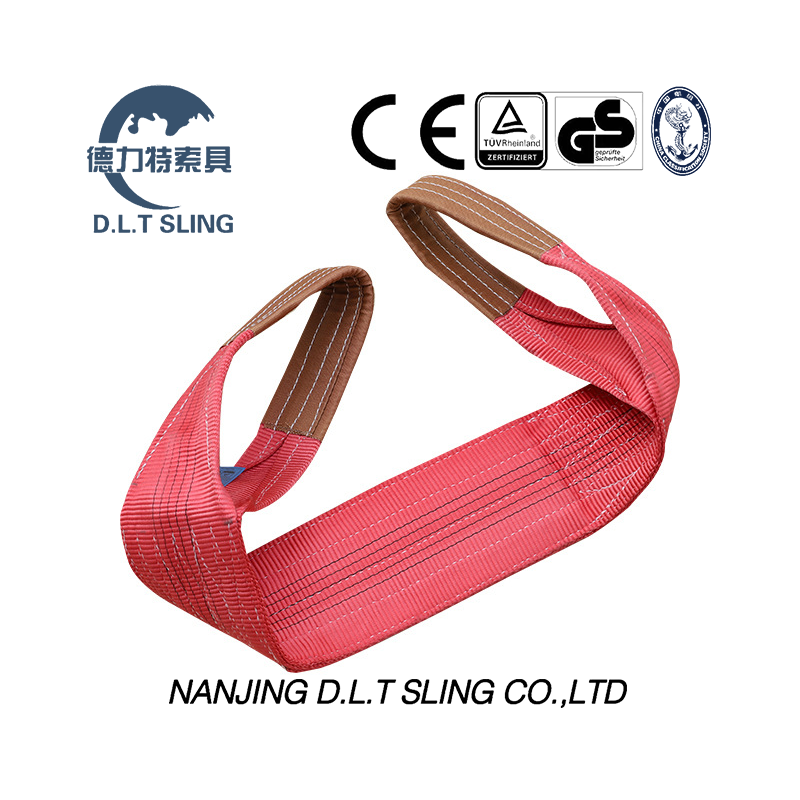
When selecting an Eye-Eye Lifting Sling, you choose between Type 3 (Flat Eye-and-Eye) and Type 4 (Twisted Eye-and-Eye) configurations. Twisted eyes lie flat on the crane hook. This allows for a more efficient choker hitch and reduces wear on the fabric. Round slings feature a continuous loop construction, while flat webbing slings are woven flat. For high-heat, abrasive, or extreme heavy-duty environments, metal alternatives like grade 80 or 100 alloy chain slings or wire rope become necessary. Synthetics will fail under extreme heat or heavy abrasion.
A vertical hitch involves a straight line from the hoist hook directly to the load. This configuration utilizes 100% of the sling's WLL. While it maximizes capacity, it provides zero rotational control over the load. The vertical hitch works best for lifting items with engineered, centralized lifting points. Examples include a single eye bolt on a motor or a designated lifting lug on a pump housing. You must ensure the load's center of gravity aligns perfectly beneath the hook to prevent swinging.
The choker hitch forms when the sling passes through itself to grip the load tightly. This method provides excellent control but reduces the WLL by approximately 20%. The reduction occurs due to the stress concentrated at the choke point and the angle of choke. A Twisted Eye-Eye Lifting Sling works best here to reduce wear at the point of choke. Never force the choke down toward the load. This practice, known as beating down the choke, severely damages the sling fibers and compromises the lift.
A basket hitch cradles the load with both eyes attached to the hoist hook. A true vertical basket hitch doubles the WLL of a single leg, provided the legs remain at a 90-degree angle to the load. You must keep the load's center of gravity below the lifting points. This prevents the load from sliding out of the basket. If the load shifts, the entire lift becomes unstable. Use double wrap basket hitches for smooth cylindrical loads to increase grip and prevent slipping.
Before applying full tension, locate the center of gravity (CG). Position the sling to ensure the CG remains stable during the initial test lift. Ensure the hook seats correctly in the eye without crowding. Avoid tip loading the hook. Tip loading causes the hook to bend or break under pressure. Use taglines to control load rotation. Taglines allow personnel to guide the load without placing themselves in the fall zone.
Identify the load weight and center of gravity.
Select the appropriate sling and hitch method.
Attach the sling to the load and the crane hook.
Apply slight tension to verify balance and secure attachment.
Lift the load a few inches to confirm stability before proceeding.
Unprotected sharp edges and abrasive surfaces cause most synthetic sling failures. In rigging, a sharp edge is any edge not rounded to the specific radius required by the sling manufacturer based on the WLL. You must use mitigation tools to protect the sling fibers from being sliced under tension. Magnetic corner protectors, cut-resistant sleeves, and heavy-duty wear pads provide necessary barriers between the load and the sling.
Establish a zero-tolerance policy for standing, walking, or working under a suspended load. Calculate and enforce a physical safety boundary based on the height of the lift and potential load deflection or swing. Establish clear hand signals or radio communication protocols between the rigger, spotter, and crane operator before lifting the load off the ground. Everyone on site must understand the communication plan.
Synthetic materials have operational limitations in harsh environments. Standard synthetics typically have a temperature limit of 194°F (90°C). You must also consider chemical exposure. Nylon remains vulnerable to acids, while polyester remains vulnerable to alkalis. Check the chemical compatibility before using synthetic slings in industrial environments. If you work in a chemical plant, verify the sling material against the specific chemicals present.
Operators must perform daily visual inspections based on ASME B30.9 standards. Reject an Industrial Webbing Sling if you find acid or caustic burns, melting, charring, holes, tears, cuts, snags, broken stitching, or excessive abrasive wear. Enforce the missing tag rule. If the WLL tag is illegible or missing, remove the sling from service immediately. Do not guess the capacity of an untagged sling.
Defect Type | Visual Indicator | Required Action |
|---|---|---|
Cuts or Tears | Severed fibers on the edge or face of the webbing. | Remove from service immediately. |
Heat Damage | Melted, charred, or fused fibers. Hard brittle spots. | Remove from service immediately. |
Chemical Damage | Discoloration, brittle fibers, or localized softening. | Remove from service immediately. |
Missing Tag | Illegible or completely detached WLL identification tag. | Remove from service immediately. |
Documented, periodic inspections by a designated competent person are required. Implement a color-coding or tagging system to track inspection intervals and ensure facility-wide compliance. This guarantees that all slings in circulation remain safe for use. Keep detailed records of these inspections to satisfy OSHA requirements and protect your liability in the event of an incident.
Avoid shock loading. Shock loading occurs during sudden acceleration or deceleration. Jerking the load temporarily exceeds the WLL, causing micro-fractures or fiber snapping. Never twist, knot, or bolt a sling together to shorten its length. This destroys the engineered load distribution. Do not rest the load on top of the sling during placement. This creates pinch points that crush synthetic fibers and compromise future lifts.
Formal rigging training and certification remain necessary for all personnel involved in overhead lifting. Establish standardized, written lift plans for complex, heavy, or asymmetrical loads. This ensures all team members understand the execution strategy. Regular toolbox talks and safety stand-downs reinforce these principles and keep safety at the forefront of daily operations.
Safe lifting operations rely on selecting the correct sling and executing mathematically sound rigging techniques. Choose your hitch types and sling materials based on load fragility, weight, center of gravity, and environmental hazards. Rigging requires precision, discipline, and strict adherence to safety standards.
Audit your current rigging hardware immediately and discard any untagged equipment.
Replace undocumented or damaged slings with certified replacements.
Invest in certified edge protection for all synthetic sling applications.
Ensure your operators receive proper, documented rigging training annually.
A: Check the manufacturer's tag for the Working Load Limit (WLL). Adjust this base capacity depending on the hitch type (vertical, choker, or basket) and calculate the reduction caused by the sling angle using the sling angle factor.
A: An eye-eye sling is flat woven webbing with loops at both ends. A round sling is a continuous loop of synthetic yarn encased in a protective tubular jacket.
A: Type 3 flat eyes are oriented in the same plane as the sling body. Type 4 twisted eyes are twisted 90 degrees, allowing them to sit better on crane hooks and form more efficient choker hitches.
A: As the horizontal angle of the sling decreases, the tension on the sling increases exponentially. A lower angle reduces the effective lifting capacity of the sling.
A: Remove it immediately if you find cuts, holes, tears, snags, chemical burns, melting, broken stitching, excessive wear, or if the identification tag is missing or illegible.
A: No. Tying a knot severely reduces the sling's capacity and destroys the engineered load distribution, making it highly unsafe.

