

close
Choose Your Site
Global
Social Media

Views: 0 Author: Site Editor Publish Time: 2026-07-29 Origin: Site


Synthetic web slings are foundational to modern material handling, offering a high strength-to-weight ratio while protecting delicate or finished loads from surface damage. Improper hitch execution, incorrect configuration selection, or failure to mitigate edge friction routinely leads to catastrophic load drops, equipment damage, and severe OSHA violations. This guide breaks down the technical evaluation of synthetic slings, detailing how to match specific configurations to load geometries, execute standard hitches safely, and implement strict compliance protocols to eliminate rigging failures. We will cover the exact field practices required to secure loads properly, calculate tension multipliers, and select the right materials for harsh operating environments. You will learn how to deploy a lifting sling safely across various industrial applications.
Capacity is Dynamic: A lifting sling’s Working Load Limit (WLL) changes drastically based on the hitch type used (Vertical, Choker, or Basket) and the angle of the lift.
Configuration Dictates Application: An Endless Webbing Sling offers superior wear rotation for continuous use, while an Eye-Eye Webbing Sling provides precise control for traditional rigging points.
Material Selection Impacts Stability: Nylon offers stretch (up to 10%) for shock absorption, whereas polyester provides minimal stretch (around 3%) for strict load control.
Edge Protection is Mandatory: OSHA regulations strictly require cut-resistant padding or sleeves when synthetic slings contact any load edges or corners.
Before executing any lift, riggers must assess the center of gravity, structural integrity of the load, and available pick points. These factors determine the necessary sling length, width, and balance required for a safe operation. A load with an offset center of gravity requires adjustable rigging components to ensure the load remains level once suspended. You must calculate the exact weight of the load and verify that the rigging hardware matches or exceeds that weight.
Evaluating load surface friction helps determine if specialized wraps are needed to prevent the load from shifting or sliding out of the hitch. Proper load control is essential when handling smooth or irregularly shaped objects like machined shafts or coated pipes. If the surface is too slick, a standard choker hitch will fail to grip the material, requiring a double-wrap configuration to increase surface contact and friction.
Operating environments must be evaluated for UV degradation, extreme temperatures, and chemical exposure. Standard synthetic materials lose their structural integrity when exposed to temperatures above 194°F (90°C). You must also identify whether the environment contains active acids or alkalis. These environmental factors dictate the specific material requirements for the rigging equipment.
Identifying loads that require the soft, wide bearing surface of a synthetic web sling over wire rope or alloy chain prevents crushing, scratching, or marring. Synthetic materials distribute the lifting force over a wider area. This makes them ideal for handling finished products, delicate machinery, or painted surfaces where metal rigging would cause unacceptable damage.
The rigging industry categorizes synthetic slings into specific types based on their end fittings and loop configurations. Understanding these classifications ensures you select the correct tool for the specific hitch required by your lift plan.
Type 1 (TC - Triangle & Choke) features a triangle fitting on one end and a slotted choke fitting on the other. This design allows for quick, secure choker hitches. The metal fittings reduce wear on the synthetic material at the choke point. Type 2 (TT - Triangle & Triangle) features triangle fittings on both ends. These are used strictly for vertical and basket hitches and cannot be choked.
Type 3 (EE - Flat Eye-Eye) features flat sewn loops at both ends. They are highly versatile and easy to slide out from beneath loads. Type 4 (EE - Twisted Eye-Eye) features eyes sewn at a 90-degree angle to the sling body. This allows the sling to lay flat against the load in choker hitches, reducing stress on the fabric.
Type 5 (EN - Endless) is a continuous loop configuration. It is highly adaptable with easily rotated wear points. By shifting the contact points before each lift, you extend the operational lifespan of the equipment significantly.
Sling Type | Configuration | Primary Hitches | Best Application |
|---|---|---|---|
Type 1 (TC) | Triangle & Choke Fittings | Choker | Frequent choking of rough materials |
Type 2 (TT) | Triangle & Triangle Fittings | Vertical, Basket | Heavy basket lifts requiring metal bearing points |
Type 3 (EE) | Flat Eye-Eye | Vertical, Basket, Choker | General purpose rigging, easy removal |
Type 4 (EE) | Twisted Eye-Eye | Choker, Vertical | Choker hitches requiring flat body contact |
Type 5 (EN) | Endless Loop | Vertical, Basket, Choker | Abrasive environments, continuous use |
Adding layers of webbing increases the Working Load Limit (WLL) without increasing the overall width. Single-ply slings are flexible and conform easily to load contours. Multi-ply slings (double, triple, quad) offer much higher capacities but are stiffer. They require larger minimum D/d (Diameter of bend to diameter of sling) ratios to prevent internal fiber damage at the bearing points.
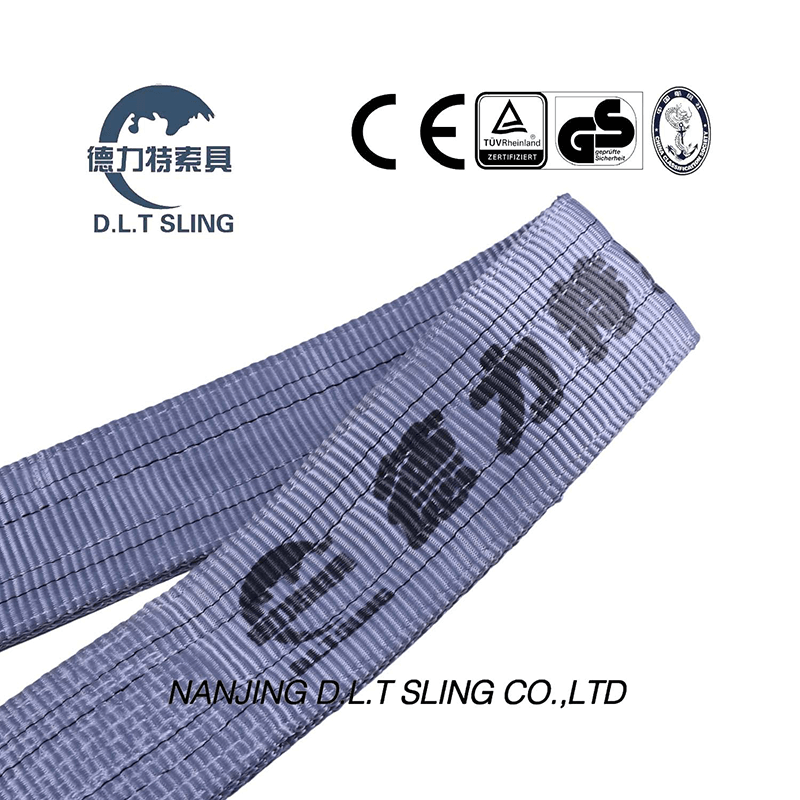
The Eye-Eye Webbing Sling features sewn loops at both ends. It is available in Flat Eye (Type 3) for basket hitches and easy recovery, and Twisted Eye (Type 4) optimized for choker hitches to reduce fabric stress at the connection point. These slings are best used for standardized lifts with dedicated trunnions, shackles, or lifting lugs where quick, secure hookup is required.
Wear points on eye-and-eye configurations are concentrated at the bearing points of the eyes. This limits the overall lifespan compared to continuous loops, as the same sections of fabric bear the load and friction during every lift. You must inspect the eyes closely for broken stitches or severe abrasion.
The Endless Webbing Sling is a continuous loop of synthetic material. It is highly versatile for all three primary hitches and ideal for abrasive environments. The user can rotate the sling to distribute wear evenly across the entire length. This rotation prevents premature failure at a single contact point.
While highly adaptable, endless configurations can be bulkier to manage in tight rigging spaces. The doubled fabric may pinch or bundle inside small hoist hooks, which can cause uneven tension across the width of the webbing. Always ensure the hook bowl is wide enough to accommodate the material without bunching.
Ordering the correct rigging equipment requires precise specifications to ensure the gear matches the physical demands of the lift. Guessing capacities or lengths leads to dangerous rigging geometries and potential failures.
Identify the configuration type (Type 1 through Type 5) based on the specific hitches you plan to execute.
Select the material type (Nylon vs. Polyester) based on environmental hazards, chemical exposure, and stretch requirements.
Match the maximum load weight to the appropriate number of plies (single, double, or multi-ply ratings) while accounting for hitch capacity reductions.
Measure the exact bearing-point-to-bearing-point length under tension to ensure accurate reach and headroom compatibility.
Determine the required width to ensure the bearing surface will not crush delicate load edges.
Always verify the manufacturer's tag requirements. The tag must clearly state the material, WLL for all three hitches, and the manufacturer's name. If a tag is missing or illegible, the equipment must be removed from service immediately.
The vertical hitch is a direct, straight line from the crane hook to the load's designated connection point. It utilizes 100% of the rated WLL. This hitch provides zero load rotation control, meaning the load may spin freely once suspended. It must only be used when the center of gravity is perfectly balanced directly below the hook and a tag line is utilized by a spotter.
In a choker hitch, the material passes around the load, and one eye passes through the other before attaching to the crane hook. This configuration reduces the WLL by at least 20% due to the severe stress concentrated at the choke point. A double-wrap choker variation involves wrapping the material 360 degrees around the load before choking. This prevents slippage of loose bundles or smooth materials like pipes and tubing.
The angle of choke must exceed 120 degrees to maintain standard choker ratings. If the angle is tighter, the capacity drops further. Never force or hammer the choke point down toward the load to tighten the grip, as this causes invisible internal fiber damage.
The basket hitch cradles the load from beneath, with both ends attaching to the crane hook or master link. It effectively doubles the WLL of a single vertical hitch if the legs are perfectly vertical (90 degrees to the load). A double-wrap basket variation involves wrapping the material completely around the load to compress and secure loose materials.
As the angle between the legs and the horizontal plane decreases, the tension increases exponentially. Riggers must calculate horizontal angles prior to lifting. A 30-degree horizontal angle doubles the tension on each leg, requiring equipment with a significantly higher base capacity.
Nylon stretches 8-10% at rated capacity, making it excellent for absorbing heavy shock loads during sudden acceleration or deceleration. It is resistant to aldehydes, ethers, and strong alkalis. However, nylon degrades rapidly in acidic environments. It also absorbs moisture, which can affect performance in freezing conditions or lead to mold degradation if stored improperly.
Polyester stretches only 3% at rated capacity. This provides superior performance for lifts requiring precise clearance, low headroom, and strict load control. It is highly resistant to most acids and common bleaching agents. Polyester is susceptible to damage from concentrated alkalis like lye or caustic soda, and organic solvents.
You must match the chemical resistance of the material to the specific hazards of your job site. Using nylon in a battery manufacturing plant or polyester in a concrete treatment facility will lead to rapid chemical degradation and catastrophic failure.
Synthetic fibers under tension will shear instantly against sharp, rough, or even moderately rounded load edges. Mandatory edge protection is required to prevent catastrophic failure. A common misconception is that a rounded edge is safe; however, under thousands of pounds of tension, even a slightly textured surface acts like a saw blade against synthetic fibers.
OSHA regulations strictly require cut-resistant padding or sleeves when synthetic materials contact any load edges or corners. Cardboard or thin rags are not acceptable edge protection. You must use engineered magnetic corner protectors, Kevlar sleeves, or heavy-duty polyurethane pads designed specifically for rigging applications.
Proper inspection and maintenance protocols must be followed to ensure safe lifting operations. Inspect the equipment for wear, cuts, broken stitches, or chemical damage before every single use. If you find red core warning yarns exposed, acid burns, or melting from heat friction, remove the gear from service and destroy it to prevent accidental use.
Audit your current rigging inventory to ensure all tags are legible and state the correct WLL for vertical, choker, and basket hitches.
Procure engineered edge protection devices for all lifts involving steel plates, machined edges, or rough concrete surfaces.
Train your rigging crews to calculate horizontal tension multipliers before executing any basket hitches with angles under 60 degrees.
Implement a strict daily visual inspection protocol to identify and destroy any synthetic gear showing signs of abrasion, cuts, or chemical burns.
A: The WLL is printed directly on the manufacturer's tag for vertical, choker, and basket hitches. Always consult the tag before rigging. If you are using a basket hitch at an angle, you must manually calculate the tension multiplier to ensure you do not exceed the rated capacity.
A: No. Standard synthetic materials should not be used in environments exceeding 194°F (90°C). High temperatures melt the synthetic fibers, permanently compromising the structural integrity and leading to immediate load drops.
A: A Flat Eye sling has loops sewn flat in the same plane as the body, making it ideal for basket hitches. A Twisted Eye sling has loops sewn at a 90-degree angle to the body, optimizing it for choker hitches by allowing the main body to lay flat against the load.
A: You must conduct a visual inspection before every single use to check for cuts, abrasions, or chemical damage. Additionally, OSHA requires a thorough, documented inspection by a qualified person at least once every 12 months.
A: Synthetic fibers cut easily when exposed to sharp or rough edges under high tension. Engineered edge protection prevents the fibers from shearing against the load, eliminating the risk of catastrophic failure and dropped loads.

