

close
Choose Your Site
Global
Social Media


Views: 0 Author: Site Editor Publish Time: 2026-07-29 Origin: Site


Industrial lifting operations carry immense risk every single day. Dropped loads easily cause catastrophic equipment damage, severe injuries, and irreversible workplace fatalities. Proper rigging equipment selection serves as the primary defense against these cascading failures. Procurement teams and safety managers constantly balance operational efficiency against strict compliance limits. You need lightweight, cost-effective tools to maintain daily productivity. However, you must also respect critical safety factors and harsh environmental constraints without compromise. Choosing an improper sling compromises the entire rigging system and exposes your team to hidden, potentially fatal dangers.
This guide provides a pragmatic, engineering-aligned framework for precise sling selection. You will learn how to assess material properties, decode hitch capacities, and implement industry-mandated safety protocols. We will help you specify the exact lifting equipment needed for your unique operational environment.
Lifting heavy industrial loads requires precise mechanical planning. A common business problem involves balancing high capacity demands against highly fragile payload surfaces. You often need to lift polished metal sheets, painted aerospace components, or delicate fiberglass machinery. Standard alloy chains can easily crush these exterior surfaces under tension. Steel wire ropes often leave deep scratches and permanent indentations. This scenario demands a significantly softer mechanical approach to prevent costly product damage.
Using a synthetic webbing sling solves this business problem effectively. These modern tools offer an incredibly high strength-to-weight ratio. They flex naturally to conform to complex, asymmetrical load geometry. Furthermore, they are entirely non-sparking by design. This unique property makes them strictly necessary for explosive, chemical, or highly volatile environments. They wrap tightly around the heavy load and distribute the lifting pressure evenly across a wide surface area.
However, synthetic materials possess distinct physical limitations. They remain highly susceptible to surface abrasion. Sharp steel edges easily slice through tensioned synthetic fibers. Environmental factors also pose major operational threats. UV exposure, extreme heat, and harsh chemical fumes degrade the microscopic fibers rapidly over time. You must carefully monitor these variables during daily operations.
You must evaluate your success criteria before finalizing procurement. Synthetic rigging remains appropriate only when the payload strictly requires a soft footprint. You must also guarantee operating temperatures remain strictly below 194°F (90°C). If ambient or surface temperatures exceed this critical limit, you must immediately pivot to wire rope or specialized alloy chains to ensure structural integrity.
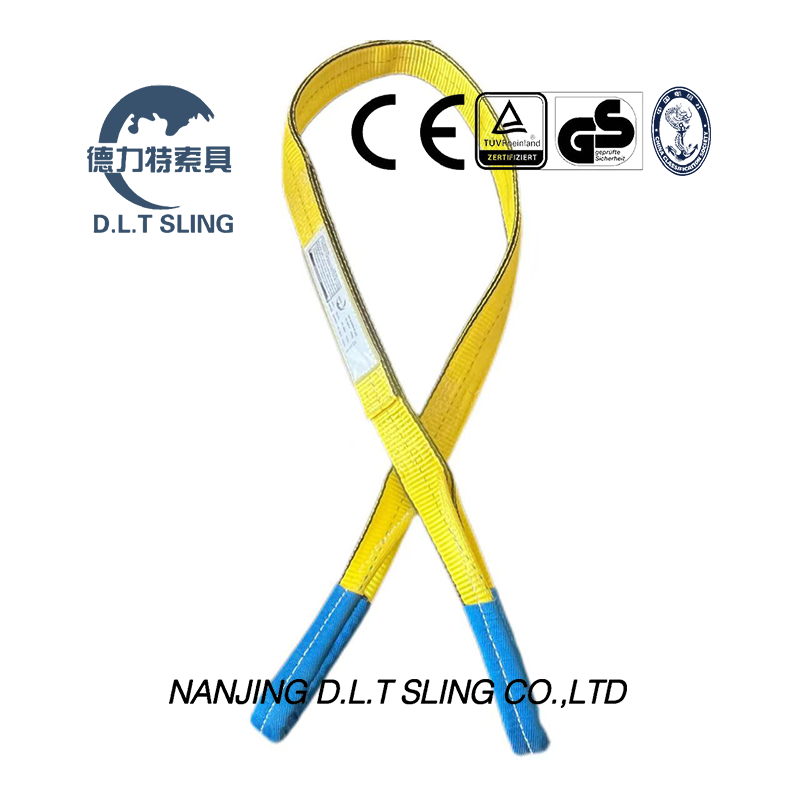
Understanding standard hardware configurations prevents critical rigging failures on the job site. Every specific webbing sling category ensures the absolute correct eye configuration for your specific rigging hardware. The industry categorizes these synthetic tools into six primary types.
You must also master hitch types and capacity derating mathematics. Working Load Limits change drastically depending on your chosen hitch configuration. A standard vertical hitch retains 100% of the manufacturer-rated capacity. A choker hitch severely pinches the fabric fibers together. This physical pinching reduces the overall lifting capacity to approximately 80%. Conversely, a basket hitch cradles the load entirely. When rigged at a perfect 90-degree angle, a basket hitch essentially doubles the lifting capacity to roughly 200%. You must adjust your lifting plans based on these changing mathematical realities.
Material chemistry directly dictates performance in harsh industrial environments. You must match the specific fiber type to your exact facility conditions. The rigging industry relies primarily on two distinct synthetic polymers.
Polyester serves as the absolute industry default for general lifting. It exhibits minimal stretch under maximum load. It typically elongates only about 3% at maximum capacity. This provides excellent load control and spatial predictability. Polyester resists most common industrial acids very effectively. However, you must never expose it to strong alkalis or ethers. They will dissolve the load-bearing fibers.
Nylon offers completely different operational properties. It provides much higher stretch, usually around 10% at maximum capacity. This unique elasticity offers excellent shock absorption during sudden load shifts or jerky crane movements. Nylon resists strong alkalis exceptionally well. Unfortunately, it degrades rapidly when exposed to even mild acidic environments.
| Property | Polyester | Nylon |
|---|---|---|
| Elongation Stretch at Capacity | ~3% (Low Stretch) | ~10% (High Stretch) |
| Chemical Resistance | Resists Most Acids | Resists Most Alkalis |
| Chemical Vulnerability | Severely Degraded by Alkalis | Severely Degraded by Acids |
| Primary Application | Precision Lifting & Control | Dynamic Shock Absorption |
Sizing your rigging equipment requires careful Working Load Limit evaluation. You will often see a universal color-code system utilized heavily in the field. For example, violet indicates one ton of capacity, while green indicates two tons. You must use these colors only as a rapid visual aid. Never use color alone as a definitive engineering specification. The dye can fade, and custom orders often ignore standard color codes entirely. Always verify the printed identification tag before lifting.
The mathematics of lifting angles play a critical, often misunderstood role. Lifting loads at angles less than 90 degrees exponentially increases the actual fiber tension. A 30-degree horizontal angle effectively doubles the stress placed on each individual leg. You must explicitly specify a much higher-capacity unit when operating at severe lifting angles to prevent sudden rupture.
Workplace safety relies entirely on strict adherence to established regulatory protocols. National regulatory bodies set absolute mandatory minimums for structural integrity and testing. Following the flat webbing sling ASME standards prevents tragic workplace accidents and hefty compliance fines.
The ASME B30.9 mandate details exact structural and testing requirements for synthetic equipment. It governs exactly how manufacturers construct, test, and certify their synthetic lifting products. Compliance remains strictly mandatory across all industrial environments. OSHA inspectors frequently reference this exact standard during site evaluations.
Identification tags serve as your primary, undisputed compliance marker. The rules regarding these tags remain absolute and unforgiving. A unit becomes instantly non-compliant if the manufacturer’s ID tag is missing, torn, or simply illegible. You must destroy the equipment immediately. Required tag data includes the manufacturer name, material type, and the core/cover composition. It must also explicitly list the rated loads for standard vertical, choker, and basket hitches.
We must also critically address the Design Factor. Industry standards dictate a strict 5:1 design factor for all synthetic lifting gear. This means the actual breaking strength is theoretically five times higher than the stated working capacity. You must watch out for a very dangerous, common mistake here. Never use this safety design factor to purposefully exceed the marked limit. Engineers build this invisible margin strictly to account for invisible wear, minor shock loads, and slight angle miscalculations. Treat the printed weight limit as an absolute, unbreakable physical barrier.
Rigging hardware rarely fails from pure blunt tension overloading. These synthetic tools almost always fail from being violently cut. The edge protection mandate represents arguably the most important operational rule in rigging.
You must evaluate your edge protection solutions carefully and proactively. Raw steel edges slice through highly tensioned synthetic fibers instantly. Wear pads offer basic, entry-level protection for moderate loads. Kevlar sleeves provide superior cut resistance for significantly sharper geometries. Magnetic corner protectors snap directly onto the metal load itself. This ensures the synthetic fibers never even touch the sharp metal surface during the lift.
Environmental degradation represents a hidden, deeply silent risk. Prolonged UV exposure slowly destroys fiber integrity on a molecular level. A faded unit is always a chemically weakened unit. Occasional weld spatter instantly melts right through the vital load-bearing layers. Chemical fumes in enclosed manufacturing plants can silently eat away at the core fibers over several months. You cannot easily see this internal chemical damage.
You must establish clear, unforgiving rejection criteria to know exactly when to retire equipment. Daily pre-shift inspections actively prevent sudden catastrophic failures. Use the following practical checklist to rigorously evaluate your gear every morning:
Remove the equipment from active service immediately if you spot any of these glaring defects. Slashing the eye loops in half guarantees no one pulls it from the trash for another hazardous lift.
Selecting the appropriate lifting equipment follows a highly logical, step-by-step sequence. First, calculate the absolute maximum load weight and account for extreme rigging angles. Next, deeply determine any chemical or thermal limits present in your facility. You then select the proper material and specific configuration type to match the geometry. Finally, you must mandate robust edge protection to prevent catastrophic, sudden cuts.
We highly recommend standardizing your facility procurement process. Partner exclusively with a specific, vetted tier of ASME-compliant manufacturers. This strategy significantly reduces liability and ensures consistent quality control across your entire operation.
Do not leave your heavy lifting operations to mere chance. Promptly consult with a certified rigging engineer regarding your specific daily operations. Submit a detailed RFQ outlining your precise load geometries, maximum weights, and environmental conditions to ensure maximum workplace safety.
A: A synthetic sling lacks a fixed expiration date. Its lifespan depends entirely on usage frequency, environmental exposure, and load harshness. Heavy daily use in abrasive environments may destroy it in weeks. Clean, infrequent use allows it to last for years. You must prioritize strict daily inspections over arbitrary timeframes to determine true safety.
A: No. ASME B30.9 strict limitations prohibit patching, stitching, or re-webbing damaged synthetic load-bearing fibers. You can never safely restore severed or chemically degraded fibers. However, manufacturers can sometimes recover and reuse heavy metallic hardware (like Type 1 triangles) if they pass rigorous magnetic particle inspections.
A: Some manufacturers use proprietary dyes or specialized high-performance materials that fall outside the standard polyester color-coding guidelines. Custom lifting gear often ignores universal color systems entirely. You must never rely on color alone for capacity ratings. Always trust the physical data printed directly on the manufacturer’s identification tag.
A: ASME guidelines do not explicitly mandate individual proof testing for standard synthetic slings utilizing standard web materials and eye configurations. However, if the manufacturer incorporates custom or previously used metallic hardware into the assembly, they must perform an initial proof test before delivering the equipment to your facility.

