

close
Choose Your Site
Global
Social Media

Views: 0 Author: Site Editor Publish Time: 2026-07-21 Origin: Site


In professional transport, securing a load properly keeps highways safe. Load securement failures routinely cause serious cargo damage, costly Department of Transportation (DOT) violations, and catastrophic operator injuries. The tensioning mechanism often serves as the primary failure point in these securement systems. When operators use substandard hardware, tension drops, and heavy loads inevitably shift during transit.
Moving beyond generic strap choices requires you to evaluate specific mechanical components. You must analyze handle ergonomics and verify strict compliance ratings for professional transport. Choosing the right equipment ensures your fleet remains compliant and secure under extreme conditions.
This guide builds an evidence-based framework to help you evaluate, shortlist, and select tensioning hardware. We cover crucial engineering factors to equip fleets properly. You will learn how to match components, calculate weight limits, and choose the correct ratchet tie down handle for any hauling scenario.
Understanding the mechanical anatomy of a ratchet tie down handle prevents critical hardware failures. You must break down the tensioning mechanism into verifiable evaluation points. Each component plays a distinct role in maintaining load security over thousands of miles.
First, examine the grip. It serves as the primary interface between the operator and the tensioning system. A poorly designed grip causes hand fatigue. It limits the amount of force you can safely apply. Next, inspect the release trigger, often called the pawl. This spring-loaded component locks the gear teeth in place. It must operate smoothly but hold rigidly under extreme pressure. The gear teeth themselves require deep cuts and sharp profiles. Worn or shallow teeth allow the pawl to slip, instantly releasing belt tension. Finally, the mandrel holds the webbing. It must feature smooth edges to prevent the strap material from fraying during the tensioning process.
Material integrity determines how long your equipment survives harsh environmental exposure. Manufacturers typically build heavy-duty handles from carbon steel, stainless steel, or aluminum. Carbon steel offers maximum tensile strength but requires protective coatings. Stainless steel resists corrosion naturally, making it ideal for maritime transport. Aluminum provides a lightweight alternative, though it sacrifices some sheer strength compared to steel alloys.
You must also assess protective finishes on carbon steel models. Zinc-plated hardware withstands basic moisture and rain. However, powder-coated finishes provide superior resistance against corrosive road salts and harsh industrial chemicals. Choosing the wrong finish leads to rapid oxidation, which destroys the handle's structural integrity.
Mechanical tolerances demand close attention during your evaluation. You must ensure tight pawl-to-gear engagement. When manufacturers allow loose tolerances, the pawl wiggles inside the gear track. Loose tolerances result in handle slippage under maximum load. This slippage compromises the entire securement system, posing severe risks to the operator and the public.
Regulatory compliance starts with precise mathematical calculations. You cannot guess the capacity of a ratchet tie down handle. Transport laws require you to understand the exact relationship between Working Load Limit (WLL) and Minimum Breaking Strength (MBS).
The standard transport formula mandates WLL equals one-third of the MBS. If laboratory tests prove a hardware assembly breaks at 10,000 pounds, its legal WLL becomes 3,333 pounds. This built-in safety factor accounts for shock loading. Shock loading happens when you hit potholes, brake suddenly, or take sharp turns. You must remember the weakest link principle. The weakest component in your entire assembly always dictates the system's final rating. If you pair a 10,000-pound strap with a 5,000-pound handle, your total MBS drops to 5,000 pounds.
Federal regulations enforce these ratings strictly. The DOT and the Federal Motor Carrier Safety Administration (FMCSA) require visible, legible WLL tagging on all securement hardware. Inspectors will check your equipment during roadside stops. If they cannot read the WLL stamp on your handle, they will downgrade its rating to zero. This immediately triggers a compliance violation and forces you to park the vehicle.
You must audit prospective hardware thoroughly before purchasing it. Look for clear, deep stamping on the metal frame. Request verifiable testing data directly from the manufacturer. Reputable suppliers willingly provide pull-test certifications for their products.
Hardware Capacity Matrix
| Component Material | Minimum Breaking Strength (MBS) | Working Load Limit (WLL) | Typical Application |
|---|---|---|---|
| Light-Duty Aluminum | 3,000 lbs | 1,000 lbs | Interior Van Securement |
| Standard Carbon Steel | 6,000 lbs | 2,000 lbs | Utility Trailers |
| Heavy-Duty Zinc-Plated | 10,000 lbs | 3,333 lbs | Flatbed Freight |
| Industrial Powder-Coated | 15,000 lbs | 5,000 lbs | Heavy Machinery Transport |
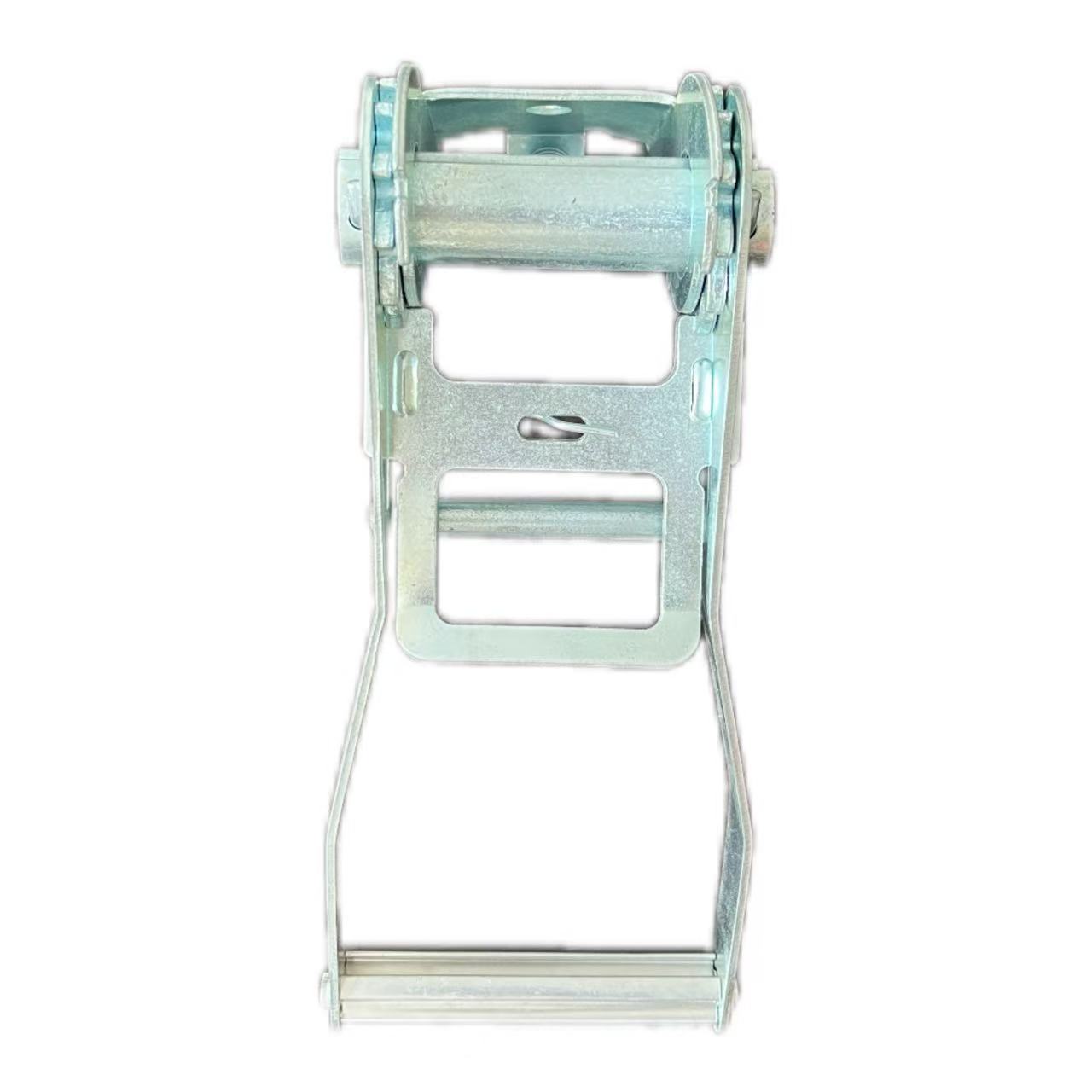
The physical shape of a ratchet tie down handle influences operational efficiency. Ergonomics directly impact your ability to secure loads quickly and safely. You must choose a handle profile that matches your daily hauling environment.
Choosing the wrong profile slows down deployment times. It creates unsafe tensioning practices. Always match the handle length and grip style to the physical demands of your freight.
A bare tensioner cannot secure freight alone. You must build a complete, cohesive system. The handle assembly requires perfect matching with webbing materials and anchor hardware. System integrity depends entirely on these connections.
First, evaluate webbing compatibility. You must match the handle mandrel width precisely to the strap material. If you use a 2-inch handle, you must use a 2-inch ratchet lashing belt. Feeding a narrow strap into a wide mandrel causes uneven spooling. Feeding a wide strap into a narrow mandrel causes dangerous bunching and severe edge abrasion. You must also consider the fabric itself. Polyester resists UV degradation and water absorption, minimizing stretch. Nylon stretches significantly under load, making it unsuitable for rigid transport applications.
Next, focus on end fitting integration. Your vehicle's anchor points dictate your hardware choices. You must evaluate specific accessories required to connect the strap safely to the trailer. Flat hooks integrate seamlessly with flatbed rub rails. Wire J-hooks lock perfectly into standard recessed D-rings. Chain anchors provide extreme durability when tying down heavy equipment to heavy-duty trailers. You cannot force a flat hook into a small D-ring without compromising the connection angle.
System synergy prevents compliance failures. The risk of mixing and matching unrated components remains high in busy fleets. If you attach cheap, unrated hooks to a high-WLL handle, you create a false sense of security. The handle might hold 3,333 pounds, but the cheap hook will snap at 1,000 pounds. You must verify that every component in the assembly shares the exact same WLL rating.
Different transport sectors demand different hardware configurations. You cannot buy a universal tensioner and expect it to perform perfectly across all scenarios. You must build a shortlist based on your primary cargo type.
For flatbed and heavy machinery transport, prioritize raw strength. You require high-leverage extended handles. Look for 3-inch to 4-inch assemblies featuring heavy-duty, deep-cut gear teeth. Ensure chain-anchor compatibility. Focus entirely on maximizing the WLL to handle massive steel loads safely.
Enclosed vans and Less-Than-Truckload (LTL) freight operations face different challenges. You should prioritize low-profile standard handles. Pair them with E-track or L-track interior fittings. This configuration maximizes your internal cargo space. It prevents the handle from rubbing against pallets. Focus on speed of deployment and ease of release.
Utility and flat-deck trailers sit exposed to the elements continuously. Optimize your hardware for weather resistance. Demand thick zinc coating or marine-grade stainless steel. Select versatile attachments like double-wire J-hooks, which adapt to multiple standard anchor configurations easily.
To implement these criteria, follow concrete next-step actions. Conduct a comprehensive fleet audit of your current trailer anchor points. Calculate the aggregate WLL required for your heaviest standard loads. Finally, request official compliance documentation and pull-test certificates from all prospective suppliers before finalizing your purchase.
Selecting the correct tensioning hardware requires careful analysis of multiple engineering factors. You must balance strict WLL compliance, operator ergonomics, and environmental durability. Ignoring any of these elements puts your cargo and fleet at risk.
Taking these actionable steps ensures your load securement system performs reliably. Proper selection eliminates DOT violations, protects your operators, and secures your bottom line during every transit.
A: You must inspect handles during every pre-trip inspection. Look specifically for bent mandrels, worn gear teeth, and cracked frames. If the pawl mechanism catches or fails to spring back firmly, remove the unit from service immediately. Monthly deep inspections should verify WLL tag legibility.
A: Jamming usually occurs due to dirt trapped in the gear track or severe lack of lubrication. You can clean the gears and apply dry graphite spray. However, you must never weld, bend, or field-repair the load-bearing metal frame. Altering the structural integrity destroys the WLL rating.
A: Not always. Inspectors distinguish between light surface oxidation and deep structural rust. Surface rust on a zinc coating requires cleaning but often passes. Structural rust that pits the metal, compromises the gear teeth, or weakens the pawl spring will trigger an immediate compliance failure.
A: Yes, provided the handle mechanism remains mechanically sound and free of defects. However, you must ensure the replacement webbing perfectly matches the WLL rating of the existing hardware. Connecting a low-rated strap to a high-rated handle downgrades the entire system's legal capacity.

