

close
Choose Your Site
Global
Social Media

Views: 0 Author: Site Editor Publish Time: 2026-08-03 Origin: Site


Rigging equipment serves as the critical connection between a hoist and a load in high-stakes material handling. This connection is often the most vulnerable point of any hoisting operation. Selecting the wrong equipment introduces severe operational and safety risks. You face load drops, asset damage, OSHA compliance violations, and catastrophic workplace injuries. These failures typically stem from mismatched materials, ignored environmental hazards, or a failure to account for sling angles during the lift. This guide provides a technical framework for evaluating load requirements, understanding material trade-offs, and selecting the correct lifting sling for specific industrial applications. By analyzing the physical properties of the load and the dynamics of the hoisting environment, operators can execute safe, compliant, and efficient material transfers.
Application Specificity: Lifting slings are not universally interchangeable; selection must be dictated by load weight, surface fragility, center of gravity, and environmental conditions (heat, chemicals).
Material Trade-offs: Synthetic slings offer load protection and flexibility, while alloy chain and wire rope provide superior durability, temperature resistance, and abrasion tolerance.
Capacity Derating: A sling's Working Load Limit (WLL) drastically changes based on the hitch type (vertical, choker, basket) and the angle of use.
Regulatory Compliance: Safe deployment requires strict adherence to ASME B30.9 standards, including mandatory pre-use inspections and proper tag legibility.
Understanding the fundamental mechanics of load distribution is necessary for safe rigging. A sling acts as the critical interface that transfers the weight of a load to a crane or hoist while maintaining balance and control. It absorbs the dynamic forces generated during hoisting and distributes the physical stress across its load-bearing components to prevent structural failure. When you rig a load, you are managing physics. The equipment must handle the static weight and the dynamic shock loads introduced when the crane starts or stops moving.
An Industrial Lifting Sling is deployed to achieve four fundamental actions in practice:
Lifting: Vertically hoisting loads against gravity while maintaining a stable center of gravity.
Moving/Transferring: Safely traversing loads through three-dimensional space across a facility or job site.
Positioning: Precision placement and alignment of heavy machinery, structural elements, or delicate components.
Securing/Tensioning: Holding loads static during assembly, fabrication, or transport operations.
A successful lift is defined by strict criteria. You need zero load shift during transit, zero surface damage to the load, and you must maintain the structural integrity of both the sling and the hoisted object. Achieving this requires an understanding of key technical terminology. The Working Load Limit (WLL) dictates the maximum allowable weight the equipment can handle under specific conditions. Breaking strength refers to the point of catastrophic failure during destructive testing. The design factor is the ratio between the breaking strength and the WLL, providing a built-in safety margin. Finally, the D/d ratio (the diameter of the load divided by the diameter of the sling) determines how bending stresses impact the sling's overall capacity.
To further clarify the technical requirements, operators must understand how these terms interact in the field. If you ignore the D/d ratio when wrapping a wire rope around a tight corner, the bending stress will permanently deform the wire core. This reduces the actual capacity well below the stated WLL. Rigging is an exact science. You cannot guess weights or estimate angles. You must calculate them.
Different sectors demand highly specialized rigging solutions based on the nature of the materials handled and the surrounding environment. You cannot use the same rigging setup for a steel mill that you use for a cleanroom manufacturing facility.
Heavy-duty rigging is foundational to modern construction. Operators deploy high-capacity slings for hoisting structural steel beams, precast concrete blocks, and heavy architectural materials. These environments require equipment that can withstand abrasive surfaces, sharp edges, and constant exposure to outdoor weather conditions. Wire rope and alloy chain dominate this sector due to their ruggedness. When lifting a 10-ton precast concrete panel, the rigging must survive the rough concrete edges and the potential for sudden shock loads if the crane operator moves too quickly.
Facility upgrades and assembly line modifications require precision. Deploying a Machinery Lifting Strap is standard practice for positioning CNC machines, assembly line equipment, and sensitive industrial motors. Synthetic materials prevent damage to delicate housings, painted surfaces, and calibrated components during complex plant relocations. If you use a chain to lift a freshly painted generator housing, you will destroy the finish and potentially dent the enclosure. Synthetic straps distribute the pressure evenly, protecting the asset.
These industries frequently handle cylindrical and irregular objects. Operations involve lifting heavy drill rigs, industrial valves, steel pipes, and raw logs. These applications heavily rely on choke holds to prevent slippage, requiring slings that can grip tightly around the load while resisting crushing forces. In forestry, a choker hitch is the only way to safely drag or lift a massive timber log. The hitch tightens as the load increases, biting into the wood to prevent it from sliding out vertically.
Port operations and shipyards present unique challenges. Rigging is used for the loading and unloading of shipping containers, oversized cargo, and shipyard materials. Equipment in these sectors must secure loads effectively while withstanding highly corrosive marine environments, saltwater exposure, and extreme dynamic forces from ship movement. Galvanized wire rope and specialized synthetic blends are common here to fight off the rapid oxidation caused by salt spray.
Selecting the correct material is the most critical decision in lift planning. Each material offers distinct physical properties that dictate its suitability for specific environments and load types. You must match the material to the hazard.
Alloy chain is the standard for high-temperature environments, heavy manufacturing, slag operations, and foundries. Grade 80 and Grade 100 chains are the most common in industrial rigging. The primary advantages include extreme durability, repairability through individual link replacement, and total resistance to UV degradation, harsh chemicals, and severe abrasion. However, the trade-offs include a high dead weight, the potential to scratch or crush delicate loads, and a higher initial procurement cost. If you are lifting steel billets out of a furnace, alloy chain is your only viable option.
Wire rope is heavily utilized in general construction, heavy rigging, and environments requiring a balance of strength and flexibility. It offers high tensile strength, a lower cost profile than alloy chains, and significant reserve strength. Reserve strength means multiple individual wires must break before a catastrophic failure occurs. The trade-offs are that wire rope is susceptible to kinking, crushing, and internal corrosion. Furthermore, it is difficult to inspect for hidden core damage. If a wire rope develops a severe kink, the structural integrity is permanently compromised, and it must be discarded.
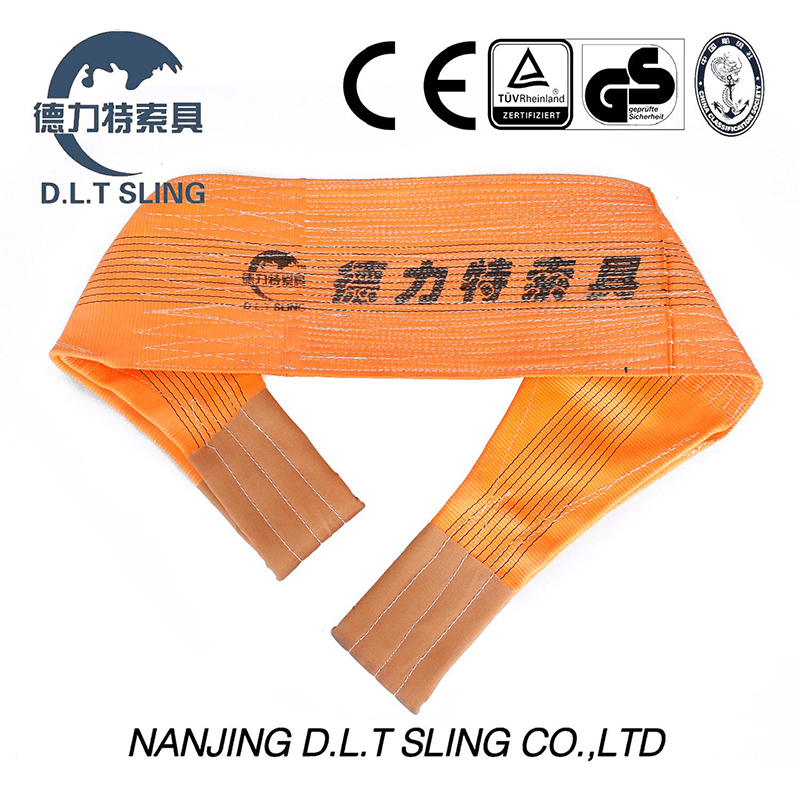
Synthetic web slings are engineered for lifting fragile, painted, polished, or easily scratched loads. They are lightweight, highly flexible, mold easily to the shape of the load, and are relatively inexpensive. Design configurations play a major role in selection. Type 3 (Flat Eye & Eye) slings feature eyes on the same plane as the sling body, suitable for general use. Type 4 (Twisted Eye & Eye) configurations feature eyes twisted at a right angle, optimizing them specifically for choker or basket hitches. The main trade-offs include extreme vulnerability to sharp edges, degradation under continuous UV exposure, and a low melting point, typically failing at temperatures above 194°F (90°C).
Round slings excel at lifting round, cylindrical, or highly irregular objects like pipes, logs, and machined shafts requiring a tight, high-friction grip. The continuous loop design allows operators to rotate the wear points evenly across the sling. They are color-coded for quick capacity identification and provide excellent load grip with minimal slippage. The primary trade-off is that the internal load-bearing yarns are hidden inside the tubular jacket. If the outer jacket is breached, punctured, or torn, the sling must be removed from service immediately. You cannot see the core yarns, so you must assume any jacket damage compromises the entire unit.
When choosing between synthetic options, evaluate the contact surface area. Flat web slings distribute weight across a wider surface, reducing localized pressure on the load. Round slings concentrate the load but offer superior flexibility under choke hitches. For loads with wide, flat bottoms, web slings provide better stability. For bundled materials or cylindrical loads, round slings offer superior grip and durability against wear.
Material Type | Best For | Key Advantage | Primary Vulnerability |
|---|---|---|---|
Alloy Chain | Foundries, heavy steel, high heat | Extreme durability and repairability | Heavy dead weight, damages soft loads |
Wire Rope | Construction, general rigging | High tensile strength, reserve strength | Kinking, internal core corrosion |
Synthetic Web | Machinery, painted surfaces | Wide load distribution, lightweight | Sharp edges, high temperatures |
Synthetic Round | Pipes, logs, irregular shapes | Superior grip, rotatable wear points | Hidden core damage if jacket tears |
A sling's capacity is not static. It changes dramatically based on how it is attached to the load and the hoist. You must calculate the effective capacity for every single lift based on the hitch configuration.
The vertical hitch involves a direct line of lifting from the crane hook to the load attachment point. This configuration provides 100% of the base WLL. However, it offers zero load control against rotation, making it unsuitable for loose or unbalanced materials. If you lift a long steel beam with a single vertical hitch in the center, it will spin uncontrollably.
A choker hitch involves wrapping the sling around the load and passing it through its own eye before attaching it to the hoist. This configuration reduces the WLL, typically by 20-25%, due to the stress placed on the choke point. Despite the capacity reduction, it provides superior grip for loose, bundled, or cylindrical materials. The choke point creates a severe bending stress on the material, which is why the capacity drops.
The basket hitch cradles the load, with both eyes of the sling attached directly to the hoist hook. This configuration effectively doubles the WLL of a single leg, provided the sling angle remains optimal and the load is perfectly balanced. If the load is bottom-heavy and wide, a basket hitch provides excellent stability.
The impact of sling angles cannot be overstated. Horizontal sling angles multiply the tension on the sling legs. As the angle between the load and the sling decreases, the stress increases exponentially. For example, lifting a load with a 30-degree horizontal sling angle doubles the stress on each leg compared to a straight vertical lift. Failing to calculate this trigonometric reduction in capacity is a leading cause of rigging failures.
Horizontal Sling Angle | Tension Multiplier (Load Factor) | Effective Capacity Remaining |
|---|---|---|
90 Degrees (Vertical) | 1.000 | 100% |
60 Degrees | 1.155 | 86% |
45 Degrees | 1.414 | 71% |
30 Degrees | 2.000 | 50% |
Even the correct equipment will fail if deployed without proper risk mitigation and environmental awareness. You must actively manage the hazards on your job site.
Edge protection is an absolute necessity. Using synthetic slings on loads with sharp or abrasive edges, such as structural steel beams or machined metal parts, requires cut-resistant sleeves, wear pads, or corner protectors. Without edge protection, a synthetic sling can sever under tension in a matter of seconds. A sharp edge is not just a razor blade; in rigging, a sharp edge is any corner where the radius is smaller than the thickness of the sling.
Environmental degradation must be actively managed. Nylon and polyester react differently to chemical exposure. Nylon is destroyed by acids, while polyester is degraded by alkalis. Operators must verify material compatibility before lifting in chemical plants. Extreme temperatures also dictate material selection, as synthetic fibers will melt or become brittle outside their specified temperature ranges. If you use a standard polyester sling near a welding operation, the weld spatter will burn straight through the load-bearing fibers.
Inspection and compliance are governed strictly by ASME B30.9 standards. Mandatory rejection criteria require immediate removal from service for specific defects. Pre-use inspections are non-negotiable. You must physically run your hands over the equipment to check for hidden damage.
Check the identification tag. If the tag is missing or illegible, remove the sling from service immediately.
Inspect for thermal damage. Look for melting, charring, or weld spatter burns on synthetic materials.
Examine for chemical damage. Acid or caustic burns will discolor and weaken the fibers.
Look for structural cuts. Any snags, punctures, tears, or cuts in the load-bearing material dictate immediate rejection.
Check hardware integrity. Inspect all attached hooks, rings, and fittings for deformation, cracks, or excessive wear.
Storage best practices directly impact equipment longevity. Proper storage involves keeping slings off the ground, hanging them in clean, dry environments, and storing them away from direct UV light, extreme heat, and moisture. This prevents rot, corrosion, and fiber degradation, extending the lifecycle of the equipment. Leaving synthetic rigging in the back of a pickup truck exposed to the sun and rain will destroy its capacity within months.
The correct lifting equipment does not exist in a vacuum. Selection is entirely dependent on the specific load characteristics, the center of gravity, and the hazards present in the lifting environment. A systematic approach to evaluation prevents catastrophic failures and ensures operational efficiency. You must match the material to the hazard, calculate the angles, and protect the gear from sharp edges.
Calculate your maximum load weight and determine the exact center of gravity before selecting any rigging equipment.
Assess your lifting environment for chemical exposure, extreme temperatures, and abrasive hazards to choose the correct material.
Consult manufacturer load charts to calculate the exact capacity reduction based on your planned hitch type and sling angles.
Implement mandatory pre-use inspections based on ASME B30.9 rejection criteria to catch damaged gear before a lift.
Engage with a certified rigging specialist to engineer a formal lifting plan for any complex, unbalanced, or critical lifts.
A: A web sling features a flat woven construction that distributes weight across a wider surface area. A round sling consists of continuous load-bearing yarn loops enclosed inside a protective tubular jacket, offering superior flexibility and grip for cylindrical objects.
A: Flat eye slings have loops on the same plane as the sling body. Twisted eye slings have loops that sit naturally at a 90-degree angle to the body, making them ideal and much easier to configure for choker and basket hitches.
A: Select synthetic materials like polyester or nylon to prevent scratching delicate equipment housings or painted surfaces. Ensure you accurately calculate the machine's center of gravity to prevent shifting, and use edge protection on any sharp metallic corners.
A: Slings must be removed immediately if they meet ASME rejection criteria. This includes missing or unreadable capacity tags, severe cuts, snags, acid burns, heat melting, broken wires, or stretched chain links.
A: Alloy chain slings can often be repaired by replacing damaged links and then recertified through proof testing. However, damaged synthetic web and round slings cannot be repaired; they must be destroyed and replaced to ensure safety.
A: As the horizontal angle between the load and the sling decreases, the tension on the sling legs increases exponentially due to trigonometric forces. A 30-degree angle effectively doubles the stress on the sling compared to a vertical lift.
A: A double wrap choker hitch is the safest configuration for cylindrical loads like pipes and logs. The double wrap provides 360-degree contact, creating maximum friction and preventing the load from slipping out of the sling.

