

close
Choose Your Site
Global
Social Media


Overhead lifting leaves zero margin for error. When moving tons of suspended material, equipment failure leads to catastrophic safety incidents, regulatory penalties, and operational downtime. At the center of this operation is the lifting sling, the essential link between the load and the crane.
Matching the correct rigging equipment to specific load profiles, environmental conditions, and hitch configurations presents a complex engineering challenge. Using the wrong material or underestimating dynamic forces compromises safety instantly. Riggers must evaluate tension, angles, and material limitations to ensure the load remains secure from the moment it leaves the ground.
This guide provides a comprehensive framework for evaluating, selecting, and implementing the correct rigging equipment. By understanding material properties, Working Load Limits (WLL), and strict industry compliance standards, you can execute safe, efficient, and compliant lifting operations.
Material dictates application: Synthetic, wire rope, and alloy chain slings each possess distinct thermal, chemical, and abrasion-resistant properties that determine their suitability for specific operational environments.
Capacity is dynamic: A sling’s Working Load Limit (WLL) is not static; it fluctuates significantly based on the hitch type (vertical, choker, basket) and the angle of the lift.
Compliance is mandatory: Strict adherence to ASME B30.9 and OSHA standards for daily inspections, proper tagging, and removal-from-service criteria is non-negotiable for liability mitigation.
Edge protection is critical: Synthetic slings require engineered edge protection to prevent catastrophic failure from cutting or friction under tension.
A lifting sling serves as the connective rigging hardware bridging the load to the lifting device. Whether attaching to a crane hook, hoist, forklift attachment, or lifting beam, it must safely transfer the weight of the load to the lifting mechanism without structural deformation.
Slings rarely operate in isolation. They interface with connection components such as master links, shackles, hooks, and specialized attachment points. The compatibility between the sling and this interfacing hardware dictates the success of the lift. Mismatched fittings cause uneven stress distribution, leading to premature wear or sudden failure. For example, placing a wide synthetic web sling into a narrow shackle pinches the fabric, concentrating the load on the outer edges and drastically reducing its effective strength.
The concept of Working Load Limit (WLL) governs all lifting operations. WLL represents the maximum mass or force that the rigging equipment is authorized to support in general service. This limit incorporates specific design factors to account for dynamic forces, shock loading, and minor material degradation. Exceeding the WLL guarantees structural fatigue and invites immediate failure.
Industry standards mandate specific design factors (safety factors) based on the material used. These factors ensure a buffer between the WLL and the actual breaking strength of the equipment.
Sling Material | Standard Design Factor (ASME B30.9) | Meaning |
|---|---|---|
Synthetic Webbing | 5:1 | Breaking strength is 5 times the WLL |
Synthetic Round | 5:1 | Breaking strength is 5 times the WLL |
Wire Rope | 5:1 | Breaking strength is 5 times the WLL |
Alloy Chain | 4:1 | Breaking strength is 4 times the WLL |
Evaluating a sling requires establishing strict success criteria before the lift begins. You must analyze the total load weight and accurately locate the center of gravity. Lifting a load with an offset center of gravity using equal-length sling legs results in load shift and potential dropping. Load fragility dictates the required material, while environmental constraints like heat, chemicals, and sharp edges determine the necessary protective measures.
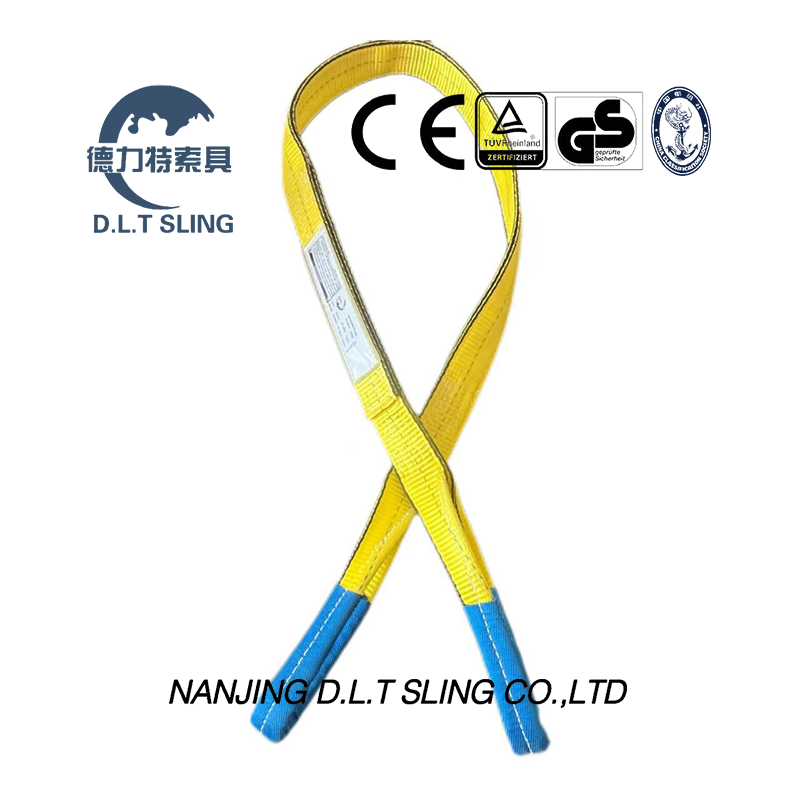
A Webbing Sling features a flat, woven synthetic fabric profile, typically constructed from nylon or polyester. This design prioritizes flexibility and load protection, conforming easily to the shape of the lifted object while distributing the weight over a wider surface area.
Configuration variations adapt to different rigging needs. The Flat Eye & Eye (Type 3) offers a versatile design with eyes on both ends resting in the same plane. The Twisted Eye (Type 4) features eyes twisted at 90-degree angles, forming a better profile for choker hitches and hook attachments. The Endless (Type 5) configuration provides a continuous loop, allowing the rigger to rotate wear points and extend the equipment's lifespan.
These slings excel when handling highly finished parts, delicate or uneven loads, and scenarios requiring lightweight, easily handled rigging. The soft material prevents scratching and crushing damage to sensitive surfaces like machined steel, painted components, or fiberglass structures.
Synthetic webbing has notable trade-offs. It is highly susceptible to cuts, abrasion, and UV degradation. Strict temperature limitations apply; standard synthetic materials cannot exceed 194°F (90°C). They require frequent inspection and mandatory engineered edge protection when lifting loads with sharp corners or rough surfaces.
A Round Sling consists of continuous loops of load-bearing synthetic yarn encased in a protective tubular woven jacket. This construction provides immense strength while maintaining a soft, pliable exterior.
These are ideal for lifting heavy but fragile loads, cylindrical objects, and executing tight choke-point applications. The tubular design conforms tightly around the load, offering excellent grip and stability. Because the core yarns are independent of the outer jacket, they can shift and adjust to the load's contours, providing superior load distribution compared to flat webbing.
The primary trade-off involves inspection difficulty. The outer protective jacket hides internal load-bearing yarn damage. Riggers must perform rigorous tactile inspections, feeling for lumps, depressions, or hard spots that indicate broken internal yarns. They share the same thermal and chemical limitations as flat synthetic webbing.
Round slings offer superior flexibility, excellent load-gripping capabilities, and exceptionally high capacity-to-weight ratios, making them a staple in heavy construction, power generation, and manufacturing.
Alloy chain slings utilize high-strength alloy steel chains, specifically Grade 80, 100, or 120. This rugged profile is engineered for the most demanding industrial environments where synthetic materials would fail instantly.
They are the standard choice for severe service environments, foundries, steel mills, heavy industrial construction, and loads with sharp, abrasive edges. Chain slings withstand physical abuse, heavy impacts, and dragging across rough surfaces.
The trade-offs include significant weight, making them difficult to handle manually. They carry a high initial procurement cost and can easily crush, scratch, or mar delicate loads due to the hard steel links. Riggers must use caution when lifting machined parts or soft metals with bare chain.
Alloy chain slings provide the highest durability and temperature tolerance. They operate safely up to 400°F without capacity reduction and can be derated for use up to 1000°F. They are fully repairable; damaged links or hooks can be replaced by certified facilities, extending their operational life significantly.
Wire rope slings feature braided carbon or stainless steel wires wound around an independent wire rope core (IWRC). This construction creates a strong, semi-rigid lifting tool that bridges the gap between the flexibility of synthetics and the durability of chain.
They are ideal for rugged, everyday lifting in construction, marine environments, and heavy manufacturing. Wire rope handles abrasive conditions well and provides significant lifting capacity. The multi-wire construction offers redundancy; if one outer wire breaks, the remaining wires continue to support the load.
Wire rope is prone to irreversible kinking, crushing, and corrosion. Once a wire rope is kinked, the internal structure is permanently damaged, and the sling must be removed from service. As the rope wears, broken wires known as "fishhooks" develop, presenting severe puncture hazards to riggers handling the equipment.
Wire rope slings offer an excellent balance of strength, flexibility, and cost. They provide visual warning signs of fatigue, such as broken outer wires, allowing riggers to identify wear before catastrophic failure occurs.
A Vertical Hitch involves direct line lifting, where the sling hangs straight down from the hook to the load. This configuration provides 100% of the base Working Load Limit. The load must be perfectly balanced, and the attachment point must be directly above the center of gravity to prevent swinging.
A Choker Hitch requires wrapping the sling around the load and passing it through itself. This method reduces the baseline capacity, typically by 20-25%, due to the concentrated stress at the choke point and the friction against the load. The angle of the choke also affects capacity; a choke angle less than 120 degrees requires further derating.
A Basket Hitch cradles the load with both ends attached to the hook. This setup effectively doubles the WLL of a vertical hitch, provided the legs remain perfectly vertical at 90 degrees. If the legs are angled, the capacity decreases based on the sling angle.
The math of sling angles dictates rigging safety. Decreasing the angle between the sling leg and the horizontal plane exponentially increases the tension on the sling. A 30-degree angle doubles the tension compared to a vertical lift, requiring severe derating of the WLL to prevent failure.
Sling Angle (Horizontal) | Tension Multiplier (Load Angle Factor) | Effective Capacity Reduction |
|---|---|---|
90 Degrees | 1.000 | 0% (Full Capacity) |
60 Degrees | 1.155 | ~13% Reduction |
45 Degrees | 1.414 | ~30% Reduction |
30 Degrees | 2.000 | 50% Reduction |
Handling asymmetrical and uneven loads demands precise calculation. Riggers must determine the center of gravity and adjust sling lengths to ensure level lifting. Multi-leg setups must be configured so that the load distributes correctly.
Identify the total weight of the load.
Locate the exact center of gravity (CG).
Determine the distance from the CG to each pick point.
Calculate the tension on each individual sling leg based on the angle and distance from the CG.
Select equipment with a WLL that exceeds the highest calculated tension on any single leg.
Thermal constraints heavily influence selection. Alloy chains offer high-heat resistance, making them suitable for foundries and steel mills. Synthetic webbing and round slings have low melting points and will fail catastrophically if exposed to extreme heat, weld spatter, or direct flame.
Chemical exposure requires careful material matching. Different materials react violently to specific chemical compounds, leading to rapid degradation of tensile strength.
Material | Resistance to Acids | Resistance to Alkalis | UV Resistance |
|---|---|---|---|
Nylon | Poor (Degrades rapidly) | Good | Fair (Degrades over time) |
Polyester | Good | Poor (Degrades rapidly) | Good |
Alloy Chain | Poor (Corrodes) | Excellent | Excellent |
Wire Rope | Poor (Corrodes) | Good | Excellent |
Abrasion and edge protection are absolute necessities. When lifting loads with sharp or abrasive edges, particularly with synthetic materials, riggers must use engineered cut protection. Sleeves, corner pads, and magnetic edge guards prevent the load from slicing through the tensioned fibers. Cardboard, rags, or old fire hoses do not qualify as engineered edge protection and violate safety standards.
The regulatory framework governing overhead lifting is strict. ASME B30.9 and OSHA 1910.184 establish the baseline requirements for manufacturing, usage, and inspection. Compliance ensures operational safety and legal protection against liability.
Identification and tagging are mandatory. Every sling must feature a legible, durable manufacturer tag displaying the WLL for each hitch type, material, size, and traceability data. Untagged or illegible equipment must be immediately removed from service, regardless of its physical condition.
Pre-use inspection protocols prevent accidents. Riggers must follow a strict removal-from-service checklist before every shift.
Verify the identification tag is present and fully legible.
Inspect synthetic materials for acid burns, melting, snags, holes, tears, or broken stitches.
Inspect chain for elongated links, gouges, bent hooks, or severe rust.
Inspect wire rope for broken wires, kinking, crushing, bird-caging, or core protrusion.
Check all interfacing hardware (hooks, rings) for deformation, wear, or missing safety latches.
Proper storage and maintenance extend equipment life. Store gear in clean, dry, and well-ventilated areas. Protect synthetics from UV degradation by storing them away from direct sunlight. Keep all equipment off the ground to prevent moisture accumulation, chemical exposure, and mechanical damage caused by vehicles or heavy machinery.
Audit your current rigging inventory immediately to ensure all tags are legible and equipment meets OSHA/ASME inspection standards.
Implement a mandatory edge protection policy for all lifts involving synthetic materials and sharp load edges.
Consult with a certified rigging engineer to calculate dynamic forces and center of gravity for complex, asymmetrical, or unusually heavy lifts.
Establish a dedicated, climate-controlled storage area to prevent UV degradation and chemical contamination of your rigging hardware.
A: A webbing sling is a flat, woven synthetic fabric that provides a wide surface area for load distribution. A round sling consists of continuous loops of synthetic yarn encased in a tubular jacket, offering superior flexibility and grip for cylindrical or heavy loads.
A: Type 3 slings have eyes resting in the same plane as the sling body, making them versatile for various hitches. Type 4 slings feature eyes twisted at 90 degrees, providing a better fit on crane hooks and improving performance in choker hitches.
A: Capacity is determined by reading the manufacturer's identification tag, which lists the Working Load Limit (WLL) for vertical, choker, and basket hitches. You must also calculate reductions based on the specific sling angle used during the lift.
A: Remove a sling from service immediately if the identification tag is missing or illegible. Other removal criteria include cuts, holes, acid burns, melting, broken stitching, elongated hardware, or severe abrasion.
A: Generally, no. Standard nylon and polyester synthetic slings should not be used in environments exceeding 194°F (90°C). Exposure to higher temperatures causes melting and catastrophic failure.
A: As the angle between the sling leg and the horizontal plane decreases, the tension on the sling increases exponentially. A lower angle requires a significant reduction (derating) of the sling's effective Working Load Limit to maintain safety.

