

close
Choose Your Site
Global
Social Media


Lifting heavy, expensive, or fragile loads requires equipment where failure is not an option. The high-stakes reality of industrial rigging means every hoist, move, and placement demands absolute precision. Specifying the wrong lifting equipment introduces severe operational and safety risks. You risk localized load damage, surface marring, catastrophic drops, and strict non-compliance with OSHA or ASME standards. When rigging components fail, the consequences threaten site safety and project timelines directly. To mitigate these risks, rigging professionals use the webbing sling as a versatile, high-strength synthetic solution. Unlike rigid chains or abrasive wire ropes, synthetic slings provide flexibility, strength, and load protection. This technical guide provides the framework for selecting the correct material, configuration, and capacity for specific lifting applications.
Material Specificity Dictates Application: Choosing between a Polyester Lifting Sling and nylon depends entirely on stretch requirements and chemical exposure (acid vs. alkali).
Hitch Types Alter Capacity: The Working Load Limit (WLL) is not static; it fluctuates significantly based on whether a vertical, choker, or basket hitch is utilized.
Edge Protection is Non-Negotiable: The leading cause of synthetic sling failure is cutting and abrasion from unprotected load edges.
Hardware Interface Compatibility: Connecting eye-and-eye slings to bow-type or pin-type shackles requires precise physical matching to prevent structural bunching and accelerated wear.
Strict Compliance Standards: Adherence to ASME B30.9 inspection and removal criteria is mandatory for operational safety and liability mitigation.
An Industrial Webbing Sling is a flat, high-strength, flexible lifting strap woven from synthetic fibers. Manufacturers engineer these straps specifically to hoist, move, and lower heavy loads safely. The structural anatomy consists of a flat woven body made up of load-bearing warp and weft yarns. The warp yarns run lengthwise and carry the actual load tension. The weft yarns run crosswise, binding the warp yarns together and providing abrasion resistance. Reinforced eyes serve as the primary bearing points for hardware connections. Protective sleeves often shield the core fibers from localized friction. Every compliant sling features a mandatory manufacturer identification tag detailing its specifications.
Understanding industry terminology keeps rigging operations safe. You must know these acronyms:
WLL: Working Load Limit. This indicates the maximum allowable load under specific hitch conditions.
SF: Design/Safety Factor. This is typically 5:1 for synthetic webbing slings under ASME B30.9 standards.
EE: Eye-and-Eye Configuration. These slings feature loops at both ends.
EN: Endless Configuration. These form a continuous synthetic loop.
The load distribution mechanics of a flat synthetic sling offer distinct field advantages. The wide surface area reduces localized pressure on fragile, painted, or finished loads. We see this constantly when lifting machined pump housings or painted generator enclosures. This contrasts sharply with the concentrated pressure points created by wire ropes or steel chains. Chains easily crush or scratch delicate surfaces. Furthermore, these slings effectively bridge the gap between heavy loads and primary lifting devices. They seamlessly interface with overhead crane hooks, hoists, and forklift pocket-lifter attachments.
To properly inspect the anatomy of your lifting gear before a shift, follow this numbered sequence:
Locate and verify the manufacturer tag for legibility and WLL ratings.
Run your bare hands along the entire length of the flat body to feel for hidden cuts or embedded debris.
Inspect the bearing points inside the eyes for severe abrasion or melted fibers.
Check the load-bearing splice stitching for broken or pulled threads.
Examine any attached hardware for deformation, gouges, or weld splatter.
Selecting the correct synthetic material dictates operational success. A Polyester Lifting Sling features a low elongation property. It stretches approximately 3% at its rated capacity. This minimal stretch makes it ideal for low-headroom areas and precision lifting. It prevents dangerous load bounce during transport. Polyester offers high resistance to acidic environments, bleaching agents, and moisture absorption. This effectively prevents freezing and dry-rot in outdoor applications. We use polyester almost exclusively around battery plants and acid-wash stations.
Conversely, nylon slings feature a higher elongation property. They typically stretch 8% to 10% at rated capacity. This elasticity provides shock absorption for sudden load shifts or dynamic acceleration. While nylon boasts excellent resistance to alkaline environments, it remains severely vulnerable to acids and chemical degradation. Both materials share similar environmental trade-offs regarding temperature. Maximum limits typically cap at 194°F (90°C). Both suffer gradual UV degradation over time when left in direct sunlight.
Metric / Feature | Polyester Lifting Sling | Nylon Webbing Sling |
|---|---|---|
Elongation at WLL | Low (~3%) - Best for precision | High (8-10%) - Best for shock loads |
Chemical Resistance | Excellent for Acids; Poor for Alkalis | Excellent for Alkalis; Poor for Acids |
Wet Strength Retention | 100% (Does not absorb water) | 85-90% (Loses strength when wet) |
Max Temp Limit | 194°F / 90°C | 194°F / 90°C |
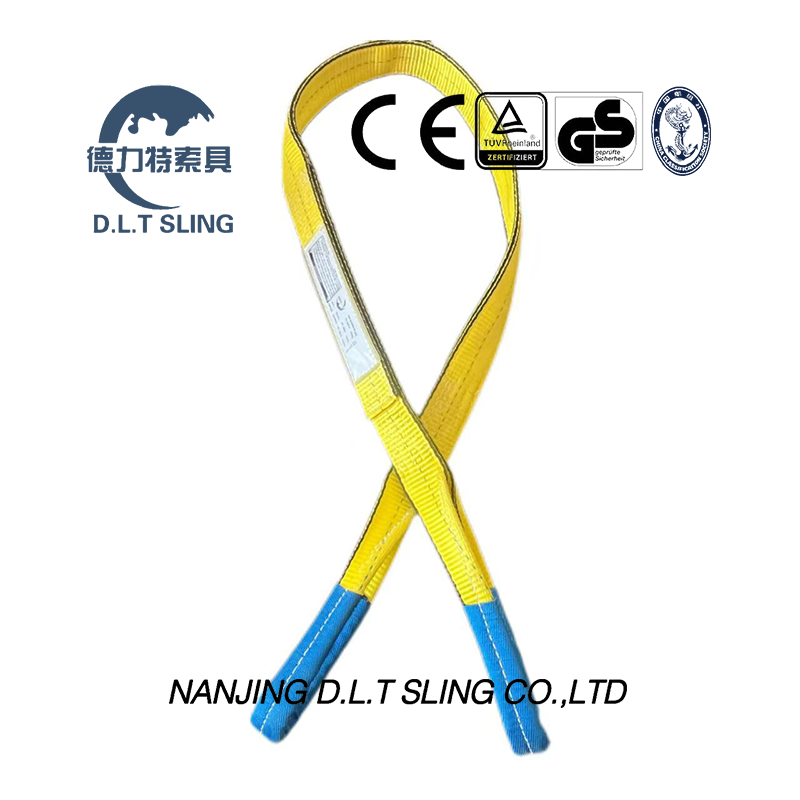
Manufacturers build synthetic slings in various configurations to accommodate diverse rigging scenarios. Type 3 and Type 4 represent Eye-and-Eye (EE) slings. The Flat Eye (Type 3) allows easy removal from beneath flat loads. The Twisted Eye (Type 4) optimizes choker hitches. The eyes sit at 90-degree angles to the sling body, allowing for a tighter, more secure wrap around pipe bundles or steel stock.
Type 5 refers to Endless Slings (EN). These are continuous loops of synthetic material. The primary operational advantage of an endless configuration is the ability to rotate the wear points along the continuous loop. By shifting the contact areas with each lift, riggers distribute abrasion evenly. This significantly extends the sling's lifespan. Type 1 and Type 2 slings incorporate Triangle and Choker fittings. These configurations utilize integrated alloy steel or aluminum hardware at the ends for specialized rigging attachments. This reduces wear directly at the crane hook.
Sling widths and plies dictate performance. Ply ratings range from single-ply to multi-ply constructions. Web widths typically run between 1 inch and 12 inches. Adding plies increases the lifting capacity without proportionally increasing the width. This allows the sling to maintain necessary flexibility for wrapping around complex load geometries. A four-ply sling offers massive strength but becomes rigid, making it harder to choke down on small diameter loads.
When selecting a configuration for a specific lift, consider these factors:
Determine the load weight and center of gravity.
Identify the available connection points on the load.
Select the hitch type required to stabilize the load.
Choose the sling type (EE, EN, or hardware-fitted) that matches the hitch.
Calculate the required length to maintain safe sling angles.
The anatomy of connection points requires careful attention. You must observe how the bearing point of the sling eye interacts with rigging hardware. Improper mating between synthetic fibers and steel hardware leads to rapid degradation. Bow-type, or anchor shackles, accommodate wider sling eyes. They allow multi-leg sling angles without lateral pinching. The rounded bow provides ample space. This prevents structural bunching of the synthetic fibers under heavy tension.
Pin-type, or chain shackles, present specific limitations. Placing synthetic webbing directly on a screw pin causes severe friction, heat generation, and fiber damage as the load shifts. Riggers must adhere to the 1/3 width rule. The width of the shackle bow or pin must be at least 1/3 of the flat eye width. This geometric constraint prevents localized overloading. It ensures the load distributes evenly across the bearing point of the eye.
Hardware Type | Best Application | Webbing Compatibility Risk |
|---|---|---|
Bow-Type Shackle | Multi-leg slings, wide flat eyes | Low risk if sized correctly |
Pin-Type Shackle | In-line tension, chain connections | High risk of fiber bunching on pin |
Crane Hook | Direct vertical lifts | Crowding if hook bowl is too narrow |
The baseline capacity of any sling is determined by the vertical hitch. This occurs when the sling is rigged straight from the hoist hook to a single connection point on the load. However, the WLL is dynamic. Derating is required for choker hitches. The mechanical stress of the sling wrapping back on itself and passing through its own eye creates friction and compression. Industry standards mandate reducing the capacity to 80% of the vertical rating when utilizing a choker hitch.
Conversely, a true vertical basket hitch multiplies capacity. It effectively doubles (200%) the WLL by distributing the load across two vertical legs. This requires the bend radius of the load to be sufficient to prevent fiber damage. Sling angle tension calculations dictate safety on multi-leg lifts. As sling angles drop below 60 degrees from the horizontal, tension on the webbing increases exponentially. This requires a higher-rated sling. The actual tension is calculated by dividing the load weight by the number of legs multiplied by the sine of the horizontal sling angle.
To calculate tension accurately in the field, follow these steps:
Measure the total weight of the load.
Determine the number of load-bearing legs.
Measure the horizontal angle of the slings.
Find the load angle factor (e.g., 1.414 for 45 degrees).
Multiply the vertical share of the load by the angle factor to find actual tension per leg.
Comparing flat webbing to round slings reveals distinct application preferences. The flat, wide load-bearing surface of a webbing sling excels at distributing weight across delicate surfaces. Round slings contain load-bearing continuous strand core yarns inside a tubular jacket. They conform tightly to irregular shapes but offer a narrower contact patch. We specify flat webbing for crush-prone or highly polished loads where surface area contact prevents damage.
When comparing synthetic webbing to wire rope or chain, the trade-offs center on ergonomics versus durability. Synthetic slings offer superior ergonomics, lightweight handling, zero risk of rust, and excellent surface-finish protection. However, they sacrifice the extreme temperature tolerance, sharp-edge resistance, and rugged durability inherent to steel chains or wire rope. Riggers evaluate the load environment to determine which material properties matter most for the specific lift.
The primary threat to synthetic slings is edge cuts. The failure mode is sudden and catastrophic. Mandating the use of engineered edge protection is essential. You must use synthetic sleeves, heavy-duty wear pads, or magnetic corner protectors. Improvised solutions like cardboard or discarded fire hoses violate safety protocols and fail under pressure.
Chemical and environmental degradation pose significant risks. In active chemical plants, marine settings, or offshore environments, mitigation strategies include proper dry storage away from UV light and active chemicals. Adherence to ASME B30.9 inspection and removal criteria is non-negotiable. Slings must be removed from service if they exhibit specific damage.
Missing, unreadable, or detached manufacturer identification tags.
Acid or caustic burns.
Melting, charring, or weld splatter.
Snags, punctures, tears, or cuts.
Broken or worn stitching in the load-bearing splices.
Discoloration or stiffening of fibers caused by chemical or UV degradation.
The effectiveness and safety of a synthetic lifting setup rely entirely on matching the correct material and configuration to the specific load geometry, rigging hardware, and environmental conditions. Overlooking chemical compatibility, edge protection, or hitch derating factors guarantees equipment failure. To optimize your rigging operations, execute these next steps:
Audit your current lifting inventory to ensure all tags are legible and compliant with ASME B30.9.
Implement mandatory engineered edge protection for all lifts involving synthetic materials.
Standardize the use of bow shackles over pin shackles when connecting flat eyes to hardware.
Train all rigging personnel on calculating tension increases based on horizontal sling angles.
A: No, synthetic slings must never be used on sharp edges without engineered edge protection. Unprotected sharp or abrasive edges will cut the synthetic fibers under tension, leading to immediate and catastrophic load failure.
A: Nylon absorbs moisture, which reduces its overall strength by 10% to 15% when wet. Polyester does not absorb water and retains 100% of its strength in wet conditions.
A: Both standard polyester and nylon synthetic slings have a maximum safe operating temperature limit of 194°F (90°C). Exposure to temperatures above this threshold causes the fibers to melt and lose structural integrity.
A: A choker hitch reduces capacity because the sling passes through its own eye, creating a sharp bend and localized stress points. This mechanical disadvantage typically reduces the working load limit to 80% of the vertical rating.
A: Slings must receive a visual inspection by the user before each shift or lift. A documented, periodic inspection by a designated, qualified person must be conducted at least annually, or more frequently based on usage severity.

