

close
Choose Your Site
Global
Social Media

Views: 0 Author: Site Editor Publish Time: 2026-07-28 Origin: Site


Industrial material handling presents a persistent operational challenge for riggers every single day. You must lift immensely heavy loads without damaging finished surfaces. Simultaneously, your crews need to minimize rigging weight while maintaining strict safety compliance across the site. A webbing sling directly solves these complex lifting problems. We define this as a flexible, synthetic lifting tool engineered from woven high-tenacity fibers. Manufacturers typically use industrial-grade polyester or nylon to create these durable, load-bearing tools.
This article serves as a technical guide for lifting professionals and safety managers. We will evaluate exactly when synthetic slings provide the optimal choice over traditional wire rope or alloy chain alternatives. You will learn how to assess specific load characteristics, identify critical environmental constraints, and navigate stringent compliance requirements. Understanding these variables ensures you execute safe, efficient, and damage-free lifts during every operation.
Manufacturers build synthetic woven fibers using specific chemical compositions to achieve desired lifting characteristics. Polyester, nylon, and polypropylene serve as the primary materials in the rigging industry. Each fiber type offers distinct elongation properties under tension. Polyester stretches roughly three percent at its rated capacity. This minimal stretch offers superior load control during precision lifts. Nylon stretches up to ten percent under maximum load. Riggers choose nylon when they need to absorb shock loading. Polypropylene offers minimal strength but floats in water, making it useful in specific marine applications. Understanding these material behaviors helps you select the right tool for the job.
Steel chains and wire ropes easily gouge painted surfaces or crush delicate edges. Synthetic fibers offer a critical non-marring advantage. The flat, wide surface area distributes lifting pressure evenly across the contact zone. This distributed pressure prevents localized crushing on delicate, painted, or highly polished loads. When lifting a newly manufactured yacht or a freshly painted industrial generator, you cannot risk surface abrasion. The soft fabric conforms to the object's contours. It securely grips the load without digging into the material structure.
Traditional steel rigging is exceptionally heavy and cumbersome. We contrast this against the lightweight nature of synthetic webbing. A synthetic sling can lift tens of thousands of pounds while weighing only a few pounds itself. This incredible weight-to-strength ratio directly reduces rigger fatigue on the job site. Workers can easily carry multiple slings across a facility without specialized transport equipment. This reduction in physical strain accelerates your overall setup time. Faster setup translates directly to improved operational efficiency and reduced downtime.
We must maintain transparent disclosure regarding the operational risks of synthetic fibers. These tools possess strict limitations. They are highly susceptible to edge-cutting. A sharp or even slightly abrasive load edge can slice through synthetic tension fibers instantly. Additionally, they suffer from thermal degradation. You cannot use standard synthetic slings in environments exceeding 194°F (90°C). Extreme heat will melt the fibers and cause catastrophic failure. Chemical vulnerabilities also pose a massive risk. Accidental exposure to incompatible industrial chemicals will invisibly degrade the internal load-bearing yarns.
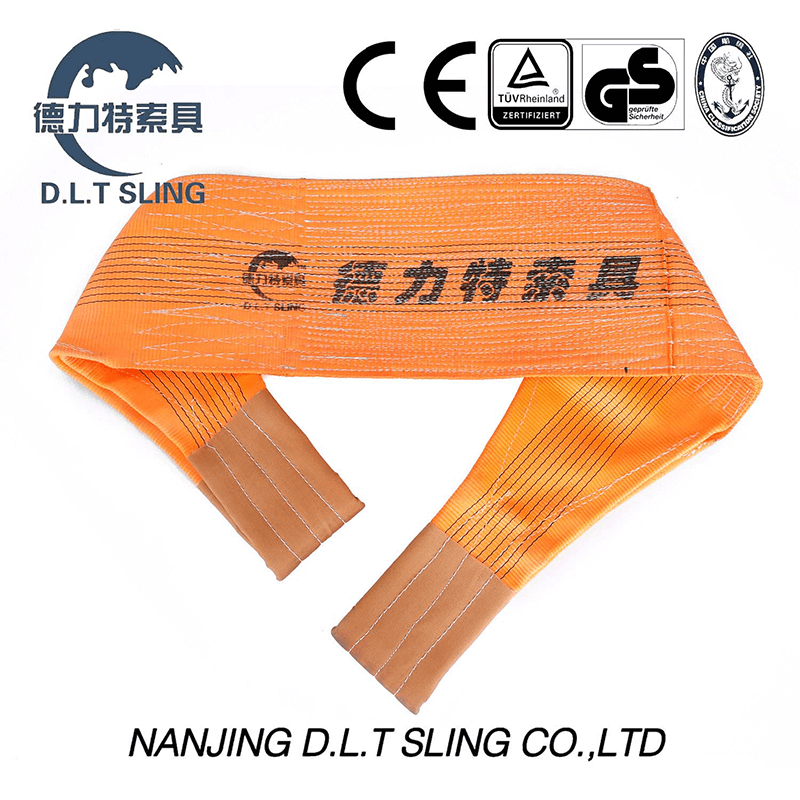
Understanding structural design helps you make accurate rigging decisions. A polyester flat webbing sling is woven completely flat. Manufacturers build them in single-ply or multi-ply configurations for added rigidity. They usually feature reinforced eye loops at each end, known as an Eye-and-Eye configuration. In contrast, a round sling consists of endless loops of load-bearing synthetic yarn. A protective tubular jacket heavily encases these core yarns. The outer jacket bears no load; it only protects the internal strength members from abrasion and UV damage.
You should specify flat webbing when lifting loads that require a wider footprint for stability. The flat design sits flush against the bottom of rectangular objects. This makes them optimal for basket hitches on smooth, flat objects like stacked drywall, wooden crates, or sheet metal bundles. The wide bearing surface prevents the sling from slipping or twisting during the lift. They also slide easily under pallets or low-clearance machinery. If your load requires maximum surface contact to prevent tipping, the flat design performs exceptionally well.
You should specify endless round configurations for heavy, cylindrical, or highly abrasive loads. Their tubular design allows the internal yarns to shift and conform around irregular shapes. Round slings are superior for tight choker hitches because the tubular jacket slides smoothly over itself. Furthermore, you can rotate a round sling between lifts. Rotating it ensures the exact same contact point does not bear the friction every time. This rotation distributes wear evenly across the entire jacket, extending the tool's usable lifespan significantly.
You must compare the initial procurement cost against the expected lifecycle based on typical wear patterns. Flat slings generally cost slightly less upfront due to simpler manufacturing processes. However, their fixed eye loops mean the crane hook and the load always contact the exact same wear points. Round configurations often cost more initially. Yet, their ability to rotate the bearing point extends their lifespan in high-friction environments. If your operation involves frequent lifts of abrasive materials, the extended lifecycle of the round design often justifies the higher initial procurement cost.
Your primary criteria for selecting synthetic over steel always begins with load fragility. You must assess the surface finish and structural integrity of the object. Machined aerospace parts, composite materials, and finished boats demand synthetic rigging. A steel chain will immediately scratch an airplane wing or crack a fiberglass hull. If the load possesses a painted, polished, or easily crushed surface, steel is automatically disqualified. Synthetic materials provide the necessary cushioning. They absorb minor impacts and prevent localized surface stress, ensuring your high-value loads reach their destination intact.
Environmental factors strictly dictate whether synthetic fibers will survive your operational conditions. The chemical atmosphere of your facility can destroy rigging tools rapidly. We must match the fiber chemistry to the environment. Polyester thrives in acidic environments but degrades quickly when exposed to alkalis. Nylon exhibits the exact opposite behavior; it resists alkalis but melts under acid exposure.
Additionally, synthetic materials provide crucial non-sparking and non-conductive benefits. If you work in volatile environments like oil refineries or explosive chemical plants, a dropped steel chain can cause a fatal spark. Synthetic materials eliminate this spark risk entirely.
| Fiber Type | Acid Resistance | Alkali Resistance | Stretch Characteristic |
|---|---|---|---|
| Polyester | High / Excellent | Poor / Vulnerable | Low (~3%) |
| Nylon | Poor / Vulnerable | High / Excellent | High (~10%) |
| Polypropylene | Good | Good | Moderate (Low Strength) |
Mobile lifting operations face unique constraints regarding space and transport weight. You must consider logistics when equipping utility trucks or mobile cranes. Chain slings require heavy metal bins and significant physical effort to load. Wire ropes resist coiling and often spring out, requiring large storage hooks. Synthetic fibers bypass these issues completely. You can easily roll them up into tight, compact bundles. They require minimal storage space in a rigging locker or truck bed. This compact footprint allows mobile crews to carry a wider variety of lengths and capacities without overloading their vehicle.
Industry standards utilize strict color-coding systems to help riggers verify the Working Load Limit (WLL) instantly. You can look at the color of a sling and immediately know its base capacity. For example, purple indicates one metric ton, green indicates two tons, and yellow indicates three tons. Furthermore, manufacturers weave thick black stripe indicators directly into the webbing. Each black stripe typically represents one ton of capacity. However, you must never rely solely on color or stripes. You must always confirm the precise capacity by reading the manufacturer's identification tag.
Regulatory bodies like OSHA and ASME B30.9 enforce uncompromising rules regarding identification tags. Every lifting device must possess a permanent, legible tag attached by the manufacturer. This tag displays the material type, manufacturer name, serial number, and the rated capacities for different hitches. If a tag is missing, illegible, or partially detached, regulations mandate immediate removal from service. You cannot guess the capacity of a faded tag. Operating without clear tagging violates safety compliance and creates extreme liability for the operation.
Pre-use inspection forms the backbone of operational safety. Riggers must visually and physically inspect the equipment before every single lift. You must rigorously evaluate the fabric for specific defect criteria.
We cannot overstate the operational necessity of edge protection. Synthetic fibers are exceptionally strong in tension but incredibly weak against friction and cutting forces. Wrapping unprotected synthetic fabric around a sharp steel I-beam guarantees catastrophic failure. You must proactively deploy corner protectors, magnetic edge guards, or heavy-duty wear sleeves. These protective barriers sit between the abrasive load edge and the synthetic fabric. They absorb the cutting force and allow the webbing to glide safely during the lift. Failing to use edge protection remains a leading cause of dropped loads.
You must calculate capacity adjustments based on your intended hitch configuration. The baseline Working Load Limit always assumes a straight Vertical hitch. If you configure a Choker hitch, the friction and severe bending angle reduce the baseline capacity by approximately twenty percent. Conversely, using a Basket hitch doubles the baseline capacity, provided both legs remain perfectly vertical. You must clearly define how you plan to attach the load to ensure you specify a tool with adequate strength for that specific hitch.
The angle of the lift exponentially increases the tension applied to the fabric. You must understand how sling angles affect rigging math. As the angle between the load and the horizontal plane decreases, the tension on each leg drastically increases. Lifting with a 30-degree horizontal angle effectively doubles the load weight experienced by the sling. You cannot simply divide a 10,000-pound load evenly between two legs if the angle is shallow. You must up-size your equipment to accommodate this increased angular tension.
Manufacturers manipulate ply and width to balance flexibility and strength. A single-ply configuration remains highly flexible. It conforms easily around complex load geometries and chokes down tightly. However, single-ply designs have lower overall capacities. Multi-ply configurations stack two, three, or four layers of webbing together. This dramatically increases the lifting capacity and the rigidity of the strap. If you need to lift massive loads but cannot use a wider strap due to space constraints, adding plies provides the necessary strength. You must balance the need for flexibility against the required capacity.
Ordering the correct rigging gear requires systematic data collection. You must build a comprehensive operational profile before contacting suppliers. Use this checklist of required data before initiating procurement.
Webbing slings offer unmatched load protection and handling ease on the modern job site. They drastically reduce rigger fatigue, prevent costly surface damage to fragile loads, and eliminate spark hazards in volatile environments. However, their successful deployment requires your team to conduct strict environmental and structural evaluations before lifting. You must respect their vulnerability to sharp edges, high heat, and chemical exposure.
We strongly advise implementing regular rigging audits within your facility to identify and destroy damaged synthetics before they fail. Furthermore, always consult with certified rigging engineers when planning complex lifts. Ensuring your selected sling precisely matches your operational load profile guarantees both regulatory compliance and the safety of your crew.
A: The industry standard limit for polyester and nylon slings is 194°F (90°C). Exceeding this temperature causes the synthetic fibers to melt and lose load-bearing integrity. If your operational environment exceeds this limit, you must switch to wire rope, alloy chain, or specialty heat-resistant synthetic blends designed for high-temperature lifts.
A: You determine the WLL primarily by reading the manufacturer's identification tag. You can also use the industry color-coding system (e.g., yellow for 3 tons) and count the black thread lines woven into the fabric. However, regulatory standards dictate that you must never lift a load if the manufacturer's tag is missing or illegible.
A: No. Load-bearing synthetic slings generally cannot be repaired. Safety standards mandate that any sling with cuts, severe abrasion, punctures, or broken load-bearing stitches must be immediately removed from service and destroyed. Only protective outer sleeves or specific hardware components can occasionally be replaced by the original manufacturer.
A: A standard choker hitch reduces the sling's base vertical capacity by approximately 20%. This capacity reduction occurs due to the severe stress, friction, and sharp bending angle generated at the choke point. You must always account for this reduction when calculating your required rigging strength.

