

close
Choose Your Site
Global
Social Media

Views: 0 Author: Site Editor Publish Time: 2026-07-08 Origin: Site


Industrial lifting represents a high-stakes operational environment. Equipment failure often causes severe safety hazards, massive compliance penalties, and expensive operational downtime. Procurement managers and safety officers constantly face difficult challenges. You must match the correct rigging equipment to delicate or oddly shaped loads. Selecting incorrect gear easily damages valuable cargo. It also introduces catastrophic risk to your rigging crew.
This guide serves as your comprehensive technical evaluation tool. You will learn how to specify, shortlist, and source the correct equipment for your site. We cover international lifting standards, rigorous compliance checks, and practical deployment strategies. By mastering these principles, you can safely integrate a flat webbing sling into your daily operations. Proper selection ensures maximum load protection while maintaining strict adherence to ASME and EN safety regulations.
Heavy industrial loads frequently feature fragile surfaces. You might lift freshly painted turbine rotors, polished aerospace components, or delicate fiberglass boat hulls. These loads demand specialized care. Traditional wire rope or alloy chain slings often crush these vulnerable surfaces. Metal rigging creates point-loading stress. This stress easily scratches finishes and compromises structural integrity.
Synthetic materials solve this problem elegantly. A flat webbing sling delivers a wide surface area. It grips loads securely while distributing pressure evenly across the contact zone. Riggers gain exceptional control over awkward centers of gravity.
When comparing synthetic options against wire rope and chain, several operational advantages emerge:
You must also evaluate flat profiles versus tubular round slings. Round slings work well for massive capacities. However, a flat profile prevents rolling on flat-bottomed loads. It offers tighter control in restricted clearance spaces. Riggers can slide flat webbing under tight pallets much faster than bulky round slings.
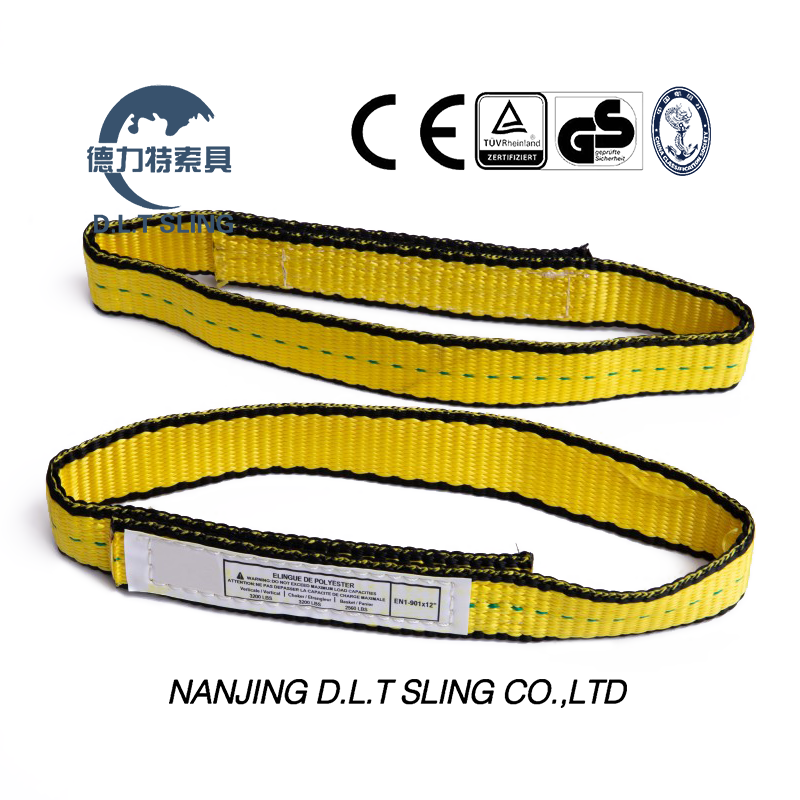
Understanding the webbing sling category requires knowing your structural options. Manufacturers construct these tools using different ply layers and end terminations. You must match the physical configuration directly to your lifting hitch.
First, evaluate the difference between simplex and duplex constructions. Simplex means a single-ply design. It handles lighter duty tasks and offers maximum flexibility. Duplex denotes a double-ply construction. Manufacturers stitch two layers together. This doubles the Working Load Limit (WLL) while maintaining a manageable width. Triplex and quadraplex versions exist for extreme industrial loads.
Eye-and-eye designs feature sewn loops at both ends. You will typically choose between three eye styles:
The endless flat lifting webbing sling operates differently. It features a continuous loop design without designated eye points. This configuration offers a massive operational advantage. You can rotate the wear points after every single lift.
When riggers use eye-and-eye models, the crane hook always rubs the exact same spot. An endless loop shares this friction across its entire circumference. This rotation significantly extends the product's lifespan during repetitive manufacturing tasks. Furthermore, an endless design excels in choker hitches. It grips pipes and raw timber aggressively without slipping.
Safety officers cannot purchase rigging equipment blindly. You must evaluate raw materials, load limits, and engineering safety factors before authorizing a purchase.
Manufacturers weave synthetic lifting gear from two primary polymers. Each reacts differently to physical stress and chemical exposure.
Polyester (PES) serves as the industry standard. It features a very low stretch rate of approximately 3% under a full load. This low elasticity provides excellent clearance control in tight factories. Polyester resists acidic environments well. However, alkalis will rapidly destroy it.
Nylon (Polyamide / PA) provides a higher stretch rate of around 10%. This elasticity acts as a shock absorber. It cushions the crane during sudden load shifts. Nylon resists alkalis beautifully but degrades instantly in acidic conditions.
Table 1: Synthetic Sling Material Specifications
| Material Type | Stretch at WLL | Acid Resistance | Alkali Resistance | Primary Use Case |
|---|---|---|---|---|
| Polyester (PES) | ~3% | Excellent | Poor | Precision lifting, acidic environments |
| Nylon (PA) | ~10% | Poor | Excellent | Shock absorption, alkaline environments |
The global rigging industry uses a standardized color matrix for polyester slings. This system helps riggers quickly identify safe capacities on the job site.
While color provides a helpful visual aid, you must remember one absolute rule. Sunlight fades colors. Dirt obscures dyes. Therefore, the physical identification tag remains the ultimate authority. Never lift a load based purely on faded fabric color.
The safety factor dictates the built-in breaking strength of the product. North American standards (ASME B30.9) generally require a 5:1 design factor. If the WLL is 2 tons, the sling breaks at 10 tons. European standards (EN 1492-1) mandate a stricter 7:1 safety factor. A 2-ton European model breaks at 14 tons. Procurement teams must match the safety factor to their specific regional compliance requirements.
Even the strongest synthetic fibers remain vulnerable to specific job site hazards. Recognizing these risks prevents catastrophic accidents.
Sharp load edges represent the absolute weakest point of any synthetic lifting gear. Unlike steel, fabric cannot withstand shear tension against a sharp corner. A heavy load shifting against a bare steel edge will slice through double-ply polyester instantly.
You must mitigate this risk proactively. Standard practice requires budgeting for proper edge protectors. Polyurethane corner pads create a safe radius between the metal and the fabric. Alternatively, you can specify reinforced wear sleeves made from Kevlar. These sleeves slide over the webbing body. They take the abrasive damage so the core fibers remain intact.
Synthetic polymers operate safely within strict temperature boundaries. Standard limits range from -40°C to 100°C (-40°F to 212°F). Exposing the material to temperatures above 100°C melts the polymer chains. This causes immediate structural failure.
Prolonged UV exposure also degrades the material. Sunlight bleaches the color and makes the fibers brittle. Riggers should always store synthetic gear in dark, dry toolboxes when not in use.
Authoritative compliance relies entirely on traceability. A sling without a legible manufacturer's tag is legally dead. If your team cannot read the tag, they must destroy the equipment immediately.
Procurement and safety officers must verify specific data on every tag:
Sourcing safe lifting equipment requires strict vendor qualification. You cannot treat life-saving rigging gear as a simple commodity.
Before placing an order, investigate the manufacturer's quality control processes. Do they provide verifiable batch testing certificates? Reputable factories destructively test samples from every production run. They should willingly share these test videos and certificates.
Verify their ISO 9001 manufacturing status. Quality management systems ensure consistent stitching patterns and reliable thread tension. Furthermore, evaluate their custom capabilities. A strong vendor should offer custom lengths and specialized wear-sleeve configurations tailored to your unique loads.
The global market contains dangerously cheap, non-certified imports. Counterfeiters often use recycled plastics to spin weak yarns. They sew fake tags onto substandard fabric and exaggerate WLL ratings. Sourcing these products introduces severe criminal liability if an accident occurs. Always buy directly from established industrial manufacturers or certified rigging houses.
You must transition from theory to practical application. First, audit your current load weights. Identify your most frequent chemical exposure risks and preferred hitch types. Next, contact a qualified manufacturer for a technical consultation. Request a certified sample batch. Deploy these samples on your site for a controlled testing period. Monitor how the fabric interacts with your specific cargo before committing to a bulk fleet replacement.
A: No. Under industry standards like ASME B30.9, you cannot repair load-bearing synthetic webbing. If you discover cuts, snags, broken stitches, or chemical burns, you must immediately remove the equipment from service and destroy it.
A: The user must perform a visual inspection before every single shift or lift. Additionally, a qualified person must conduct a documented periodic inspection at least annually. Severe service conditions require more frequent periodic inspections.
A: Polyester absorbs very little moisture. Its lifting strength remains generally unaffected by water. However, freezing conditions can cause absorbed surface water to form abrasive ice crystals inside the weave. These crystals can cut fibers from the inside out under tension.

