

close
Choose Your Site
Global
Social Media

Views: 0 Author: Site Editor Publish Time: 2026-07-13 Origin: Site


Every lift carries inherent operational risks. Selecting the correct lifting equipment is a highly critical decision. You must carefully balance load protection, rigging efficiency, and strict site safety. A round sling consists of continuous loops of high-strength polyester yarn. A protective tubular jacket completely encloses these internal core yarns. Rigging professionals rely on them daily for specific, high-capacity maneuvers. They provide incredible tensile strength. They also avoid adding excessive, unnecessary weight to the crane hook.
However, selecting the ideal sling requires looking far beyond basic load charts. Riggers must deeply understand complex hitch dynamics. They must accurately recognize critical material wear limits. They must also closely evaluate comparative advantages over other traditional sling types. Knowing the physical properties of your equipment prevents catastrophic failures. This article explores how specialized construction dictates heavy lifting performance. You will learn the exact evaluation criteria for choosing the proper sling for your next demanding project.
Understanding the internal mechanics helps riggers make safer decisions. The core construction relies entirely on specialized polyester yarns. These yarns form a continuous, unbroken loop. This load-bearing core provides exceptionally high tensile strength. You can expect minimal stretch during heavy applications. Stretch typically remains around three percent at standard working capacities. This predictable low stretch prevents dangerous load bouncing during rapid crane movements.
A protective tubular jacket surrounds this polyester core. This outer cover consists of an independent woven fabric. The jacket does not bear any of the lifting load. Instead, it serves purely as a robust environmental shield. It protects the sensitive internal yarns from ultraviolet degradation. It blocks abrasive dirt particles from penetrating the core. It also resists moderate surface abrasion during daily operations.
The continuous loop design provides a significant practical advantage. Riggers can freely rotate the sling before each lift. This simple rotation shifts the primary contact points. The crane hook and the heavy load rarely touch the exact same spot twice. This operational flexibility prevents localized friction damage. Evenly distributed wear extends the operational safety margin considerably.
Always manually rotate the sling after completing a strenuous lift. Smooth out any visible bunches in the tubular jacket. Ensure the internal yarns lie flat inside the cover. Twisted internal yarns can severely reduce the overall lifting capacity.
Certain loads demand specific equipment profiles for safe handling. You should specify this equipment based on load geometry and surface fragility. Here are the primary applications where they outperform rigid alternatives.
Riggers often encounter complex lifts combining all three challenges. A painted cylindrical load in a tight warehouse demands precise control. In these scenarios, soft polyester loops become the most reliable tool available. They guarantee secure choking without causing expensive surface damage.
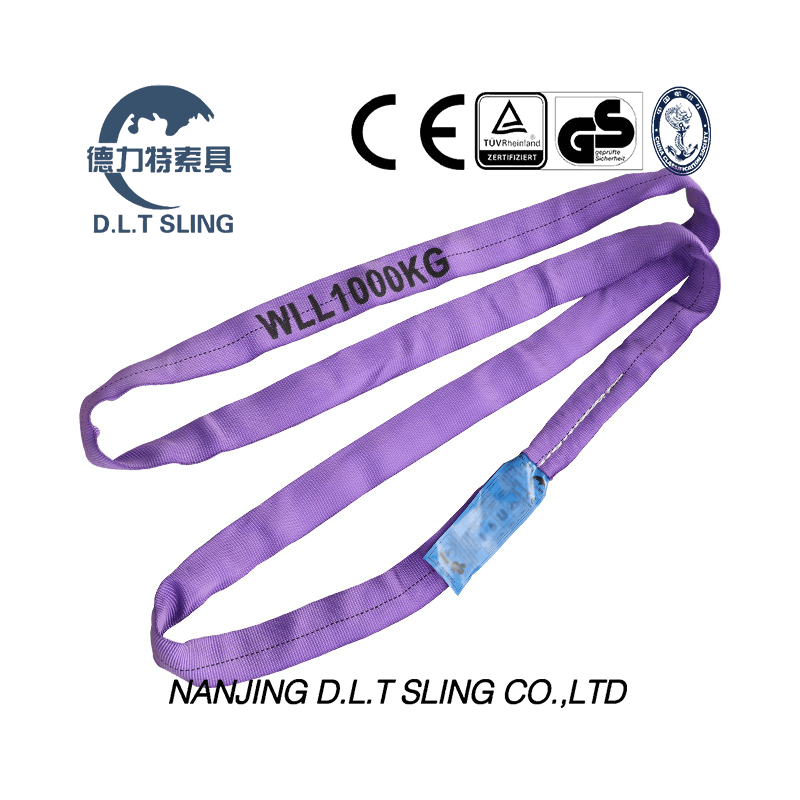
Choosing between flexible lifting options requires careful technical comparison. You must thoroughly contrast the round sling category against the webbing sling category. Both utilize high-strength polyester. However, their fundamental structural differences dictate entirely different operational strengths.
A round sling features a continuous circular loop structure. Conversely, a flat web sling typically utilizes an eye-to-eye or endless woven flat design. This primary structural difference alters how they distribute physical weight. Webbing slings naturally distribute weight over a wider flat surface area. This wide stance excels when supporting fragile, flat-bottomed cargo. Round slings condense into a much tighter, rounded profile under tension. This narrow profile makes them drastically superior for secure choking applications.
Durability differences also heavily influence procurement choices. Round slings generally outlast flat web slings in rigorous construction environments. The independent protective cover absorbs the majority of abrasive damage. The internal load-bearing core remains safely isolated inside. In contrast, a flat web sling acts as both the cover and the core. If a sharp edge cuts the flat surface, structural integrity becomes instantly compromised.
| Evaluation Criteria | Webbing Sling | Round Sling |
|---|---|---|
| Primary Load Shape | Flat-bottomed or rectangular loads | Cylindrical, irregular, or bundled loads |
| Weight Distribution | Wide surface contact area | Condensed, localized grip |
| Choking Efficiency | Moderate (can crease under tension) | Exceptional (tight 360-degree grip) |
| Damage Tolerance | Low (surface cuts compromise strength) | High (cover protects the inner core) |
Use a rapid shortlisting rule for field operations. Choose flat webbing for wide weight distribution on flat loads. Choose round slings for high-capacity choking and continuous wear rotation. Understanding this crucial distinction prevents unsafe rigging configurations.
Safety regulations demand immediate visual identification of lifting capacities. Reputable manufacturers strictly adhere to standard international color coding. This universal system indicates the straight-line Working Load Limit (WLL). Knowing these colors prevents accidental overloading.
The universal color code system scales systematically. Purple always designates a one-ton capacity. Green indicates two tons. Yellow represents three tons. Grey handles four tons. Red supports five tons. Brown manages six tons. Blue tackles eight tons. Orange generally signifies ten tons or more. Riggers can instantly verify the baseline capacity simply by looking at the jacket color.
High-quality manufacturers provide a secondary visual backup. They weave heavy black stripes directly into the outer jacket. Each black stripe typically represents exactly one ton of rated capacity. A green jacket will display two distinct black stripes. A yellow jacket will feature three stripes. This physical feature remains visible even if dirt heavily obscures the underlying color.
The standard WLL only applies to straight vertical lifts. Changing the hitch configuration drastically alters the actual lifting capacity. You must calculate these hitch multipliers accurately before every single lift.
A three-ton yellow sling lifts six tons in a perfect basket hitch. However, it safely handles only 2.4 tons in a choker configuration. Riggers must apply these mathematical rules rigorously.
Practical implementation exposes lifting equipment to severe environmental threats. Vulnerability to sharp edges represents the single greatest job site risk. Polyester fibers remain highly susceptible to cutting under extreme tension. You must never place these synthetic materials directly against sharp metal corners.
You must employ proper edge protection aggressively. Riggers use heavy-duty magnetic corner protectors on steel plates. They slide thick, cut-resistant Kevlar sleeves over the sling body. Relying solely on the standard tubular jacket for edge protection is a critical safety violation. The jacket prevents abrasion, but it cannot stop a sharp blade-like edge under thousands of pounds of pressure.
Chemical and temperature limitations also dictate safe operational boundaries. Polyester handles moderate temperature extremes well. The equipment typically operates safely between -40 degrees Celsius and 100 degrees Celsius. Polyester actively resists damage from most common acids. However, it is extremely vulnerable to alkalis and lye. Exposure to strong caustic chemicals will rapidly degrade the structural fibers.
Strict adherence to standard inspection protocols is entirely non-negotiable. Industry frameworks like ASME B30.9 and EN 1492-2 clearly define specific rejection criteria. You must remove a sling from active service immediately if you spot critical defects.
Inspect the outer jacket thoroughly before every shift. Look closely for irregular holes, deep tears, or significant snags. If you can physically see the internal core yarns through a hole, the sling is dead. Look for chemical burns, melted fibers, or weld splatter. Verify the identification tag. If the tag becomes completely illegible or goes missing, you must discard the equipment legally. Never attempt to guess the capacity of an untagged synthetic loop.
Enterprise procurement requires vetting suppliers for strict compliance. Buyers should demand comprehensive documentation for all synthetic lifting gear. Sourcing reliable equipment directly impacts facility liability and worker safety.
Demand robust certification and traceability from your rigging supplier. Every shipped unit should include a formal certificate of conformance. Look for explicit CE marks or ISO standard compliance declarations. High-quality items feature individual serial numbers. Serialized equipment allows safety managers to track specific usage history and inspection cycles.
Tag durability serves as a major indicator of overall manufacturing quality. Evaluate manufacturers based on how they secure their identification tags. Premium builders use heavy-duty vinyl or thick leather tags. They stitch these tags securely into the jacket seam. Flimsy paper-like tags tear off easily in harsh environments. Missing tags legally require immediate removal from service, resulting in wasted procurement budgets.
Modern enterprise procurement also leverages advanced customization options. You can specify exact custom lengths for highly specialized automated lifting frames. You can order double-jacketed covers for environments with extreme surface abrasion. Many facilities now mandate RFID integration. Manufacturers sew tiny, durable RFID chips inside the jacket cover. Safety inspectors scan these chips to instantly update digital inventory and compliance records. This digital integration eliminates paperwork errors and ensures flawless OSHA compliance.
Selecting the optimal lifting gear demands technical knowledge and practical foresight. Round slings offer an unmatched combination of high load capacity and adaptability. They conform safely to complex cylindrical shapes while providing superior surface protection. Understanding their internal mechanics allows you to maximize their operational lifespan through proper wear rotation.
Your team must actively prioritize safety protocols above all else. Apply hitch multipliers correctly to calculate true lifting capacities. Always employ heavy-duty edge protection to prevent catastrophic cuts. Enforce strict, daily visual inspections to identify fatal jacket damage before a load ever leaves the ground.
Take decisive action to upgrade your current rigging inventory today. Audit your existing heavy lifting applications carefully. Assess your exact ratio of continuous loops to flat webbing gear. Contact a certified rigging supplier to specify the appropriate color-coded capacities. Ensure you purchase serialized equipment equipped with durable identification tags and suitable edge protection accessories for your next demanding project.
A: No. Industry standards dictate immediate removal from service if core yarns are exposed. The protective jacket cannot be sewn or patched in the field. Attempting repairs severely compromises the structural integrity and violates OSHA regulations.
A: Generally, the straight-line WLL is doubled, provided the sling angle is exactly 90 degrees. However, as the angle between the legs increases, the lifting capacity significantly decreases. Always consult specific manufacturer load charts to verify angled basket capacities.
A: Expected lifespan depends entirely on usage frequency, UV exposure, and operational environment. A heavily used sling in an abrasive environment may last only months. Annual third-party inspections are typically required by law to determine ongoing safety and viability.

