

close
Choose Your Site
Global
Social Media

Views: 0 Author: Site Editor Publish Time: 2026-07-09 Origin: Site


Selecting the correct synthetic lifting equipment carries massive operational and safety stakes. You cannot afford to guess when rigging multi-ton loads. Choosing the wrong sling leads directly to devastating load damage. It accelerates gear failure and creates severe safety compliance risks. Synthetic slings now serve as the industry standard for securing sensitive materials. They easily outperform abrasive chains or stiff wire ropes in delicate lifting applications. Operators must carefully navigate the specific decision between flat and round configurations. This article breaks down the exact structural differences between these popular designs. We explore load distribution, hitch adaptability, and crucial safety standards. You will learn exactly how to match the right sling profile to your specific load requirements. By the end, you can make confident, safe, and efficient rigging choices. It ensures your operations remain compliant and productive.
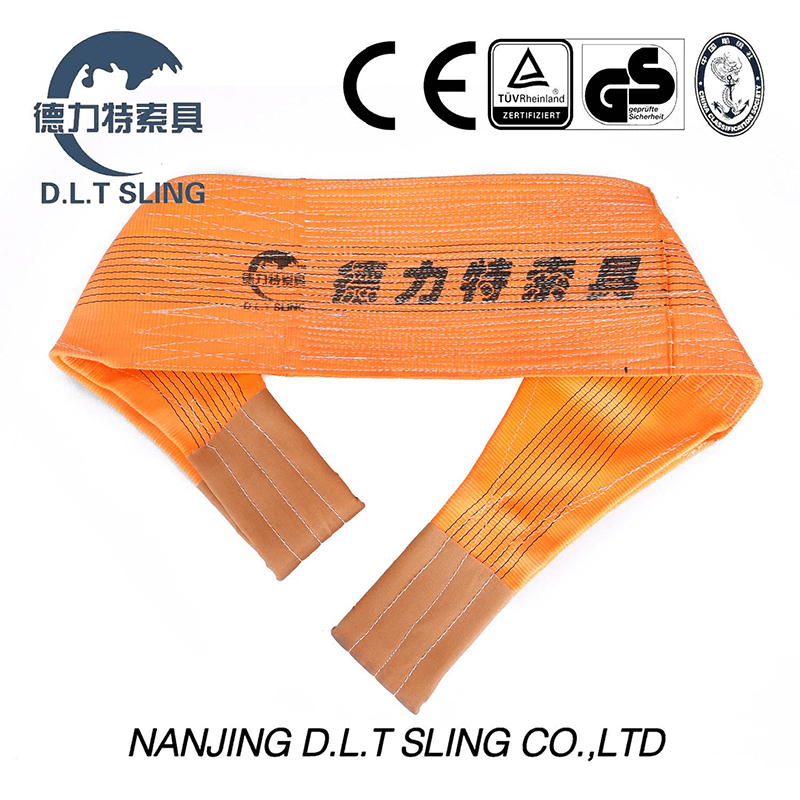
Manufacturers construct a polyester flat webbing sling using tightly woven synthetic threads. They often feature reinforced eyes at each end for easy connection. Riggers refer to these as duplex or simplex designs depending on the layer count. A simplex sling uses a single layer of woven webbing. A duplex model features two layers stitched together for double the strength. The mechanical reality of this design is highly straightforward. The entire woven surface area bears the tension of the load weight directly.
You can easily identify them by their flat, belt-like appearance. They lay completely flat against the load surface. Industry standards dictate a strict color-coding system based on the Working Load Limit (WLL). This universal color system helps riggers verify capacity at a glance. For example, a violet belt always signifies a one-ton capacity. A green belt indicates a two-ton limit. The flat profile provides excellent surface area coverage but exposes the load-bearing fibers directly to the environment.
The construction of a round sling differs fundamentally from flat belts. Manufacturers build them as an endless loop of synthetic load-bearing yarns. We call this internal yarn structure the core. A woven tubular jacket completely encases this core. This outer jacket is entirely non-load-bearing. It simply holds the yarns together and provides essential friction. The mechanical reality offers unique advantages. The internal core yarns handle 100% of the lifting tension.
You will recognize products in the round sling category by their soft, tubular, and continuous loop design. They also follow the exact same DIN EN 1492 color-coding standard as their flat counterparts. The outer jacket provides a first line of defense against UV radiation and minor friction. Because the core yarns remain loose inside the jacket, they spread out slightly when compressed. This construction allows for exceptional flexibility around odd shapes.
Riggers must evaluate how each sling interacts with the load surface. A wide flat webbing sling prevents the crushing of delicate edges. The broad profile distributes pressure evenly across a larger contact zone. Conversely, round slings tend to bunch up under heavy tension. They form a narrower pressure point. This bunching can damage highly finished or fragile edges if used incorrectly.
Hitch adaptability plays a major role in daily rigging. Both designs perform well in vertical and basket hitches. However, the round configuration excels in tight choker hitches. The tubular design grips aggressively and conforms seamlessly to cylindrical loads. Flat belts can sometimes bind or fold unevenly when choked tightly. This folding reduces their functional strength.
Weight capacity constraints heavily influence equipment selection. Manufacturers can easily scale the WLL of round designs by adding more internal yarns. They routinely specify these for ultra-heavy industrial lifts exceeding 10 tons. Achieving a 10-ton capacity in a flat design requires an unmanageably wide and stiff belt. Finally, consider stretch and load control. Polyester variants in both categories typically stretch about 3% at rated capacity. This minimal stretch absorbs sudden shock loads effectively. It prevents severe load bounce during rapid hoisting operations.
Below is a summary chart comparing the primary operational metrics.
| Feature | Flat Webbing Style | Round Tubular Style |
|---|---|---|
| Load Distribution | Excellent across wide surfaces | Concentrated, tends to bunch |
| Choker Hitch Performance | Good, but may fold unevenly | Superior flexibility and grip |
| Weight Scalability | Limited by manageable width | Highly scalable for heavy lifts |
| Wear Point Rotation | Fixed wear points at the eyes | Infinite rotation along the loop |
Selecting the correct profile requires analyzing the exact nature of your load. You must consider surface fragility, center of gravity, and lifting clearances. Practical experience proves proper matching prevents expensive accidents.
When to Specify a Flat Profile:
When to Specify a Round Profile:
You must understand the unique vulnerability and wear patterns of synthetic materials. Flat webbing remains highly susceptible to edge cuts. Surface abrasion directly degrades the load-bearing fibers. They also suffer from localized UV degradation if left outdoors. Round configurations face different threats. Jacket tears expose the internal core to dirt and grit. Internal yarns can herniate through small holes. Because the core remains hidden, you must perform tactile inspections. Riggers must feel along the entire length to detect hidden lumps or broken internal fibers.
Edge protection mandates apply strictly to both configurations. You must use external edge protectors when handling sharp or abrasive corners. Standard wear sleeves or magnetic corner pads prevent catastrophic severing under tension. Do not ignore this rule. The tension multipliers on sharp corners will slice through polyester instantly.
Industry standards provide crystal clear guidance for removal from service. Organizations like OSHA and ASME strongly enforce the B30.9 standard. You must remove any synthetic gear from service immediately upon discovering specific wear indicators. A "zero tolerance for cuts" policy applies universally across all modern rigging operations. Do not attempt to salvage compromised equipment. Cut, burned, or chemically degraded belts must be destroyed to prevent accidental reuse.
Procurement teams face critical choices when outfitting a rigging crew. You should carefully analyze initial cost against expected replacement frequency. Flat belts often appear slightly more economical at lower weight capacities. They work perfectly for light-duty warehouse tasks. However, endless loop configurations frequently outlast them in heavy industrial settings. The ability to rotate the wear points prevents premature failure. This extended lifespan easily justifies a slightly higher upfront investment.
Inventory standardization creates major operational advantages. Many facilities benefit from standardizing continuous loop models for general rigging duties. They handle diverse daily tasks efficiently. You can then maintain a much smaller, specialized inventory of flat belts specifically for fragile product handling. This dual approach optimizes warehouse space and simplifies rigger training.
Vendor evaluation criteria must remain uncompromising. Shortlist suppliers based on strict manufacturing traceability. They must provide official test certificates for every batch. Verify their compliance with ISO and ASME manufacturing tolerances. Additionally, prioritize vendors offering custom lengths and specialized wear sleeves. A strong supplier acts as a technical partner, not just a catalog.
The decision framework for synthetic lifting equipment ultimately relies on your specific operational demands. You should choose wide woven belts for maximum load protection and surface area coverage. They excel at stabilizing fragile materials. Conversely, you should choose tubular loop configurations for high-capacity, heavy-duty choker applications. Their flexibility and grip remain unmatched in harsh environments.
Your next step requires immediate action. Audit your current lifting applications carefully. Consult your load weight specifications and surface fragility requirements. Finally, request a formal technical consultation or quote from a certified rigging supplier. Proactive equipment evaluation guarantees a safer and more efficient workplace.
A: You should generally avoid mixing different synthetic sling types on a single lift. They exhibit slightly different stretch rates under heavy tension. This inconsistency can cause unwanted load shifting or uneven weight distribution. Always prioritize balanced loads using matching equipment for optimal safety.
A: Manufacturers follow the universal DIN EN 1492 color standard. Violet indicates 1 ton, green is 2 tons, yellow is 3 tons, and grey is 4 tons. Red signifies 5 tons, brown is 6 tons, blue is 8 tons, and orange denotes 10 tons or more.
A: Polyester resists most common acids relatively well. However, it remains highly vulnerable to strong alkalis. It will degrade quickly upon contact. If your environment uses heavy alkalis, you must select nylon or polypropylene alternatives. Always check chemical compatibility charts before rigging in harsh environments.
A: Strict safety regulations prohibit the repair of torn outer jackets. Once the non-load-bearing jacket tears, the internal core yarns become exposed to dirt, abrasion, and UV damage. You must immediately remove the damaged unit from service, destroy it, and replace it entirely.

