

close
Choose Your Site
Global
Social Media

Views: 0 Author: Site Editor Publish Time: 2026-07-14 Origin: Site


Selecting the wrong synthetic lifting sling introduces critical safety risks on the job site. It accelerates equipment replacement expenses and severely impacts operational efficiency. Rigging professionals face a crucial choice when sourcing load-bearing equipment for daily operations. Both round slings and webbing slings provide lightweight, non-marring alternatives. They effectively replace cumbersome wire rope and rigid steel chain for specific lifts. However, structural differences between these synthetic options dictate their distinct performance. You must match the sling architecture to the exact load profile and rigging configuration. This article equips procurement managers, safety officers, and rigging supervisors. We provide a proven, evidence-based framework to evaluate sling designs. You will discover how to align your rigging equipment choices to exact lifting requirements. We also explore compliance standards and operational safety to guide your buying decisions. Read on to master synthetic sling selection.
Understanding sling construction dictates load distribution and wear resistance. The physical makeup directly influences how rigging gear performs under tension. We evaluate these structural properties to predict lifespan and safety margins.
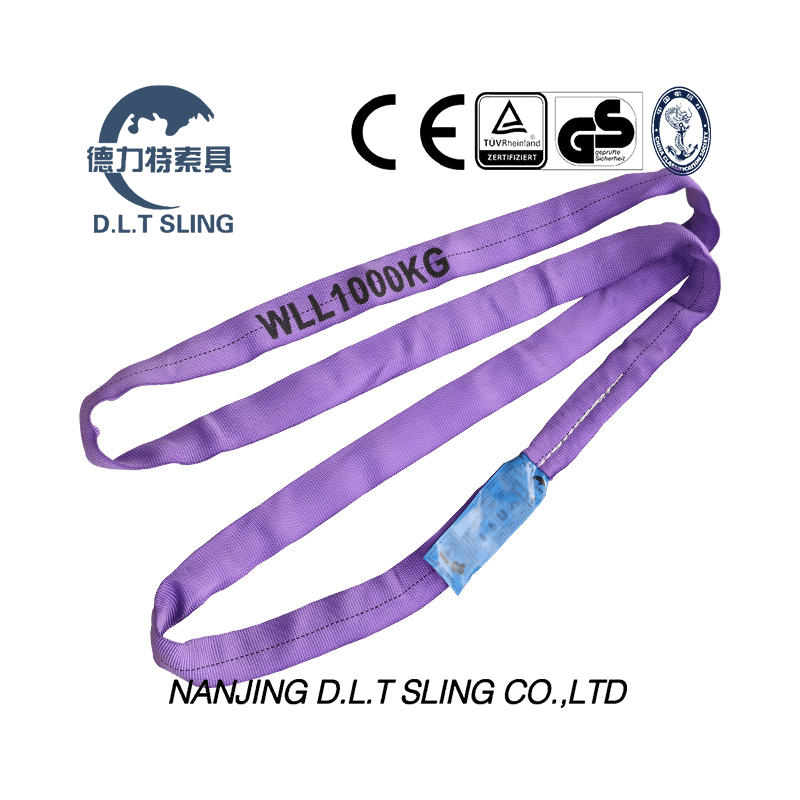
Manufacturers construct a round sling from continuous loops of synthetic yarn. They typically use high-tenacity polyester. A non-load-bearing tubular jacket encases this core material. This outer sleeve protects the internal fibers from UV degradation and minor friction.
Because the core yarns move independently of the jacket, riggers gain a unique operational advantage. The wear point can shift during each use. Crane operators simply rotate the loop before the next lift. The crane hook contacts a different section of the protective cover every time. This simple practice extends the sling’s lifespan considerably. High-volume rigging environments benefit heavily from this movable wear point.
A polyester flat webbing sling features a distinct woven structure. Manufacturers weave synthetic fibers into a solid, flat strap. They produce these straps in simplex (single layer) or duplex (double layer) configurations. Reinforced lifting eyes sit at each end to connect smoothly with hooks and shackles.
Implementation reality changes drastically here. The load-bearing tension distributes evenly across the entire width of the strap. This wide profile creates exceptional surface contact. However, this design carries a strict vulnerability. If an edge suffers a cut, structural integrity disappears. A small tear compromises the entire woven network. Riggers must discard the equipment immediately upon discovering edge cuts.
Choosing a continuous loop design provides specific mechanical advantages. We must analyze these strengths to deploy them safely.
Continuous loop yarns offer a superior strength-to-weight ratio. Crews lift extremely heavy industrial loads safely. These synthetic models eliminate the bulk found in heavy steel chain or stiff wire rope. Rigging teams handle high-capacity equipment easily, reducing worker fatigue during repetitive lifts.
Irregular load shapes demand adaptable rigging gear. The continuous yarn core molds easily around cylinders, machinery, and uneven structures. It grips firmly. This flexibility prevents load shifting during vertical movements.
Riggers consider this design the undisputed choice for choker hitches. The tubular construction creates a tight, secure grip. It cinches down securely. The internal fibers adjust seamlessly without creasing the outer jacket. This prevents localized fiber stress during tightening.
Every lifting tool carries operational limitations. The protective jacket remains highly prone to snagging on sharp edges. An angular steel beam easily slices the non-load-bearing cover. Corner protectors are mandatory. They are not optional accessories. Rigging teams must deploy magnetic or synthetic corner pads for every angular load.
Flat straps solve unique rigging challenges. Their geometry offers targeted benefits for specific lifting scenarios.
The flat profile spreads the lifting force efficiently. Force disperses over a much wider surface area compared to tubular designs. This reduces pounds per square inch applied directly to the cargo.
Many industries manufacture fragile components. Flat straps are ideal for finished parts and highly polished surfaces. They excel when moving loads prone to crushing. Typical applications include fiberglass boat hulls, painted metal panels, and soft wood products. The wide strap prevents surface marring completely.
Flat straps hold a semi-rigid shape. Riggers slide them easily under tight ground clearances. They push flat straps under pallets or heavy machinery effortlessly. After operations, crews roll them up compactly. They occupy minimal space inside storage lockers or rigging boxes.
Flat straps adapt poorly to complex choke hitches. When you pull a flat strap into a tight choker setup, the material folds. It pinches aggressively. This creasing weakens the woven fibers locally. Over time, repeated creasing at the choke point degrades load capacity. Teams should reserve flat straps primarily for basket hitches or vertical lifts.
Purchasing rigging gear requires systematic evaluation. Procurement managers must analyze multiple environmental and mechanical variables.
You must audit your typical cargo geometry before purchasing. Ask your team specific questions:
Synthetic materials elongate under heavy tension. Both polyester continuous loops and flat straps stretch approximately 3% at their Working Load Limit (WLL). Planners must account strictly for this headroom. If you execute a low-clearance lift inside a factory facility, three percent elongation matters. A 20-foot sling stretches over seven inches. You must calculate this stretch to avoid hitting floor obstacles.
Job site environments destroy synthetic fibers quickly. Chemical exposure dictates your exact material choice.
Sling Chemical Resistance Profile
| Material Type | Acid Resistance | Alkali Resistance | Maximum Temperature |
|---|---|---|---|
| Polyester | Resists moderate acids | Degrades rapidly in alkalis | 194°F (90°C) |
| Nylon | Degrades rapidly in acid | Resists alkalis safely | 194°F (90°C) |
Assess your facility chemicals carefully. Match the fiber type directly to your local hazard profile. Heat presents another critical failure point. Both materials lose integrity completely at temperatures exceeding 194°F (90°C). High-heat foundries require wire rope or specialized aramid synthetics instead.
Budget constraints frequently drive procurement decisions. Flat woven straps often carry a lower initial procurement cost for standard weight capacities. They fit tight departmental budgets easily. However, continuous loop designs offer excellent long-term value. Because operators rotate the wear points daily, the jacket degrades much slower. This rotation extends the functional lifespan, reducing annual replacement frequency.
Rigging geometry changes tension loads dramatically. Tension increases significantly at lower sling angles. A 10,000-pound load requires much more than 5,000 pounds of capacity per sling if rigged at a 30-degree angle. Buyers must ensure the selected WLL matches the actual tension calculated at the precise rigging angle. Never buy gear based solely on the static weight of the cargo.
Safety regulations demand rigorous adherence. Regulatory bodies set strict rules for lifting equipment deployment.
Adherence to global standards remains non-negotiable. Organizations follow ASME B30.9 in the United States. European operations adhere strictly to EN 1492. These frameworks dictate manufacturing and usage rules. Slings must feature legible, intact manufacturer tags. These tags detail WLL, material composition, and serial numbers. If the tag fades or rips off, you must remove the gear from service immediately.
Visual inspection proves highly straightforward for flat straps. Rejection criteria remain clear and obvious. Inspectors look for broken stitches across the splice. They check for acid burns, caustic melting, or severe snags. Any cut exceeding the manufacturer's allowed threshold demands immediate destruction. Riggers spot these defects quickly during daily pre-use checks.
Continuous loop inspections are substantially more complex. The outer jacket hides the load-bearing core entirely. Riggers cannot simply look at the gear. They must rely heavily on tactile inspection. Inspectors run their bare hands along the entire length. They feel carefully for internal lumps, hard spots, or broken core yarns. They also scan visually for holes in the outer jacket. A tiny jacket hole might indicate massive internal yarn failure.
Facility managers must evaluate their team's training maturity realistically. Tactile inspections require deep experience. If riggers lack advanced training in tactile methods, woven flat straps present a lower operational risk. Flat straps display critical damage openly. Managers reduce the risk of catastrophic failure by matching equipment complexity to team skill levels.
There is no universal "better" option when selecting synthetic lifting gear. A flat woven strap wins consistently for load protection and surface area pressure distribution. It excels during delicate machinery lifts. Conversely, a continuous loop design dominates heavy-duty capacity scenarios. It grips choke hitches perfectly and maximizes lifespan through movable wear points.
Audit your most frequent lifting scenarios immediately. Define your absolute maximum load weights and specific load surface fragilities. Map out your environmental hazards carefully. Consult directly with certified rigging specialists to review your application. Request a tailored quote for compliant synthetic gear tailored strictly to your facility needs.
A: Generally, no. Load-bearing synthetic fibers cannot be stitched or repaired safely. If the core of a continuous loop or the structural webbing of a flat strap is compromised, it must be destroyed and replaced. Occasionally, some manufacturers can repair non-load-bearing protective jackets, but only under strict recertification processes. Always prioritize replacement over risky repairs.
A: The round continuous loop design performs best here. Its tubular, flexible nature allows it to bite down tightly around a load without creasing. Flat webbing can fold during a tight choke. This folding stresses the edge fibers unevenly and weakens the strap significantly over time.
A: There is no fixed expiration date. Lifespan is entirely dictated by usage frequency, UV exposure, chemical contact, and edge abrasion. Daily rigorous use may destroy equipment in weeks. Infrequent, well-stored use can see it last for years. Daily pre-use inspections are the only valid metric for determining end-of-life.

