

close
Choose Your Site
Global
Social Media

Views: 0 Author: Site Editor Publish Time: 2026-07-14 Origin: Site


Rigging operations leave zero margin for error. Selecting the correct lifting equipment is not a guess. It requires calculating exact Working Load Limits (WLL). You must get this math completely right. Doing so prevents catastrophic failure, ensures OSHA and ASME compliance, and protects high-value industrial assets.
Synthetic lifting tools offer incredible flexibility and load protection. Yet, their base capacity is highly variable. Field application elements change everything. Hitch configuration, lifting angles, and environmental exposure dynamically alter how much weight you can safely move. We designed this guide to give you a clear advantage. We provide a technical, evidence-based framework below. You will discover exactly how to specify the right capacity for complex lifts. Whether you need a standard round sling or heavy-duty flat straps, this guide breaks down the critical data you need. Read on to master industrial rigging capacities and secure your lifting environments.
We must establish a clear baseline before planning any lift. Working Load Limit (WLL) defines the maximum empirical load authorized by the manufacturer. They calculate this rating under ideal, straight, and vertical conditions. You cannot treat the WLL as a loose suggestion. It represents an absolute operational boundary. Manufacturers determine this number through rigorous destructive testing. They pull sample products on specialized hydraulic test beds until they snap.
Safety factors play a crucial role during this testing phase. The rigging industry calls this the Design Factor. For general industrial use, manufacturers build synthetic slings to a 5:1 safety factor. This means the actual breaking strength is five times the stated WLL. Some specific international regulatory frameworks demand even more. For example, the EN 1492-2 standard requires a rigorous 7:1 safety factor.
You must understand risk mitigation to supervise safe operations. Never treat the built-in safety factor as "extra capacity." It exists solely to absorb unseen shock loads. It compensates for minor material wear over time. It protects your team during sudden dynamic load shifts. WLL must never be intentionally exceeded. If a crane operator jerks the hoist controls rapidly, a static load becomes a dynamic load. A two-ton load can momentarily exert six tons of force. If you exceed the WLL tag, you compromise the internal fibers. This leads to invisible internal structural damage. Ultimately, ignoring the stated WLL invites catastrophic rigging failure.
Your rigging configuration directly alters the effective capacity. We call this the hitch multiplier effect. You cannot blindly assume the base tag rating applies to every single lift. The specific way you attach the gear dictates the final working rating.
Here is exactly how different hitches affect your baseline capacity:
Sling angle considerations add another vital layer of mathematical complexity. Trigonometry governs rigging safety. As the angle between the leg and the horizontal plane decreases, tension increases. This tension grows exponentially. Lifting at a shallow 30-degree angle exerts massive horizontal crushing force on the equipment.
You must calculate this added tension carefully before signaling the crane operator. Riggers use a load angle multiplier formula. You divide the leg length by the vertical height from the load to the hook. This division gives you the load multiplier. You then multiply the load weight by this specific factor. This math reveals the true tension applied to each leg. We prepared a standard multiplier reference below to help visualize this reality.
Standard Angle Deration Guide
| Horizontal Angle | Tension Multiplier | Effective Capacity Loss |
|---|---|---|
| 90 Degrees | 1.000 | 0% |
| 60 Degrees | 1.155 | ~15% |
| 45 Degrees | 1.414 | ~30% |
| 30 Degrees | 2.000 | 50% |
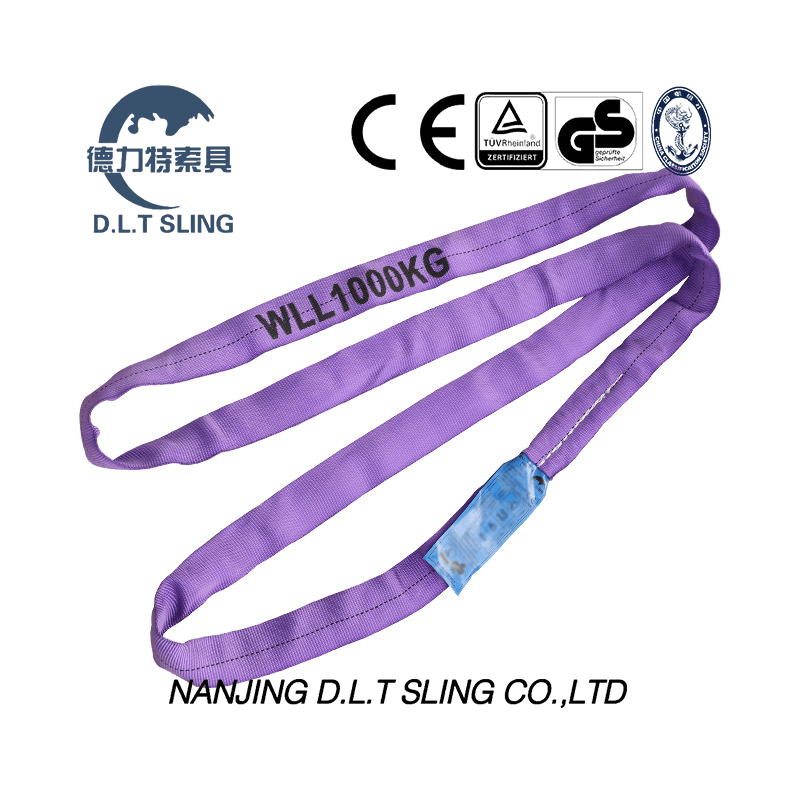
Visual capacity verification speeds up daily rigging operations. The standardized polyester color code is a vital industry tool. It helps riggers quickly identify the base WLL from a distance. You do not have to guess the rating. The jacket color tells you immediately what you are holding.
This global standard minimizes human error on busy construction sites. When your entire team knows the color chart, they make faster, safer decisions. It standardizes operations across international borders as well. Below is the standard capacity breakdown based on jacket color.
Polyester Color Identification Chart
| Jacket Color | Vertical WLL (Tons) | Typical Application Focus |
|---|---|---|
| Purple | 1 Ton | Light machinery, small parts |
| Green | 2 Ton | Pumps, medium engine blocks |
| Yellow | 3 Ton | Standard construction materials |
| Grey | 4 Ton | Heavy steel beams, large pipes |
| Red | 5 Ton | Heavy industrial equipment |
| Brown | 6 Ton | Large precast concrete slabs |
| Blue | 8 Ton | Heavy infrastructure components |
| Orange | 10+ Ton | Massive generators, marine use |
If your operation requires moving heavy steel sections, you immediately look for a red jacket. This naturally integrates the use of 5 ton lifting straps into your daily workflow. The red color provides instant confidence. Your riggers know they have sufficient baseline capacity before calculating hitch derations.
However, tag validation remains legally required. Color is only a rapid indicator. Dirt, extreme UV fading, or chemical exposure can alter the jacket appearance. Purple can look grey after six months of heavy use. The manufacturer’s legible identification tag is the only legally compliant proof of capacity. If the tag is missing or unreadable, you cannot use the equipment. You must remove it from service immediately to avoid OSHA fines.
You must evaluate the right format for your specific lift. Structural differences dictate field performance. We contrast two primary synthetic designs here. The continuous tubular design features an endless loop of load-bearing core yarns enclosed in a protective jacket. The alternative features a woven, flat fabric surface.
When should you choose a continuous loop design? They are best for cylindrical loads like pipe bundles. They excel in choker hitches because they conform easily to tight shapes. They also offer superior wear resistance. The independent outer jacket takes all the surface friction. This completely protects the inner core load-bearing yarns from abrasion. Furthermore, their rotatable design extends product lifespan. You can manually shift the contact point before every lift. This distributes wear evenly across the entire circumference.
When should you choose a webbing sling? These are better for delicate loads. They require a wider, flatter surface area to distribute pressure efficiently. If you lift fragile materials, the flat design prevents severe load crushing. They wrap securely around square edges. Flat straps are also easier to slide under crates when you have limited clearance.
We created a quick decision matrix below. Evaluate your choice based on load fragility, required grip, and expected abrasion.
Rigging hardware does not operate in a vacuum. Temperature and chemical constraints matter immensely. Standard polyester operating temperature limits are strict. Usually, they perform safely between -40°F to 194°F (-40°C to 90°C). If your environment exceeds these extremes, the synthetic fibers melt or become dangerously brittle. Furthermore, polyester has specific chemical vulnerabilities. It resists most acids fairly well. However, alkalis will rapidly destroy the fibers. You must assess the chemical environment before attaching any rigging.
Edge protection is an absolute necessity. You cannot skip this step. Emphasize to your team that synthetic equipment—regardless of massive capacity—must be paired with cut protection. When lifting loads with sharp or abrasive edges, bare synthetics will slice open under tension. The resulting drop is catastrophic. Always use engineered softeners, Kevlar sleeves, or magnetic corner protectors.
Finally, OSHA removal criteria dictate your inspection schedule. You need evidence-oriented reasons to instantly retire lifting gear. Do not gamble with worn equipment. Remove them from service if you see:
Industrial rigging demands precision, mathematical accuracy, and immense respect for physical limits. We can summarize this comprehensive evaluation framework simply. First, calculate the exact weight of the load. Second, determine the specific hitch configuration you will use. Third, account for the severe tension increase caused by load angles. Next, verify the capacity visually with standard color codes and confirm it with manufacturer tags. Finally, inspect the equipment strictly against OSHA compliance standards.
You must apply these steps consistently. Encourage your team to audit their current rigging hardware today. Throw away undocumented or damaged gear immediately. Consult with a certified rigger for complex or unbalanced lifts. If standard synthetic options do not meet your operational constraints, request a technical quote for custom configurations. Industrial safety relies entirely on your proactive, informed choices.
A: You must first determine the load's center of gravity to see how weight distributes across each leg. Then, use rigging tension charts based on leg angles. As the horizontal angle decreases, the tension on each leg increases exponentially. Multiply the load share per leg by the specific load angle multiplier to find the required capacity.
A: No. A choker hitch significantly reduces the effective lifting capacity to about 80%. Therefore, a red jacket rated for 5 tons vertically can only lift 4 tons in a choked configuration. You must upgrade to a higher-capacity rating to safely manage a 5-ton choked load.
A: The primary difference is structural. A round version features endless loops of load-bearing core yarns protected by an independent outer jacket. A webbing version features a flat, woven surface. The flat design distributes pressure better on delicate loads. The jacketed version offers superior wear resistance and conforms easily to tight choke points.
A: OSHA mandates a documented periodic inspection by a qualified person at least annually. However, rigorous daily visual inspections are required before every use. Riggers must check for illegible tags, jacket tears, exposed core yarns, and heat damage before attaching any load.

