

close
Choose Your Site
Global
Social Media

Views: 0 Author: Site Editor Publish Time: 2026-07-06 Origin: Site


Transporting heavy freight across vast distances demands zero margin for error on modern highways. A single shifting pallet creates catastrophic risks for both drivers and other motorists. Inadequate load securement leads directly to devastating FMCSA compliance violations. You face expensive cargo damage claims unexpectedly. Severe liability risks multiply rapidly when inferior straps fail mid-transit. Shifting from ad-hoc strap purchases to a standardized securement strategy is absolutely necessary. Fleet managers must evaluate hardware meticulously every single quarter. This vital evaluation depends on working load limits, specific trailer types, and daily environmental wear. This comprehensive guide provides a robust framework for evaluating your daily tensioning devices. We will help you select the precise recovery straps and containment nets. These exact items are required for various heavy-duty tasks. You will discover actionable steps to implement a highly reliable setup safely. This careful approach ensures complete safety across diverse commercial and industrial applications.
Fleet operators face strict rules at daily weigh station inspections. Define securement success by total adherence to Department of Transportation (DOT) securement rules. The Federal Motor Carrier Safety Administration (FMCSA) also dictates rigid standards universally. You must meet these regulatory baselines to operate legally anywhere. We define daily securement success by complete adherence to these safety mandates. Mismatched gear invites hefty fines instantly. Poor compliance also grounds your trucks immediately during roadside inspections.
Outline the critical difference between WLL and total breaking strength. Many buyers mistakenly look only at breaking strength metrics. This common error causes dangerous overloading scenarios during transit. Procurement teams must base all system designs on the strict 1/3 WLL rule. It provides a necessary safety margin during abrupt highway stops. If a strap breaks at 12,000 pounds, its WLL is strictly 4,000 pounds. You must calculate your tie-down requirements using the lower number always.
Address how flatbed and enclosed trailers dictate hardware compatibility completely. Trailer configurations severely limit your available anchoring choices. Flatbed operations rely on heavy-duty winch tracks and steel rub rails. Enclosed trailers typically use E-Track or L-Track interior systems. You cannot swap hardware safely between these two distinct setups. The physical anchoring mechanisms differ entirely in design and function.
Failing to standardize securing points across a fleet leads to major implementation risks. Mismatched hardware compromises your entire working load limit dangerously. Drivers might mistakenly pair a high-capacity strap onto a weak E-track ring. The weakest link always dictates the overall system capacity instantly. We strongly recommend auditing fleet anchor points annually. Consistent training ensures everyone recognizes incorrect hardware pairings immediately.
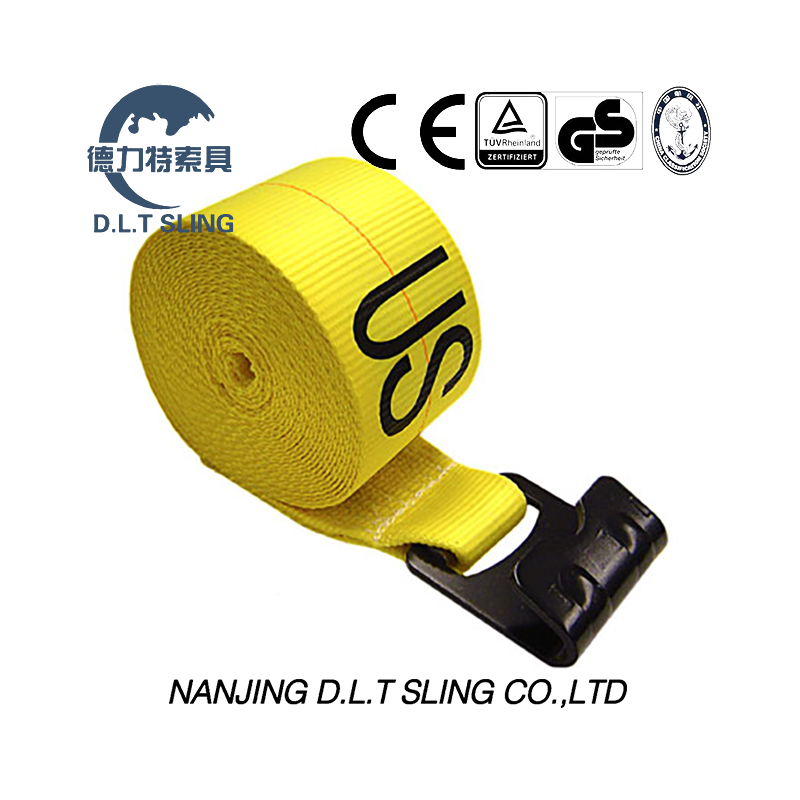
Evaluate hardware carefully for demanding open flatbed applications. High-visibility webbing allows rapid roadside inspections by safety officers. UV-resistant materials prevent rapid degradation under direct punishing sunlight. You must ensure seamless compatibility across standard 4-inch winches. Our favorite transport winch strap examples feature reinforced fabric edges. These durable edges resist tearing against highly abrasive construction materials. Flatbed drivers rely heavily on them for securing massive steel coils.
Assess alternative options for enclosed trailers or localized tie-downs. They excel at precise tensioning tasks in tight spaces. Buyers must compare various hardware ends for interior transport applications. Flat hooks suit open trailers best generally. Wire hooks grab narrow anchor points securely and quickly. Chain extensions handle abrasive metal corners safely. E-track fittings lock directly into interior van rails tightly.
Highlight elongation factors stretching under heavy dynamic load. Excessive stretch allows dangerous cargo shifting during sudden braking maneuvers. Nylon stretches far too much for static loads. Polyester remains taut and secure throughout the journey. Edge protection requirements prevent mid-transit failures effectively. Drivers should deploy tough corner protectors over sharp freight edges.
Choose winch straps for high-tension, heavy-duty flatbed loads. Select ratchet straps for precise tensioning in confined anchor points. The matrix below outlines basic selection criteria visually.
| Application Type | Preferred Tensioning Device | Key Material Feature | Typical Anchor Point |
|---|---|---|---|
| Open Flatbed (Heavy Machinery) | Transport Winch Strap | UV-Resistant Polyester | Under-mount Winch Track |
| Enclosed Dry Van (Pallets) | Standard Ratchet Strap | Low-Elongation Webbing | Interior E-Track Rails |
| Utility Trailer (Light Vehicles) | Wire Hook Ratchet Strap | Abrasion-Resistant Edges | Floor-Mounted D-Rings |
Towing operations require highly specialized and distinct gear. Never use load securement straps for vehicle recovery tasks. We must clarify this strict operational boundary immediately. Tow straps function exclusively for muddy or ditch recovery operations. You must never deploy them for standard load securement. This negligent action violates FMCSA rules directly. It causes catastrophic accidents by allowing load shifts.
Compare nylon and polyester to match the operational requirement accurately. Nylon webbing stretches significantly under heavy tension forces. This stretching provides necessary kinetic energy for safe vehicle extraction. It yanks stuck trucks smoothly from deep mud. Polyester remains highly static under tension. It offers far less stretch overall. You should use polyester only for simple towing on flat asphalt.
Outline the severe safety risks of metal hooks in recovery scenarios. A broken metal hook acts as a deadly projectile instantly. It can pierce thick windshields easily during snaps. Always choose reinforced fabric loops instead for recovery. They absorb sudden shock safely upon snapping. Fabric loops eliminate heavy flying metal fragments completely.
Establish the formula for selecting recovery straps carefully. It relies heavily on vehicle weight plus estimated drag resistance.
Identify scenarios where standard linear straps fail completely. Loose debris often slips under narrow webbing quickly. Uneven pallets lack solid anchor points for traditional hooks. Mixed-shape cargo creates dangerous gaps between items. Cargo nets solve these problems efficiently and safely. They provide the required surface area coverage perfectly. They wrap securely around awkward shapes preventing spillage.
Contrast light-duty bungee-style nets against heavy-duty containment options. Enclosed cargo division often utilizes elastic bungee styles. They keep lightweight boxes from falling out rear doors unexpectedly. Flatbed containment demands heavy-duty webbing nets instead. These exterior nets handle immense highway wind resistance easily. They secure heavy loose debris securely over long distances.
Discuss the severe limitations of off-the-shelf net dimensions. Standard retail sizes rarely fit highly specialized equipment perfectly. You should specify custom grid spacing when hauling irregular machinery continually. Custom anchor configurations ensure tight fitment across unusual shapes. We recommend ordering modular nets for highly mixed freight. Bespoke netting eliminates frustrating loose corners effectively.
Sourcing reliable equipment requires highly strategic corporate planning. Standardization brings significant financial and daily safety benefits. Procuring uniform cargo control products minimizes driver error substantially. Familiar gear reduces loading time across your entire logistics operation. It ensures consistent tensioning techniques among all new employees. Bulk ordering identical hardware reduces procurement costs considerably.
Establish strict criteria for shortlisting your industrial suppliers. Excellent vendor capabilities include certified in-house testing facilities. They provide clear WLL tagging on every single textile item. Top manufacturers offer customized length and hardware combinations easily. You must verify their direct compliance to DOT regulations continuously. Reputable vendors supply comprehensive testing certificates upon request.
Learn how to audit existing hardware systems effectively. You need to recognize critical visual warning signs early. UV degradation weakens synthetic fibers invisibly over summer months. Edge cuts reduce load capacity drastically and dangerously. Illegible tags mandate immediate replacement under strict DOT laws. Missing thread lines indicate internal structural failure clearly.
Your next steps require a highly structured framework today. Audit all current fleet hardware immediately across all terminals.
Initiate a small pilot program soon. Test the newly procured gear on highly demanding routes first.
Building a reliable cargo control system protects your entire business. It directly mitigates expensive liability and speeds up transit loading times. Our final recommendation focuses heavily on basic safety fundamentals. Prioritize easily traceable WLL ratings on all procured equipment always. Match your webbing material directly to anticipated environmental highway exposure. You must strictly separate recovery gear from daily securement gear.
Take decisive action today. Promptly audit your current tie-downs for highly readable safety tags. Remove any damaged synthetic straps from active service immediately. Contact a dedicated specialist for a custom fleet securement assessment soon. Standardizing your equipment saves lives and protects your bottom line.
A: Ratchet straps use an integrated mechanical handle to apply precise tension. They suit enclosed trailers perfectly. You typically pair them into E-track systems or floor rings. Transport winch straps lack built-in manual ratchets. They require a stationary flatbed winch to tighten down loads securely. Fleet managers choose winch straps for heavy-duty open flatbeds.
A: The transportation industry mandates a strict 3:1 safety margin always. The breaking strength indicates the absolute failure point under controlled laboratory conditions. Your truck experiences massive dynamic forces during transit. Sudden braking and swerving multiply the actual load forces exponentially. The lower WLL accounts for these unpredictable dynamic shifts safely.
A: You must never use recovery gear for static load securement. This negligent action creates a severe safety hazard instantly. It directly violates FMCSA regulations universally. Tow straps utilize highly kinetic nylon webbing. The material stretches intentionally to absorb towing shock safely. This extreme stretch allows cargo to shift dangerously during highway transit.
A: You must replace tie-downs immediately upon finding critical physical damage. Drivers should inspect webbing thoroughly daily. Look for severe edge cuts surpassing one-quarter inch entirely. Surface burns from abrasive friction mandate immediate removal. UV damage fades the fabric and makes it brittle. Missing or illegible WLL tags require instant replacement legally.

